Yao Jincao, Zhang Yanming, Shen Jiafei, Lei Zhikai, Xiong Jing, Feng Bojian, Li Xiaoxian, Li Wei, Ou Di, Lu Yidan, Feng Na, Yan Meiying, Chen Jinjie, Chen Liyu, Yang Chen, Wang Liping, Wang Kai, Zhou Jianhua, Liang Ping, Xu Dong
Department of Ultrasound, Zhejiang Cancer Hospital, Hangzhou 310022, China.
Hangzhou Institute of Medicine (HIM), Chinese Academy of Sciences, Hangzhou 310000, China.
iScience. 2023 Oct 4;26(11):108114. doi: 10.1016/j.isci.2023.108114. eCollection 2023 Nov 17.
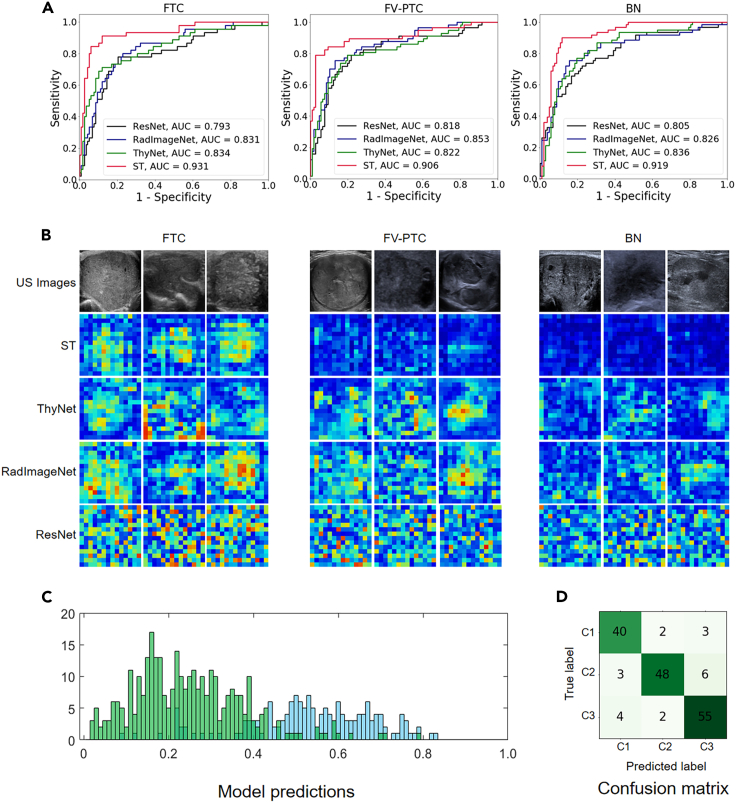
Thyroid nodules are a common disease, and fine needle aspiration cytology (FNAC) is the primary method to assess their malignancy. For the diagnosis of follicular thyroid nodules, however, FNAC has limitations. FNAC can classify them only as Bethesda IV nodules, leaving their exact malignant status and pathological type undetermined. This imprecise diagnosis creates difficulties in selecting the follow-up treatment. In this retrospective study, we collected ultrasound (US) image data of Bethesda IV thyroid nodules from 2006 to 2022 from five hospitals. Then, US image-based artificial intelligence (AI) models were trained to identify the specific category of Bethesda IV thyroid nodules. We tested the models using two independent datasets, and the best AI model achieved an area under the curve (AUC) between 0.90 and 0.95, demonstrating its potential value for clinical application. Our research findings indicate that AI could change the diagnosis and management process of Bethesda IV thyroid nodules.
甲状腺结节是一种常见疾病,细针穿刺抽吸活检(FNAC)是评估其恶性程度的主要方法。然而,对于滤泡性甲状腺结节的诊断,FNAC存在局限性。FNAC只能将它们分类为贝塞斯达IV类结节,其确切的恶性状态和病理类型仍无法确定。这种不精确的诊断给后续治疗的选择带来了困难。在这项回顾性研究中,我们收集了2006年至2022年来自五家医院的贝塞斯达IV类甲状腺结节的超声(US)图像数据。然后,基于US图像的人工智能(AI)模型被训练以识别贝塞斯达IV类甲状腺结节的具体类别。我们使用两个独立的数据集对模型进行了测试,最佳的AI模型的曲线下面积(AUC)在0.90至0.95之间,证明了其临床应用的潜在价值。我们的研究结果表明,AI可以改变贝塞斯达IV类甲状腺结节的诊断和管理流程。