Liu Yanning, De Feyter Henk M, Corbin Zachary A, Fulbright Robert K, McIntyre Scott, Nixon Terence W, de Graaf Robin A
Department of Biomedical Engineering, Magnetic Resonance Research Center (MRRC), Yale University, New Haven, CT, United States.
Department of Radiology and Biomedical Imaging, Magnetic Resonance Research Center (MRRC), Yale University, New Haven, CT, United States.
medRxiv. 2023 Oct 3:2023.10.02.23296408. doi: 10.1101/2023.10.02.23296408.
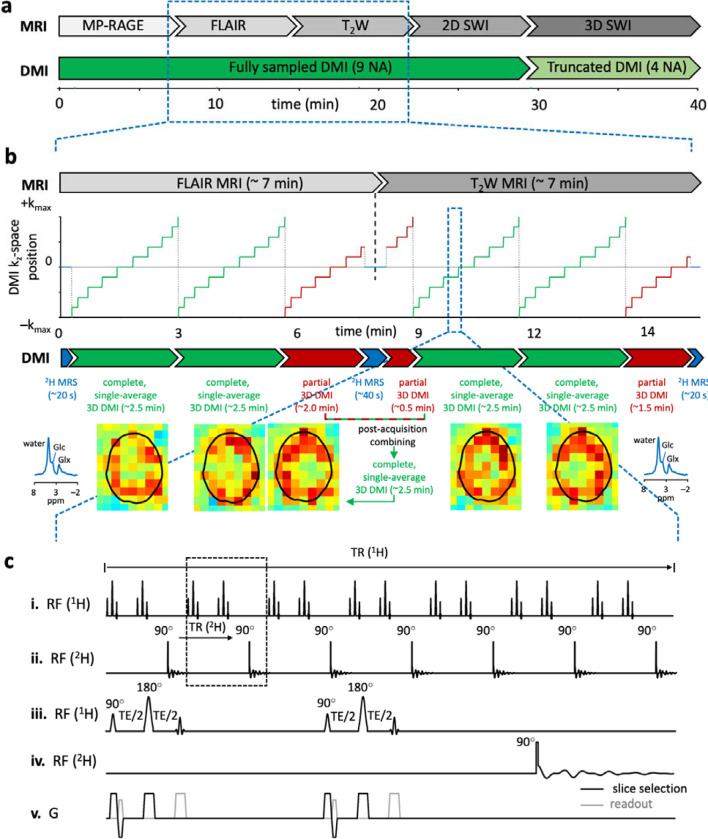
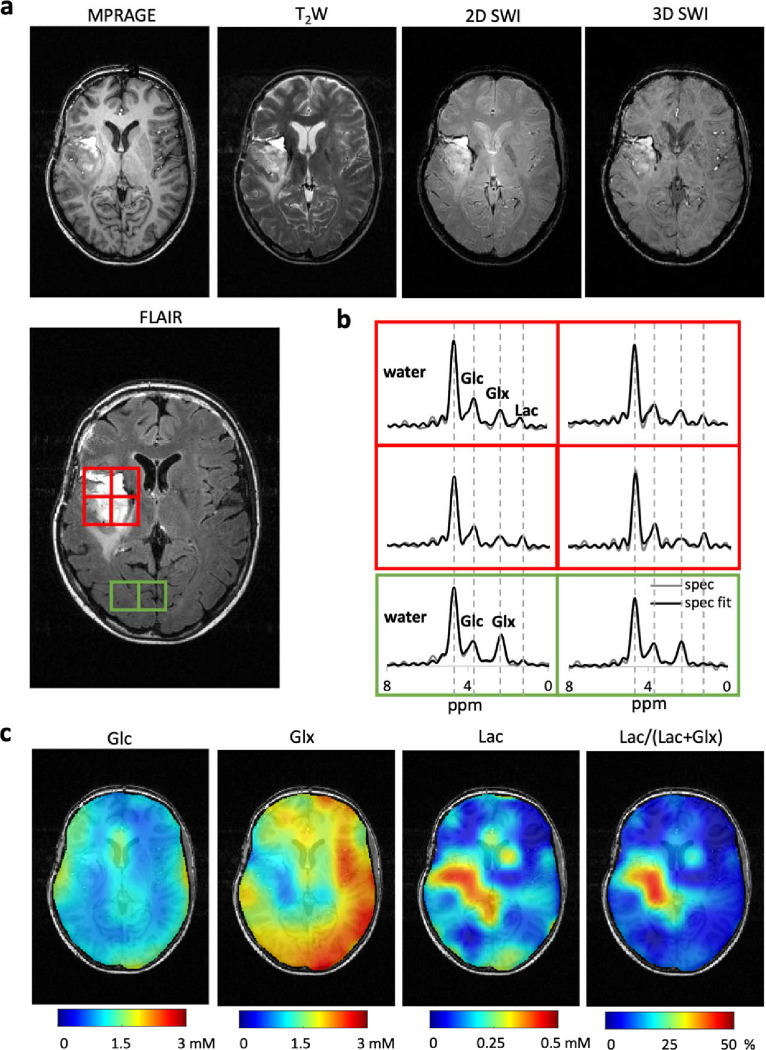
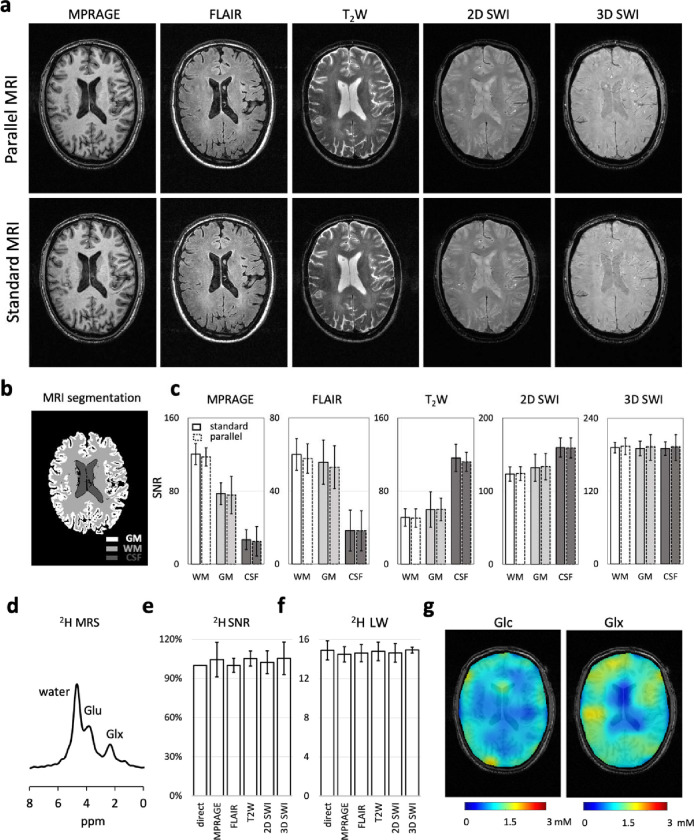
Deuterium Metabolic Imaging (DMI) is a novel method that can complement traditional anatomical magnetic resonance imaging (MRI) of the brain. DMI relies on the MR detection of metabolites that become labeled with deuterium (H) after administration of a deuterated substrate and can provide images with highly specific metabolic information. However, clinical adoption of DMI is complicated by its relatively long scan time. Here, we demonstrate a strategy to interleave DMI data acquisition with MRI that results in a comprehensive neuro-imaging protocol without adding scan time. The interleaved MRI-DMI routine includes four essential clinical MRI scan types, namely T-weighted MP-RAGE, FLAIR, T-weighted Imaging (TW) and susceptibility weighted imaging (SWI), interwoven with DMI data acquisition. Phantom and in vivo human brain data show that MR image quality, DMI sensitivity, as well as information content are preserved in the MRI-DMI acquisition method. The interleaved MRI-DMI technology provides full flexibility to upgrade traditional MRI protocols with DMI, adding unique metabolic information to existing types of anatomical image contrast, without extra scan time.
氘代谢成像(DMI)是一种可以补充传统脑部解剖磁共振成像(MRI)的新方法。DMI依赖于对在给予氘代底物后被氘(H)标记的代谢物进行磁共振检测,并能够提供具有高度特异性代谢信息的图像。然而,DMI相对较长的扫描时间使其在临床上的应用变得复杂。在此,我们展示了一种将DMI数据采集与MRI交错进行的策略,该策略可在不增加扫描时间的情况下实现全面的神经成像方案。交错式MRI-DMI程序包括四种基本的临床MRI扫描类型,即T加权MP-RAGE、FLAIR、T加权成像(TW)和磁敏感加权成像(SWI),并与DMI数据采集相互交织。模型和活体人脑数据表明,在MRI-DMI采集方法中,磁共振图像质量、DMI灵敏度以及信息含量均得以保留。交错式MRI-DMI技术为用DMI升级传统MRI方案提供了充分的灵活性,在不增加额外扫描时间的情况下,为现有的解剖图像对比度类型增添了独特的代谢信息。