Department of Ecology, Evolution, and Environmental Biology, Columbia University, New York, NY, USA.
Department of Geography and Spatial Sciences, University of Delaware, Newark, DE, USA.
Sci Data. 2023 Oct 25;10(1):738. doi: 10.1038/s41597-023-02634-w.
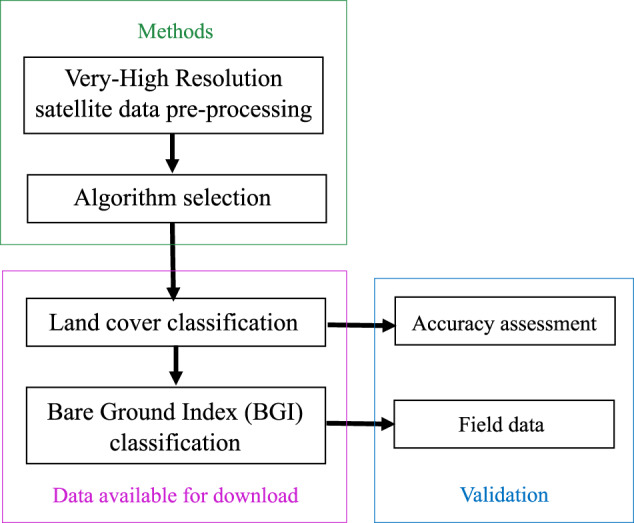
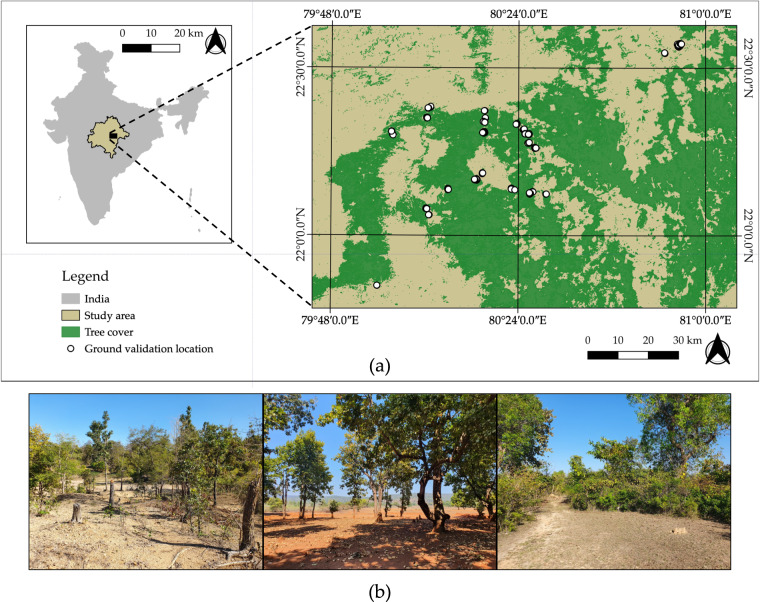
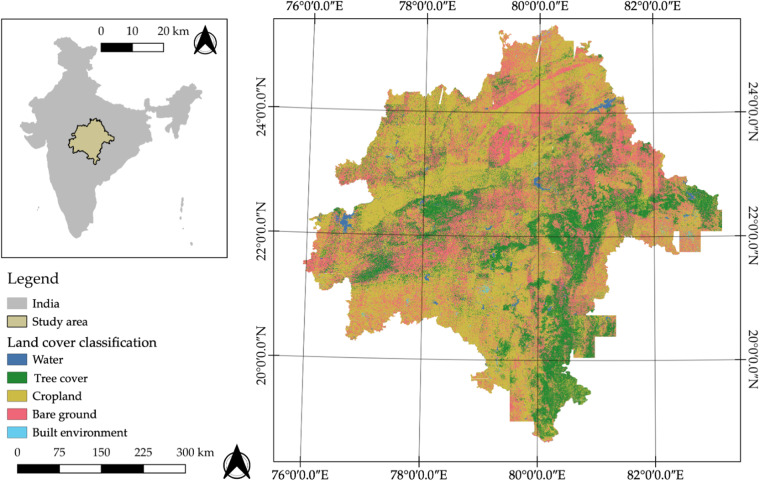
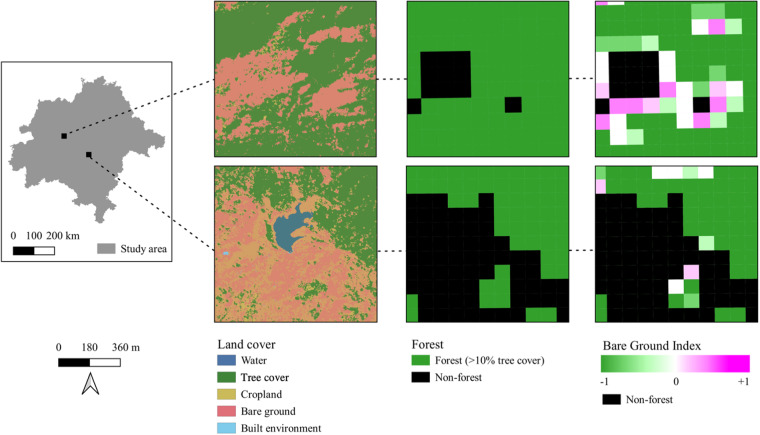
Satellite imagery has been used to provide global and regional estimates of forest cover. Despite increased availability and accessibility of satellite data, approaches for detecting forest degradation have been limited. We produce a very-high resolution 3-meter (m) land cover dataset and develop a normalized index, the Bare Ground Index (BGI), to detect and map exposed bare ground within forests at 90 m resolution in central India. Tree cover and bare ground was identified from Planet Labs Very High-Resolution satellite data using a Random Forest classifier, resulting in a thematic land cover map with 83.00% overall accuracy (95% confidence interval: 61.25%-90.29%). The BGI is a ratio of bare ground to tree cover and was derived by aggregating the land cover. Results from field data indicate that the BGI serves as a proxy for intensity of forest use although open areas occur naturally. The BGI is an indicator of forest health and a baseline to monitor future changes to a tropical dry forest landscape at an unprecedented spatial scale.
卫星图像已被用于提供全球和区域森林覆盖估计。尽管卫星数据的可用性和可访问性有所增加,但检测森林退化的方法仍然有限。我们生成了一个非常高分辨率的 3 米(m)土地覆盖数据集,并开发了一个归一化指数,即裸露地面指数(BGI),以检测和绘制印度中部森林内以 90 米分辨率裸露地面的位置。使用随机森林分类器从 Planet Labs 超高分辨率卫星数据中识别出树木覆盖和裸露地面,从而生成了一个主题土地覆盖图,总体准确率为 83.00%(置信区间:61.25%-90.29%)。BGI 是裸露地面与树木覆盖的比值,通过聚合土地覆盖数据得出。来自实地数据的结果表明,尽管自然存在开放区域,但 BGI 可作为森林利用强度的指标。BGI 是森林健康的指标,也是监测未来热带干旱林景观变化的基线,可以在前所未有的空间尺度上进行监测。