Department of Automation, Tsinghua University, Beijing, China.
Department of Electronic Engineering, Tsinghua University, Beijing, China.
Nature. 2023 Nov;623(7985):48-57. doi: 10.1038/s41586-023-06558-8. Epub 2023 Oct 25.
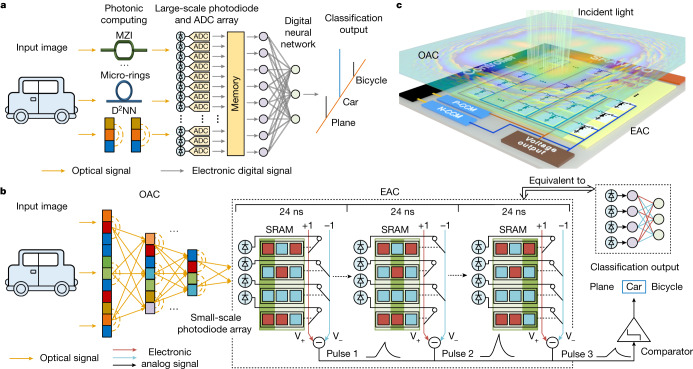
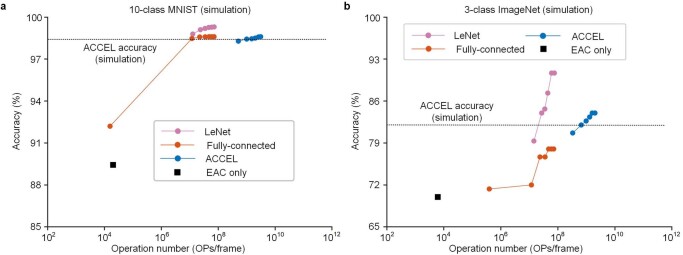
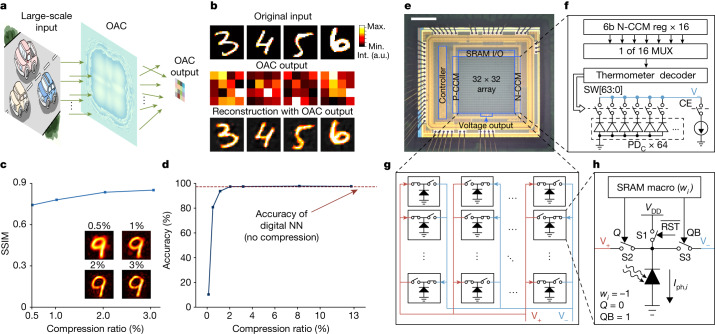
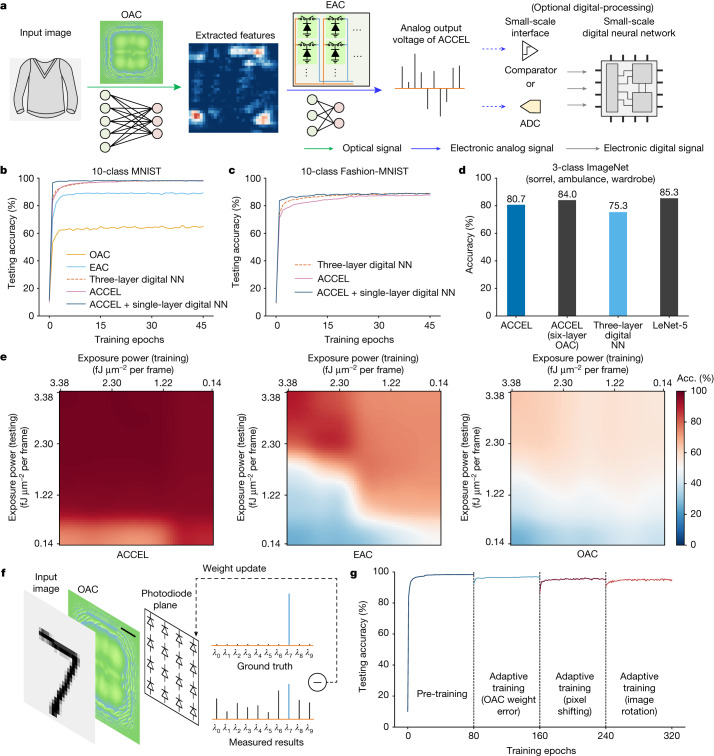
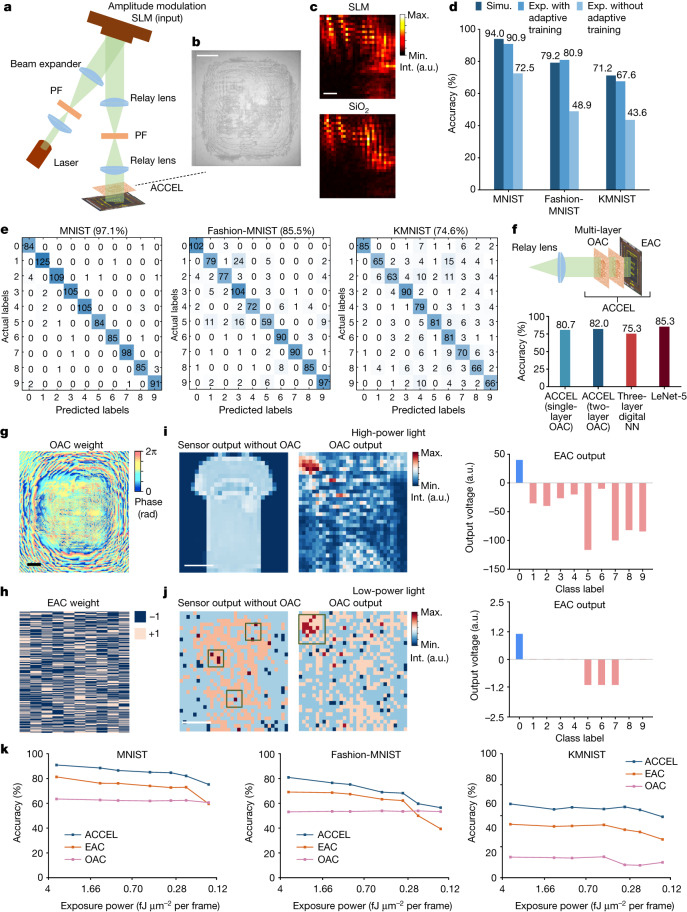
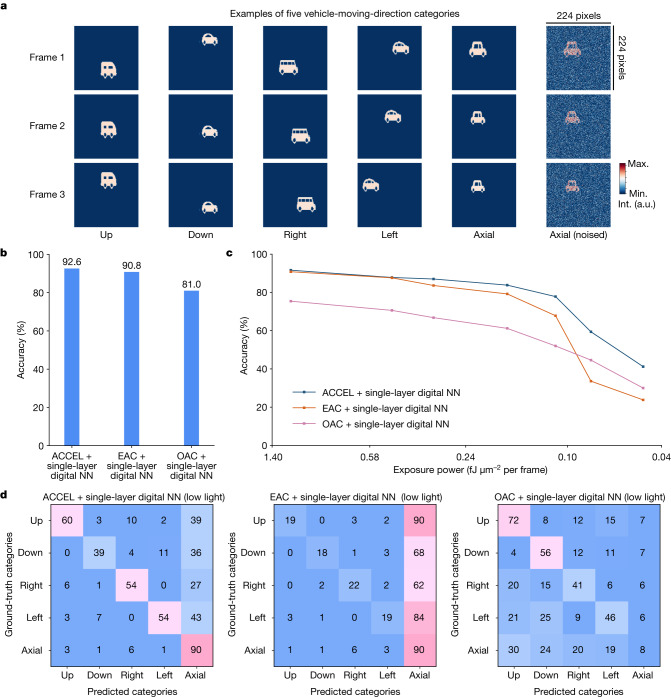
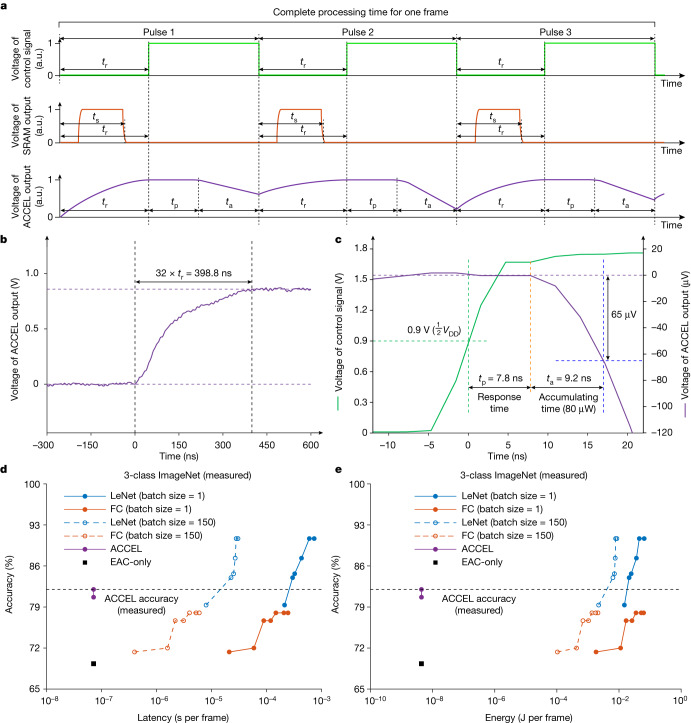
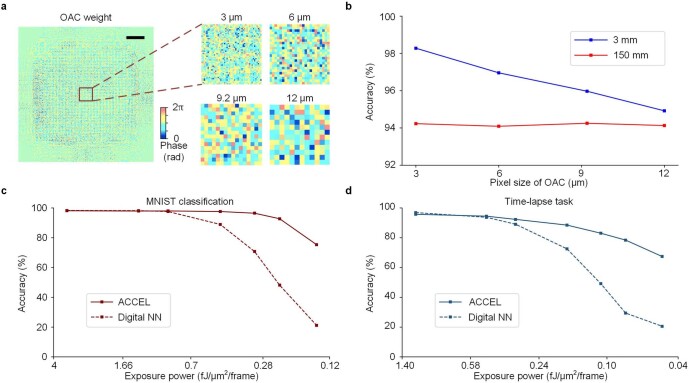
Photonic computing enables faster and more energy-efficient processing of vision data. However, experimental superiority of deployable systems remains a challenge because of complicated optical nonlinearities, considerable power consumption of analog-to-digital converters (ADCs) for downstream digital processing and vulnerability to noises and system errors. Here we propose an all-analog chip combining electronic and light computing (ACCEL). It has a systemic energy efficiency of 74.8 peta-operations per second per watt and a computing speed of 4.6 peta-operations per second (more than 99% implemented by optics), corresponding to more than three and one order of magnitude higher than state-of-the-art computing processors, respectively. After applying diffractive optical computing as an optical encoder for feature extraction, the light-induced photocurrents are directly used for further calculation in an integrated analog computing chip without the requirement of analog-to-digital converters, leading to a low computing latency of 72 ns for each frame. With joint optimizations of optoelectronic computing and adaptive training, ACCEL achieves competitive classification accuracies of 85.5%, 82.0% and 92.6%, respectively, for Fashion-MNIST, 3-class ImageNet classification and time-lapse video recognition task experimentally, while showing superior system robustness in low-light conditions (0.14 fJ μm each frame). ACCEL can be used across a broad range of applications such as wearable devices, autonomous driving and industrial inspections.
光子计算可实现更快、更节能的视觉数据处理。然而,由于复杂的光非线性、下游数字处理所需的模数转换器 (ADC) 的大量功耗以及对噪声和系统误差的脆弱性,可扩展系统的实验优势仍然是一个挑战。在这里,我们提出了一种结合电子和光计算的全模拟芯片 (ACCEL)。它具有 74.8 皮焦耳每秒每瓦的系统能效和 4.6 皮焦耳每秒的计算速度(超过 99%由光学实现),分别比最先进的计算处理器高出三个和一个数量级以上。在应用衍射光学计算作为特征提取的光学编码器之后,光致电流可直接在集成的模拟计算芯片中用于进一步计算,而无需模数转换器,从而使每个帧的计算延迟低至 72 纳秒。通过光电计算和自适应训练的联合优化,ACCEL 在实验中分别实现了 85.5%、82.0%和 92.6%的 Fashion-MNIST、3 类 ImageNet 分类和时移视频识别任务的竞争分类精度,同时在低光照条件下显示出优越的系统鲁棒性(每个帧 0.14 飞焦·微米)。ACCEL 可广泛应用于可穿戴设备、自动驾驶和工业检测等领域。