Research Center of Clinical Epidemiology, Peking University Third Hospital, Beijing, China.
Department of Hernia and Abdominal Wall Surgery, Beijing Chaoyang Hospital, Capital Medical University, Beijing, China.
JMIR Public Health Surveill. 2023 Oct 26;9:e50114. doi: 10.2196/50114.
Urticaria presents a significant global health challenge due to its sudden onset and potential for severe allergic reactions. Past data on worldwide prevalence and incidence is inconsistent due to differing study methodologies, regional differences, and evolving diagnostic criteria. Past studies have often provided broad ranges instead of specific figures, underscoring the necessity for a cohesive global perspective to inform public health strategies.
We aimed to assess the global burden of urticaria using the 2019 Global Burden of Disease (GBD) study data and systematically analyze urticaria prevalence, incidence, and disability-adjusted life years (DALYs) at global, regional, and national levels, thereby informing more effective prevention and treatment strategies.
We analyzed the global, regional, and national burden of urticaria from 1990 to 2019 using the 2019 GBD study coordinated by the Institute for Health Metrics and Evaluation. Estimations of urticaria prevalence, incidence, and DALYs were derived using DisMod-MR 2.1, a Bayesian meta-regression tool. The Socio-demographic Index (SDI) was used to correlate development status with health outcomes. The GBD's division of the world into 21 regions and 204 countries and territories facilitated a comprehensive assessment. Age-standardized estimated annual percentage changes were generated for urticaria metrics to quantify temporal trends, with age standardization adjusting for potential confounding from age structure.
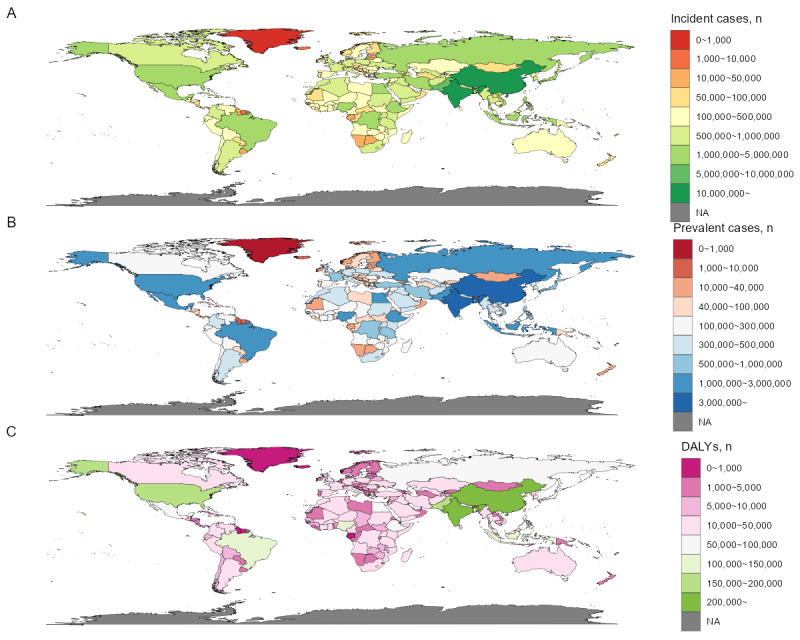
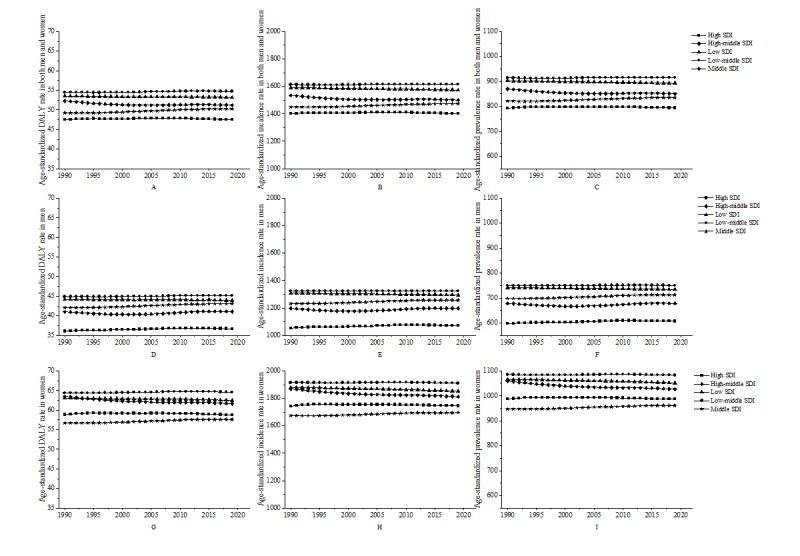
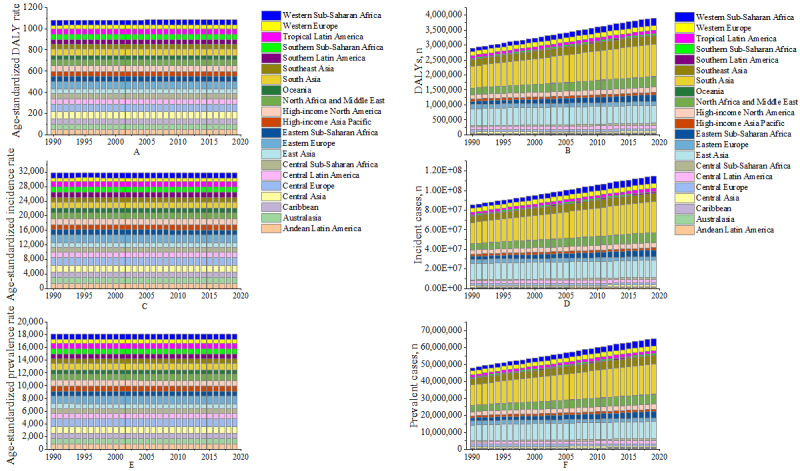
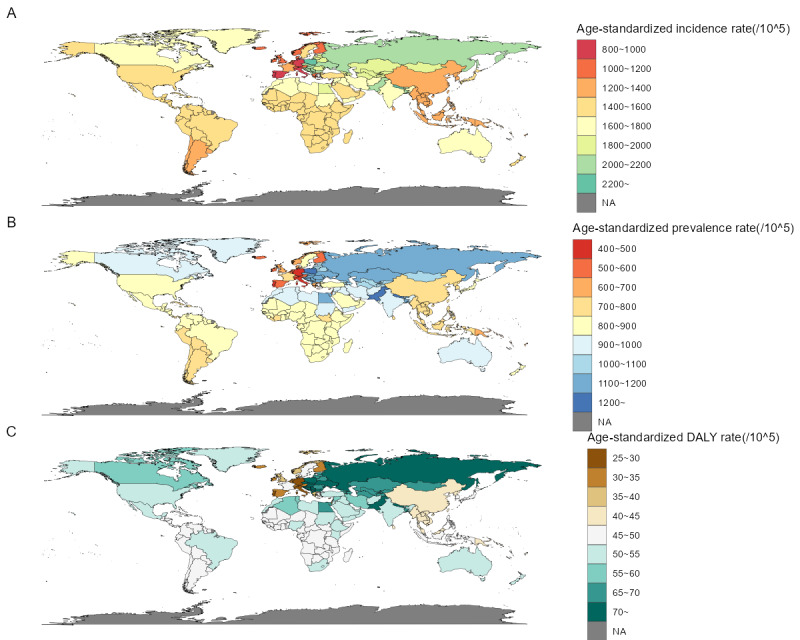
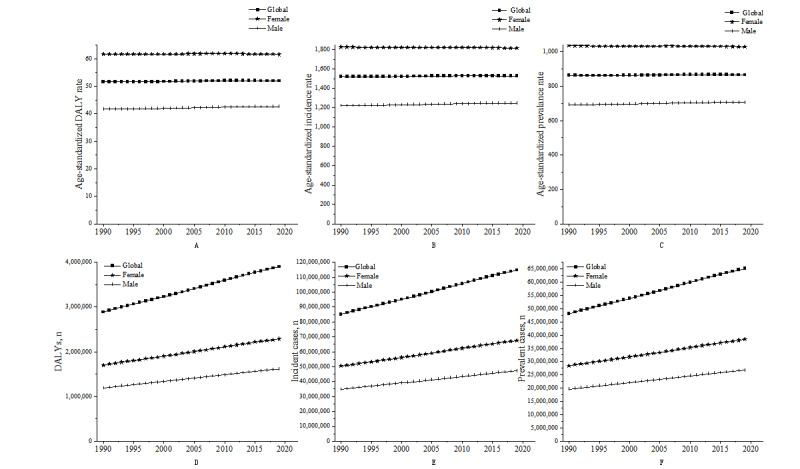
From 1990 to 2019, the global age-standardized prevalence, incidence, and DALY rates of urticaria showed marginal changes. In 2019, 65.14 million individuals were affected, with a prevalence rate of 841.88 per 100,000 population. The DALY rate was 50.39 per 100,000 population. Compared to 1990, the global age-standardized prevalence, incidence, and DALY rates saw increases of 2.92, 4.84, and 0.31 per 100,000 population, respectively. Women persistently had higher rates than men. At a regional level in 2019, low-middle SDI regions exhibited the highest age-standardized metrics, whereas high SDI regions reported the lowest. Central Europe showed the highest rates, contrasting with Western Europe's lowest rates. Nationally, urticaria prevalence in 2019 varied dramatically, from a low of 27.1 per 100,000 population in Portugal to a high of 92.0 per 100,000 population in Nepal. India reported the most DALYs at 749,495.9, followed by China, Pakistan, and the United States. Agewise data showed higher rates in younger age groups, which diminished with age and then experienced a slight resurgence in the oldest populations. This pattern was pronounced in women and younger populations, with the largest rises seen in those aged less than 40 years and the smallest in those aged more than 70 years.
Urticaria remains a significant global health issue, with considerable variation across regions, countries, and territories. The increased burden among women, the rising burden in younger populations, and the regional differences in disease burden call for tailored interventions and policies to tackle this emerging public health issue.
荨麻疹因其突发性和潜在的严重过敏反应,对全球健康构成重大挑战。由于研究方法、地域差异和不断变化的诊断标准不同,过去有关全球发病率和患病率的数据不一致。过去的研究往往提供了广泛的范围而不是具体的数字,这突显了需要从全球角度出发,以制定出更有效的公共卫生策略。
我们旨在使用 2019 年全球疾病负担(GBD)研究数据评估全球荨麻疹负担,并系统分析全球、地区和国家层面的荨麻疹患病率、发病率和残疾调整生命年(DALY),从而为制定更有效的预防和治疗策略提供信息。
我们使用由健康指标与评估研究所协调的 2019 年 GBD 研究,分析了 1990 年至 2019 年全球的荨麻疹负担。使用 DisMod-MR 2.1 估算了荨麻疹的患病率、发病率和 DALY,这是一种贝叶斯荟萃回归工具。社会人口指数(SDI)用于将发展状况与健康结果相关联。GBD 将世界划分为 21 个地区和 204 个国家和地区,从而进行了全面评估。为了量化时间趋势,我们对荨麻疹指标生成了年龄标准化的估计年百分比变化,年龄标准化通过调整年龄结构的潜在混杂因素来实现。
从 1990 年到 2019 年,全球荨麻疹的年龄标准化患病率、发病率和 DALY 率呈现出轻微的变化趋势。2019 年,全球有 6514 万人患病,患病率为每 10 万人中有 841.88 人。DALY 率为每 10 万人中有 50.39 人。与 1990 年相比,全球荨麻疹的年龄标准化患病率、发病率和 DALY 率分别增加了 2.92、4.84 和 0.31。女性的患病率一直高于男性。在 2019 年的地区层面上,中低 SDI 地区的年龄标准化指标最高,而高 SDI 地区的指标最低。中欧地区的发病率最高,而西欧地区的发病率最低。在国家层面上,2019 年的荨麻疹患病率差异很大,从葡萄牙的每 10 万人中有 27.1 人到尼泊尔的每 10 万人中有 92.0 人不等。印度的 DALY 最多,为 7494959.9,其次是中国、巴基斯坦和美国。年龄数据显示,年轻人群的发病率较高,随着年龄的增长而降低,然后在最年长的人群中略有回升。这种模式在女性和年轻人群中更为明显,年龄在 40 岁以下的人群发病率上升幅度最大,年龄在 70 岁以上的人群发病率上升幅度最小。
荨麻疹仍然是一个重大的全球健康问题,在地区、国家和地区之间存在着相当大的差异。女性发病率增加、年轻人群发病率上升以及疾病负担的地区差异,都需要采取有针对性的干预措施和政策,以应对这一新兴的公共卫生问题。