Bubba Laura, Benschop Kimberley S M, Blomqvist Soile, Duizer Erwin, Martin Javier, Shaw Alexander G, Bailly Jean-Luc, Rasmussen Lasse D, Baicus Anda, Fischer Thea K, Harvala Heli
European Non-Polio Enterovirus Network (E.N.P.E.N.), 1207 Geneva, Switzerland.
National Institute for Public Health and the Environment (RIVM), 3721 MA Bilthoven, The Netherlands.
Microorganisms. 2023 Oct 5;11(10):2496. doi: 10.3390/microorganisms11102496.
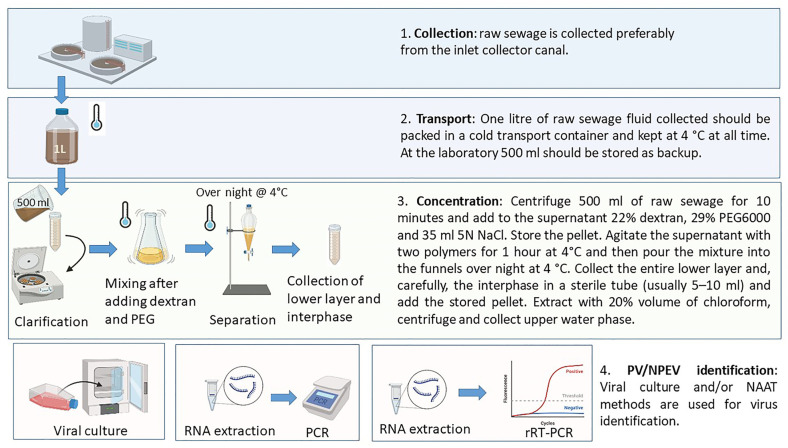
Wastewater surveillance (WWS) was developed in the early 1960s for the detection of poliovirus (PV) circulation in the population. It has been used to monitor several pathogens, including non-polio enteroviruses (NPEVs), which are increasingly recognised as causes of morbidity in children. However, when applying WWS to a new pathogen, it is important to consider the purpose of such a study as well as the suitability of the chosen methodology. With this purpose, the European Non-Polio Enterovirus Network (ENPEN) organised an expert webinar to discuss its history, methods, and applications; its evolution from a culture-based method to molecular detection; and future implementation of next generation sequencing (NGS). The first simulation experiments with PV calculated that a 400 mL sewage sample is sufficient for the detection of viral particles if 1:10,000 people excrete poliovirus in a population of 700,000 people. If the method is applied correctly, several NPEV types are detected. Despite culture-based methods remaining the gold standard for WWS, direct methods followed by molecular-based and sequence-based assays have been developed, not only for enterovirus but for several pathogens. Along with case-based sentinel and/or syndromic surveillance, WWS for NPEV and other pathogens represents an inexpensive, flexible, anonymised, reliable, population-based tool for monitoring outbreaks and the (re)emergence of these virus types/strains within the general population.
废水监测(WWS)于20世纪60年代初被开发用于检测人群中脊髓灰质炎病毒(PV)的传播情况。它已被用于监测多种病原体,包括非脊髓灰质炎肠道病毒(NPEV),这些病毒越来越被认为是儿童发病的原因。然而,在将废水监测应用于一种新病原体时,重要的是要考虑此类研究的目的以及所选方法的适用性。出于这个目的,欧洲非脊髓灰质炎肠道病毒网络(ENPEN)组织了一次专家网络研讨会,讨论其历史、方法和应用;其从基于培养的方法到分子检测的演变;以及下一代测序(NGS)的未来应用。首次针对脊髓灰质炎病毒的模拟实验计算得出,如果在70万人的人群中有1:10,000的人排泄脊髓灰质炎病毒,那么400毫升污水样本就足以检测到病毒颗粒。如果方法应用正确,就能检测到几种非脊髓灰质炎肠道病毒类型。尽管基于培养的方法仍然是废水监测的金标准,但已经开发出了直接方法,随后是基于分子和基于序列的检测方法,不仅用于肠道病毒,也用于多种病原体。与基于病例的哨点监测和/或症状监测一起,针对非脊髓灰质炎肠道病毒和其他病原体的废水监测是一种廉价、灵活、匿名、可靠的基于人群的工具,用于监测这些病毒类型/毒株在普通人群中的暴发和(再)出现。