Department of Chemical Engineering, University of Pretoria, Pretoria 0002, South Africa.
Human Sciences Research Council, 134 Pretorius Street, Pretoria 0083, South Africa.
Int J Mol Sci. 2023 Oct 23;24(20):15463. doi: 10.3390/ijms242015463.
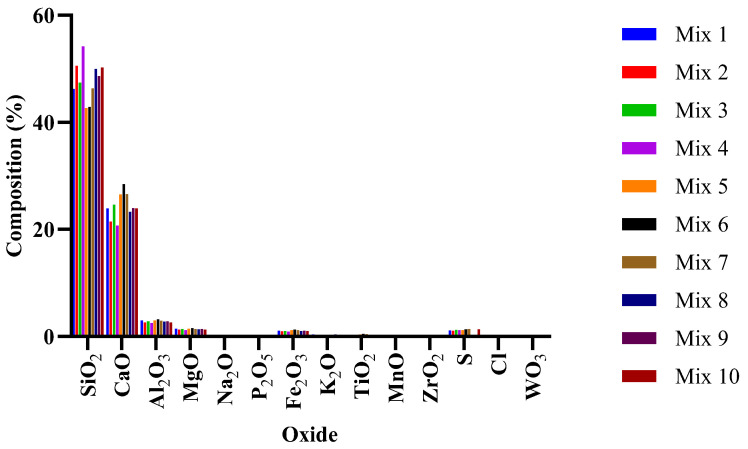
Against the backdrop of escalating infrastructure budgets worldwide, a notable portion-up to 45%-is allocated to maintenance endeavors rather than innovative infrastructure development. A substantial fraction of this maintenance commitment involves combatting concrete degradation due to microbial attacks. In response, this study endeavors to propose a remedial strategy employing nano metals and repurposed materials within cement mortar. The methodology entails the adsorption onto eggshell membranes (ESM) of silver nitrate (ESM/AgNO) or silver nanoparticles (ESM/AgNPs) yielding silver-eggshell membrane composites. Subsequently, the resulting silver-eggshell membrane composites were introduced in different proportions to replace cement, resulting in the formulation of ten distinct mortar compositions. A thorough analysis encompassing a range of techniques, such as spectrophotometry, scanning electron microscopy, thermogravimetric analysis, X-ray fluorescence analysis, X-ray diffraction (XRD), and MTT assay, was performed on these composite blends. Additionally, evaluations of both compressive and tensile strengths were carried out. The mortar blends 3, 5, and 6, characterized by 2% ESM/AgNO, 1% ESM/AgNPs, and 2% ESM/AgNPs cement replacement, respectively, exhibited remarkable antimicrobial efficacy, manifesting in substantial reduction in microbial cell viability (up to 50%) of typical waste activated sludge. Concurrently, a marginal reduction of approximately 10% in compressive strength was noted, juxtaposed with an insignificant change in tensile strength. This investigation sheds light on a promising avenue for addressing concrete deterioration while navigating the balance between material performance and structural integrity.
在全球基础设施预算不断增加的背景下,高达 45%的资金用于维护工作,而不是创新性的基础设施开发。在这一维护承诺中,很大一部分涉及对抗因微生物攻击而导致的混凝土退化。有鉴于此,本研究旨在提出一种使用纳米金属和再利用材料在水泥砂浆中修复的策略。该方法涉及硝酸银(ESM/AgNO)或银纳米颗粒(ESM/AgNPs)在蛋壳膜(ESM)上的吸附,从而产生银-蛋壳膜复合材料。随后,将所得银-蛋壳膜复合材料以不同的比例引入以替代水泥,从而形成十种不同的砂浆配方。对这些复合混合物进行了一系列技术的全面分析,如分光光度法、扫描电子显微镜、热重分析、X 射线荧光分析、X 射线衍射(XRD)和 MTT 测定。此外,还对压缩和拉伸强度进行了评估。砂浆混合物 3、5 和 6 分别用 2%ESM/AgNO、1%ESM/AgNPs 和 2%ESM/AgNPs 替代水泥,表现出显著的抗菌功效,典型的废活性污泥的微生物细胞活力显著降低(高达 50%)。同时,压缩强度略有降低,约为 10%,而拉伸强度几乎没有变化。这项研究为解决混凝土劣化问题提供了一个有前途的途径,同时在材料性能和结构完整性之间取得了平衡。