School of Pharmacy, University of California San Francisco, San Francisco, CA, USA.
California Poison Control System, San Francisco, CA, USA.
Public Health Rep. 2024 Jan-Feb;139(1):112-119. doi: 10.1177/00333549231201679. Epub 2023 Nov 7.
The COVID-19 pandemic led to widespread fear of infection, with many people expanding their use of cleaning products and trying unproven prevention and treatment strategies. We described shifts in reported exposures related to COVID-19 home interventions.
This study considered suspected toxicity exposures involving household cleaning products (bleach, peroxide, disinfectants), antimalarials (hydroxychloroquine and chloroquine), and ivermectin reported to the California Poison Control System from 2015 through 2021 and assessed trends in exposures by using interrupted time-series analyses.
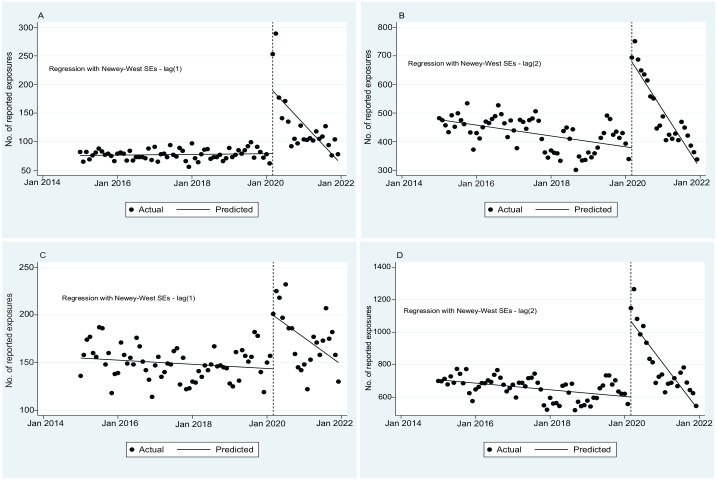
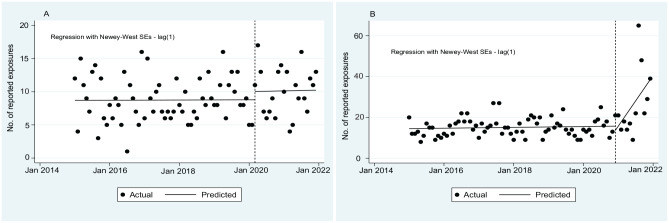
We found a significant increase in exposures reported to the California Poison Control System related to household cleaning products and ivermectin during the COVID-19 pandemic. As of January 1, 2015, the baseline level of reported exposures to household cleaning products was 707.33 per month and was declining at a rate of 1.71 (95% CI, -2.87 to -0.56) per month through February 29, 2020. In March 2020, an increase of 466.57 (95% CI, 328.08-605.07) reported exposures above baseline occurred, after which exposures to cleaning products decreased at a rate of 23.40 (95% CI, -32.48 to -14.32) per month. The number of reported exposures to antimalarials did not change significantly before or during the pandemic. The number of reported ivermectin exposures before December 2020 was initially stable at 14.50 per month and then increased by 2.05 per month through December 2021.
Our observations suggest that while some dangerous home prevention and treatment efforts resolve over time, further interventions may be needed to reduce the public health effects related to attempts to self-treat COVID-19 with ivermectin.
COVID-19 大流行导致人们普遍对感染感到恐惧,许多人扩大了清洁产品的使用范围,并尝试未经证实的预防和治疗策略。我们描述了与 COVID-19 家庭干预相关的报告暴露情况的变化。
本研究考虑了 2015 年至 2021 年期间向加利福尼亚毒物控制中心系统报告的与家用清洁产品(漂白剂、过氧化氢、消毒剂)、抗疟药(羟氯喹和氯喹)和伊维菌素相关的疑似毒性暴露情况,并使用中断时间序列分析评估暴露趋势。
我们发现,与 COVID-19 大流行期间家庭清洁产品和伊维菌素相关的加利福尼亚毒物控制中心系统报告的暴露量显著增加。截至 2015 年 1 月 1 日,报告的家用清洁产品暴露量的基线水平为每月 707.33 例,到 2020 年 2 月 29 日每月下降 1.71(95%CI,-2.87 至-0.56)。2020 年 3 月,报告的暴露量较基线增加了 466.57(95%CI,328.08-605.07),此后清洁产品的暴露量每月以 23.40(95%CI,-32.48 至-14.32)的速度下降。大流行前后,抗疟药的报告暴露量没有明显变化。2020 年 12 月之前,伊维菌素的报告暴露量最初每月稳定在 14.50 例,然后在 2021 年 12 月之前每月增加 2.05 例。
我们的观察结果表明,虽然一些危险的家庭预防和治疗措施随着时间的推移而得到解决,但可能需要进一步的干预措施来减少与试图用伊维菌素自行治疗 COVID-19 相关的公共卫生影响。