Department of Genetics, Evolution and Environment, University College London, London WC1E 6BT, United Kingdom.
Department of Veterinary Medicine, University of Cambridge, Cambridge CB3 0ES, United Kingdom.
Proc Natl Acad Sci U S A. 2023 Nov 21;120(47):e2307773120. doi: 10.1073/pnas.2307773120. Epub 2023 Nov 14.
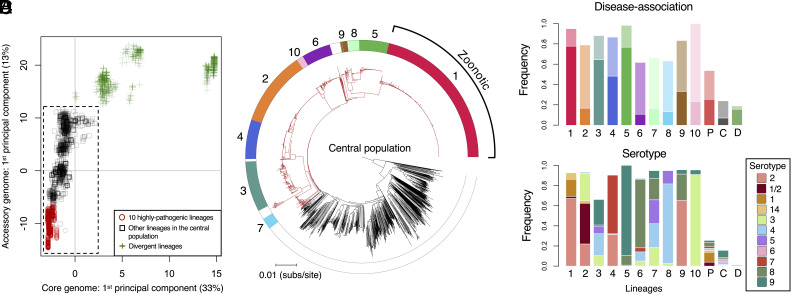
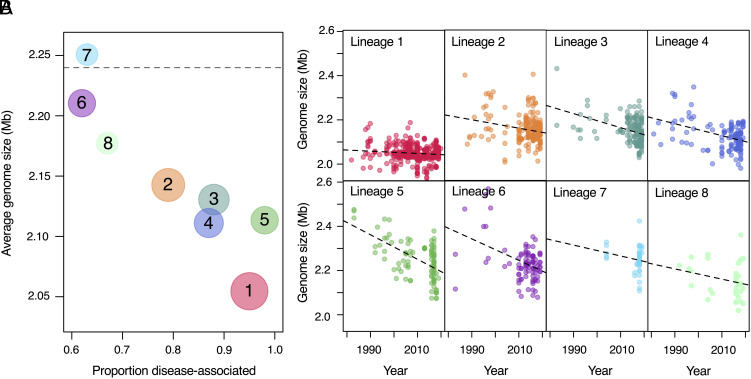
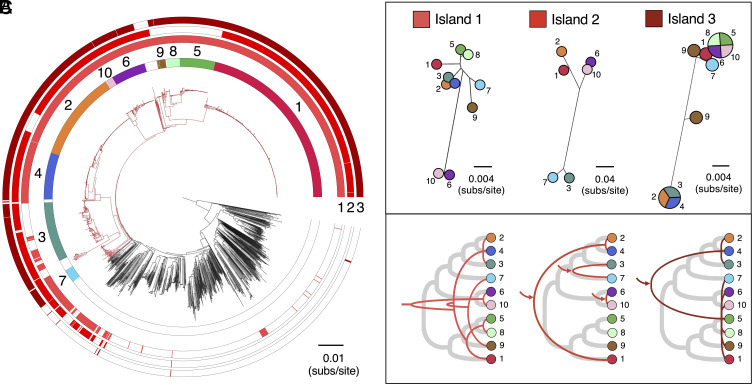
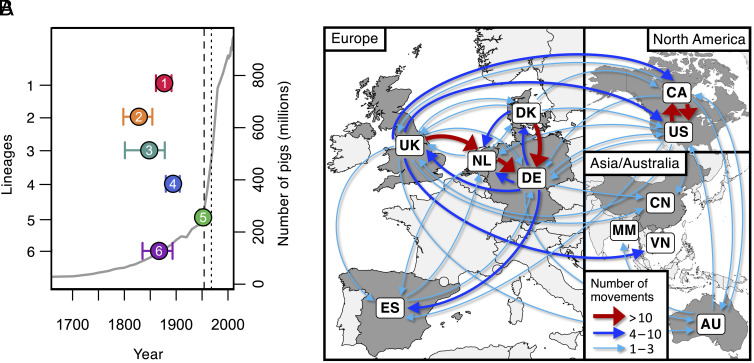
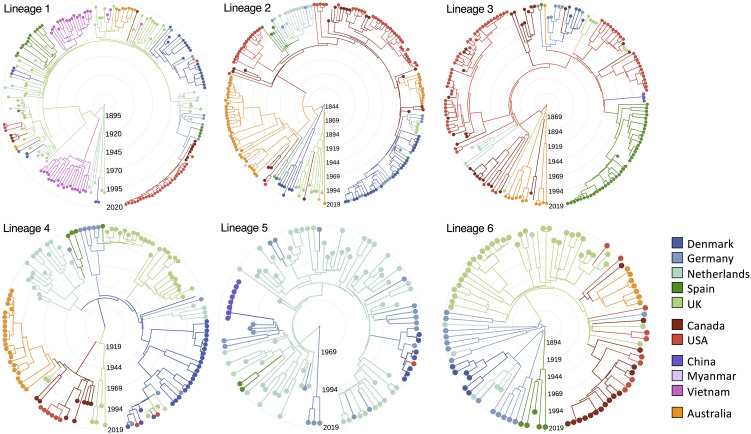
The expansion and intensification of livestock production is predicted to promote the emergence of pathogens. As pathogens sometimes jump between species, this can affect the health of humans as well as livestock. Here, we investigate how livestock microbiota can act as a source of these emerging pathogens through analysis of , a ubiquitous component of the respiratory microbiota of pigs that is also a major cause of disease on pig farms and an important zoonotic pathogen. Combining molecular dating, phylogeography, and comparative genomic analyses of a large collection of isolates, we find that several pathogenic lineages of emerged in the 19th and 20th centuries, during an early period of growth in pig farming. These lineages have since spread between countries and continents, mirroring trade in live pigs. They are distinguished by the presence of three genomic islands with putative roles in metabolism and cell adhesion, and an ongoing reduction in genome size, which may reflect their recent shift to a more pathogenic ecology. Reconstructions of the evolutionary histories of these islands reveal constraints on pathogen emergence that could inform control strategies, with pathogenic lineages consistently emerging from one subpopulation of and acquiring genes through horizontal transfer from other pathogenic lineages. These results shed light on the capacity of the microbiota to rapidly evolve to exploit changes in their host population and suggest that the impact of changes in farming on the pathogenicity and zoonotic potential of is yet to be fully realized.
畜牧业生产的扩张和集约化预计将促进病原体的出现。由于病原体有时会在物种之间跳跃,这不仅会影响牲畜的健康,也会影响人类的健康。在这里,我们通过分析广泛存在于猪呼吸道微生物群中的 ,研究了家畜微生物群如何成为这些新出现病原体的来源,而 也是猪场疾病的主要原因,也是一种重要的人畜共患病病原体。我们结合了对大量分离株的分子年代测定、系统地理学和比较基因组分析,发现几个致病性的 谱系在 19 世纪和 20 世纪出现,当时是养猪业快速发展的早期阶段。此后,这些谱系在国家和大陆之间传播,反映了活猪贸易的情况。它们的特点是存在三个具有代谢和细胞黏附作用的假定功能的基因组岛,以及持续的基因组大小缩小,这可能反映了它们最近向更具致病性的生态系统的转变。这些岛屿的进化历史重建揭示了病原体出现的限制因素,这可能为控制策略提供信息,致病性谱系始终从 的一个亚群中出现,并通过水平基因转移从其他致病性谱系中获得基因。这些结果揭示了微生物群快速进化以利用其宿主群体变化的能力,并表明农业变化对 的致病性和人畜共患病潜力的影响尚未完全显现。