• 文献检索
  • 文档翻译
  • 深度研究
  • 学术资讯
  • Suppr Zotero 插件Zotero 插件
  • 邀请有礼
  • 套餐&价格
  • 历史记录
应用&插件
Suppr Zotero 插件Zotero 插件浏览器插件Mac 客户端Windows 客户端微信小程序
定价
高级版会员购买积分包购买API积分包
服务
文献检索文档翻译深度研究API 文档MCP 服务
关于我们
关于 Suppr公司介绍联系我们用户协议隐私条款
关注我们

Suppr 超能文献

核心技术专利:CN118964589B侵权必究
粤ICP备2023148730 号-1Suppr @ 2026

文献检索

告别复杂PubMed语法,用中文像聊天一样搜索,搜遍4000万医学文献。AI智能推荐,让科研检索更轻松。

立即免费搜索

文件翻译

保留排版,准确专业,支持PDF/Word/PPT等文件格式,支持 12+语言互译。

免费翻译文档

深度研究

AI帮你快速写综述,25分钟生成高质量综述,智能提取关键信息,辅助科研写作。

立即免费体验

糖尿病患者血糖水平预测的机器学习模型:系统评价与网络荟萃分析

Machine Learning Models for Blood Glucose Level Prediction in Patients With Diabetes Mellitus: Systematic Review and Network Meta-Analysis.

作者信息

Liu Kui, Li Linyi, Ma Yifei, Jiang Jun, Liu Zhenhua, Ye Zichen, Liu Shuang, Pu Chen, Chen Changsheng, Wan Yi

机构信息

Department of Health Service, Air Force Medical University, Xi'an, Shaanxi, China.

Department of Health Statistics, Air Force Medical University, Xi'an, Shaanxi, China.

出版信息

JMIR Med Inform. 2023 Nov 20;11:e47833. doi: 10.2196/47833.

DOI:10.2196/47833
PMID:37983072
原文链接:https://pmc.ncbi.nlm.nih.gov/articles/PMC10696506/
Abstract

BACKGROUND

Machine learning (ML) models provide more choices to patients with diabetes mellitus (DM) to more properly manage blood glucose (BG) levels. However, because of numerous types of ML algorithms, choosing an appropriate model is vitally important.

OBJECTIVE

In a systematic review and network meta-analysis, this study aimed to comprehensively assess the performance of ML models in predicting BG levels. In addition, we assessed ML models used to detect and predict adverse BG (hypoglycemia) events by calculating pooled estimates of sensitivity and specificity.

METHODS

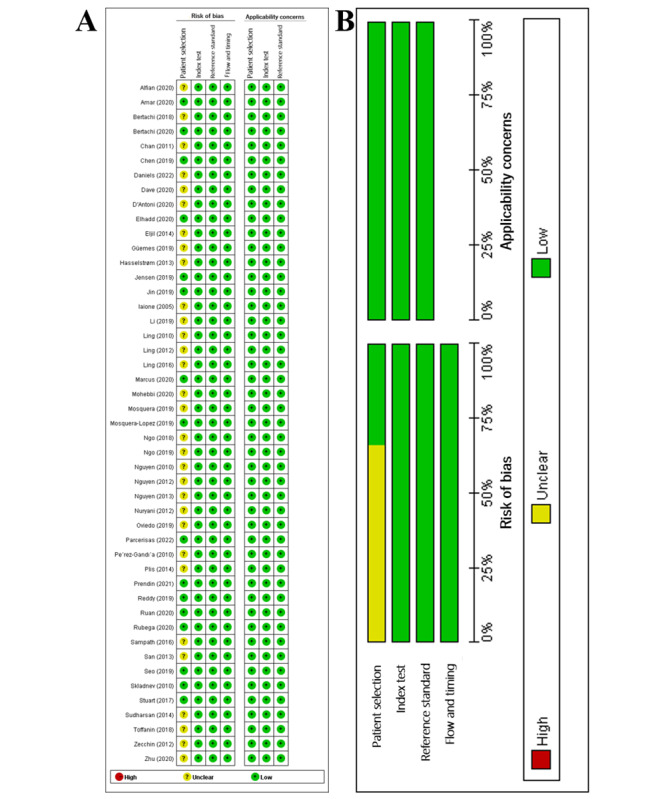
PubMed, Embase, Web of Science, and Institute of Electrical and Electronics Engineers Explore databases were systematically searched for studies on predicting BG levels and predicting or detecting adverse BG events using ML models, from inception to November 2022. Studies that assessed the performance of different ML models in predicting or detecting BG levels or adverse BG events of patients with DM were included. Studies with no derivation or performance metrics of ML models were excluded. The Quality Assessment of Diagnostic Accuracy Studies tool was applied to assess the quality of included studies. Primary outcomes were the relative ranking of ML models for predicting BG levels in different prediction horizons (PHs) and pooled estimates of the sensitivity and specificity of ML models in detecting or predicting adverse BG events.

RESULTS

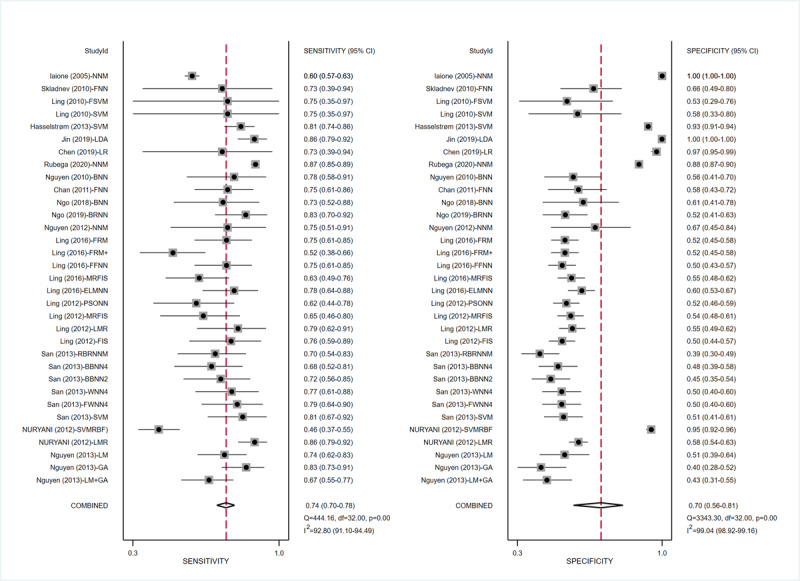
In total, 46 eligible studies were included for meta-analysis. Regarding ML models for predicting BG levels, the means of the absolute root mean square error (RMSE) in a PH of 15, 30, 45, and 60 minutes were 18.88 (SD 19.71), 21.40 (SD 12.56), 21.27 (SD 5.17), and 30.01 (SD 7.23) mg/dL, respectively. The neural network model (NNM) showed the highest relative performance in different PHs. Furthermore, the pooled estimates of the positive likelihood ratio and the negative likelihood ratio of ML models were 8.3 (95% CI 5.7-12.0) and 0.31 (95% CI 0.22-0.44), respectively, for predicting hypoglycemia and 2.4 (95% CI 1.6-3.7) and 0.37 (95% CI 0.29-0.46), respectively, for detecting hypoglycemia.

CONCLUSIONS

Statistically significant high heterogeneity was detected in all subgroups, with different sources of heterogeneity. For predicting precise BG levels, the RMSE increases with a rise in the PH, and the NNM shows the highest relative performance among all the ML models. Meanwhile, current ML models have sufficient ability to predict adverse BG events, while their ability to detect adverse BG events needs to be enhanced.

TRIAL REGISTRATION

PROSPERO CRD42022375250; https://www.crd.york.ac.uk/prospero/display_record.php?RecordID=375250.

摘要

背景

机器学习(ML)模型为糖尿病(DM)患者提供了更多选择,以便更恰当地管理血糖(BG)水平。然而,由于ML算法种类繁多,选择合适的模型至关重要。

目的

在一项系统评价和网络荟萃分析中,本研究旨在全面评估ML模型在预测BG水平方面的性能。此外,我们通过计算敏感性和特异性的合并估计值,评估了用于检测和预测不良BG(低血糖)事件的ML模型。

方法

系统检索了PubMed、Embase、Web of Science和电气与电子工程师协会探索数据库,以查找从数据库创建至2022年11月期间使用ML模型预测BG水平以及预测或检测不良BG事件的研究。纳入评估不同ML模型在预测或检测DM患者BG水平或不良BG事件方面性能的研究。排除未提供ML模型推导或性能指标的研究。应用诊断准确性研究质量评估工具评估纳入研究的质量。主要结局是ML模型在不同预测期(PH)预测BG水平的相对排名,以及ML模型在检测或预测不良BG事件时敏感性和特异性的合并估计值。

结果

总共纳入46项符合条件的研究进行荟萃分析。关于预测BG水平的ML模型,在15、30、45和60分钟的预测期内,绝对均方根误差(RMSE)的均值分别为18.88(标准差19.71)、21.40(标准差12.56)、21.27(标准差5.17)和30.01(标准差7.23)mg/dL。神经网络模型(NNM)在不同预测期内表现出最高的相对性能。此外,ML模型预测低血糖的阳性似然比和阴性似然比的合并估计值分别为8.3(95%CI 5.7 - 12.0)和0.3(95%CI 0.22 - 0.44),检测低血糖的阳性似然比和阴性似然比的合并估计值分别为2.4(95%CI 1.6 - 3.7)和0.37(95%CI 0.29 - 0.46)。

结论

在所有亚组中均检测到具有不同异质性来源的统计学显著高异质性。为了预测精确的BG水平,RMSE随着预测期的增加而增加,并且NNM在所有ML模型中表现出最高的相对性能。同时,当前的ML模型有足够的能力预测不良BG事件,但其检测不良BG事件的能力需要提高。

试验注册

PROSPERO CRD42022375250;https://www.crd.york.ac.uk/prospero/display_record.php?RecordID=375250 。

需注意,原文中“0.3”疑为“0.31”的错误,译文已按正确内容翻译。

https://cdn.ncbi.nlm.nih.gov/pmc/blobs/397f/10696506/46b95500c017/medinform_v11i1e47833_fig10.jpg
https://cdn.ncbi.nlm.nih.gov/pmc/blobs/397f/10696506/3fba032059ab/medinform_v11i1e47833_fig1.jpg
https://cdn.ncbi.nlm.nih.gov/pmc/blobs/397f/10696506/55462ab9ef87/medinform_v11i1e47833_fig2.jpg
https://cdn.ncbi.nlm.nih.gov/pmc/blobs/397f/10696506/b4199f464c78/medinform_v11i1e47833_fig3.jpg
https://cdn.ncbi.nlm.nih.gov/pmc/blobs/397f/10696506/ff4977582f43/medinform_v11i1e47833_fig4.jpg
https://cdn.ncbi.nlm.nih.gov/pmc/blobs/397f/10696506/37f37e65fc0a/medinform_v11i1e47833_fig5.jpg
https://cdn.ncbi.nlm.nih.gov/pmc/blobs/397f/10696506/e95dafe4748a/medinform_v11i1e47833_fig6.jpg
https://cdn.ncbi.nlm.nih.gov/pmc/blobs/397f/10696506/4152fa7a3e15/medinform_v11i1e47833_fig7.jpg
https://cdn.ncbi.nlm.nih.gov/pmc/blobs/397f/10696506/341934575832/medinform_v11i1e47833_fig8.jpg
https://cdn.ncbi.nlm.nih.gov/pmc/blobs/397f/10696506/157f4f6745bb/medinform_v11i1e47833_fig9.jpg
https://cdn.ncbi.nlm.nih.gov/pmc/blobs/397f/10696506/46b95500c017/medinform_v11i1e47833_fig10.jpg
https://cdn.ncbi.nlm.nih.gov/pmc/blobs/397f/10696506/3fba032059ab/medinform_v11i1e47833_fig1.jpg
https://cdn.ncbi.nlm.nih.gov/pmc/blobs/397f/10696506/55462ab9ef87/medinform_v11i1e47833_fig2.jpg
https://cdn.ncbi.nlm.nih.gov/pmc/blobs/397f/10696506/b4199f464c78/medinform_v11i1e47833_fig3.jpg
https://cdn.ncbi.nlm.nih.gov/pmc/blobs/397f/10696506/ff4977582f43/medinform_v11i1e47833_fig4.jpg
https://cdn.ncbi.nlm.nih.gov/pmc/blobs/397f/10696506/37f37e65fc0a/medinform_v11i1e47833_fig5.jpg
https://cdn.ncbi.nlm.nih.gov/pmc/blobs/397f/10696506/e95dafe4748a/medinform_v11i1e47833_fig6.jpg
https://cdn.ncbi.nlm.nih.gov/pmc/blobs/397f/10696506/4152fa7a3e15/medinform_v11i1e47833_fig7.jpg
https://cdn.ncbi.nlm.nih.gov/pmc/blobs/397f/10696506/341934575832/medinform_v11i1e47833_fig8.jpg
https://cdn.ncbi.nlm.nih.gov/pmc/blobs/397f/10696506/157f4f6745bb/medinform_v11i1e47833_fig9.jpg
https://cdn.ncbi.nlm.nih.gov/pmc/blobs/397f/10696506/46b95500c017/medinform_v11i1e47833_fig10.jpg

相似文献

1
Machine Learning Models for Blood Glucose Level Prediction in Patients With Diabetes Mellitus: Systematic Review and Network Meta-Analysis.糖尿病患者血糖水平预测的机器学习模型:系统评价与网络荟萃分析
JMIR Med Inform. 2023 Nov 20;11:e47833. doi: 10.2196/47833.
2
Folic acid supplementation and malaria susceptibility and severity among people taking antifolate antimalarial drugs in endemic areas.在流行地区,服用抗叶酸抗疟药物的人群中,叶酸补充剂与疟疾易感性和严重程度的关系。
Cochrane Database Syst Rev. 2022 Feb 1;2(2022):CD014217. doi: 10.1002/14651858.CD014217.
3
Continuous glucose monitoring using machine learning models and IoT device data: A meta-analysis.使用机器学习模型和物联网设备数据进行连续血糖监测:一项荟萃分析。
Technol Health Care. 2025;33(1):577-591. doi: 10.3233/THC-241403.
4
Ability of Current Machine Learning Algorithms to Predict and Detect Hypoglycemia in Patients With Diabetes Mellitus: Meta-analysis.当前机器学习算法预测和检测糖尿病患者低血糖的能力:荟萃分析。
JMIR Diabetes. 2021 Jan 29;6(1):e22458. doi: 10.2196/22458.
5
Data-driven modeling and prediction of blood glucose dynamics: Machine learning applications in type 1 diabetes.基于数据驱动的血糖动力学建模与预测:机器学习在 1 型糖尿病中的应用。
Artif Intell Med. 2019 Jul;98:109-134. doi: 10.1016/j.artmed.2019.07.007. Epub 2019 Jul 26.
6
Accuracy of Machine Learning Algorithms for the Diagnosis of Autism Spectrum Disorder: Systematic Review and Meta-Analysis of Brain Magnetic Resonance Imaging Studies.用于诊断自闭症谱系障碍的机器学习算法的准确性:脑磁共振成像研究的系统评价和荟萃分析
JMIR Ment Health. 2019 Dec 20;6(12):e14108. doi: 10.2196/14108.
7
Machine and Deep Learning for Tuberculosis Detection on Chest X-Rays: Systematic Literature Review.基于 X 光片的结核病检测中的机器和深度学习:系统文献综述。
J Med Internet Res. 2023 Jul 3;25:e43154. doi: 10.2196/43154.
8
Glucose-lowering effect of berberine on type 2 diabetes: A systematic review and meta-analysis.黄连素对2型糖尿病的降糖作用:一项系统评价和荟萃分析。
Front Pharmacol. 2022 Nov 16;13:1015045. doi: 10.3389/fphar.2022.1015045. eCollection 2022.
9
The Value of Applying Machine Learning in Predicting the Time of Symptom Onset in Stroke Patients: Systematic Review and Meta-Analysis.应用机器学习预测脑卒中患者症状发作时间的价值:系统评价和荟萃分析。
J Med Internet Res. 2023 Oct 12;25:e44895. doi: 10.2196/44895.
10
Diagnostic Accuracy of Artificial Intelligence Based on Imaging Data for Preoperative Prediction of Microvascular Invasion in Hepatocellular Carcinoma: A Systematic Review and Meta-Analysis.基于影像数据的人工智能对肝细胞癌微血管侵犯术前预测的诊断准确性:一项系统评价和Meta分析
Front Oncol. 2022 Feb 24;12:763842. doi: 10.3389/fonc.2022.763842. eCollection 2022.

引用本文的文献

1
Artificial intelligence in glycemic management for diabetes: Applications, opportunities and challenges.人工智能在糖尿病血糖管理中的应用、机遇与挑战。
J Transl Int Med. 2025 Aug 12;13(4):314-317. doi: 10.1515/jtim-2025-0039. eCollection 2025 Aug.
2
A multimodal deep learning architecture for predicting interstitial glucose for effective type 2 diabetes management.一种用于预测组织间液葡萄糖以实现有效2型糖尿病管理的多模态深度学习架构。
Sci Rep. 2025 Jul 29;15(1):27625. doi: 10.1038/s41598-025-07272-3.
3
Mapping the landscape of machine learning in chronic disease management: A comprehensive bibliometric study.

本文引用的文献

1
There is no such thing as a validated prediction model.没有经过验证的预测模型这种东西。
BMC Med. 2023 Feb 24;21(1):70. doi: 10.1186/s12916-023-02779-w.
2
Diabetes education for better personalized management in pediatric patients.糖尿病教育助力儿科患者实现更个性化的管理。
BMC Med. 2023 Jan 24;21(1):30. doi: 10.1186/s12916-022-02709-2.
3
Dilated Recurrent Neural Networks for Glucose Forecasting in Type 1 Diabetes.用于1型糖尿病血糖预测的扩张递归神经网络
绘制机器学习在慢性病管理中的全景:一项全面的文献计量学研究。
Digit Health. 2025 Jul 23;11:20552076251361614. doi: 10.1177/20552076251361614. eCollection 2025 Jan-Dec.
4
A deep learning framework for virtual continuous glucose monitoring and glucose prediction based on life-log data.基于生活日志数据的虚拟连续血糖监测与血糖预测深度学习框架。
Sci Rep. 2025 May 10;15(1):16290. doi: 10.1038/s41598-025-01367-7.
5
A deep learning approach for blood glucose monitoring and hypoglycemia prediction in glycogen storage disease.一种用于糖原贮积病血糖监测和低血糖预测的深度学习方法。
Sci Rep. 2025 Apr 15;15(1):13032. doi: 10.1038/s41598-025-97391-8.
6
Machine Learning-driven Identification of the Honeymoon Phase in Pediatric Type 1 Diabetes and Optimizing Insulin Management.机器学习驱动的小儿1型糖尿病蜜月期识别及胰岛素管理优化
J Clin Res Pediatr Endocrinol. 2025 Aug 22;17(3):278-287. doi: 10.4274/jcrpe.galenos.2025.2024-8-13. Epub 2025 Jan 24.
7
Machine Learning Algorithms Based on Time Series Pre-Clustering for Nocturnal Glucose Prediction in People with Type 1 Diabetes.基于时间序列预聚类的机器学习算法用于1型糖尿病患者夜间血糖预测
Diagnostics (Basel). 2024 Oct 30;14(21):2427. doi: 10.3390/diagnostics14212427.
8
A hybrid Transformer-LSTM model apply to glucose prediction.混合 Transformer-LSTM 模型在血糖预测中的应用。
PLoS One. 2024 Sep 11;19(9):e0310084. doi: 10.1371/journal.pone.0310084. eCollection 2024.
9
Predicting Glucose Values: A New Era for Continuous Glucose Monitoring.预测血糖值:连续血糖监测的新时代。
J Diabetes Sci Technol. 2024 Sep;18(5):1000-1003. doi: 10.1177/19322968241271925. Epub 2024 Aug 19.
10
The Promise of Hypoglycemia Risk Prediction.低血糖风险预测的前景
J Diabetes Sci Technol. 2024 Sep;18(5):1061-1062. doi: 10.1177/19322968241267778. Epub 2024 Aug 19.
J Healthc Inform Res. 2020 Apr 12;4(3):308-324. doi: 10.1007/s41666-020-00068-2. eCollection 2020 Sep.
4
Development and internal validation of machine learning algorithms for end-stage renal disease risk prediction model of people with type 2 diabetes mellitus and diabetic kidney disease.机器学习算法在 2 型糖尿病合并糖尿病肾病患者终末期肾病风险预测模型中的开发与内部验证。
Ren Fail. 2022 Dec;44(1):562-570. doi: 10.1080/0886022X.2022.2056053.
5
A Machine Learning Approach to Minimize Nocturnal Hypoglycemic Events in Type 1 Diabetic Patients under Multiple Doses of Insulin.一种机器学习方法,以最大限度地减少 1 型糖尿病患者多次胰岛素注射下的夜间低血糖事件。
Sensors (Basel). 2022 Feb 21;22(4):1665. doi: 10.3390/s22041665.
6
Development and validation of an incidence risk prediction model for early foot ulcer in diabetes based on a high evidence systematic review and meta-analysis.基于高证据系统评价和荟萃分析的糖尿病早期足部溃疡发病风险预测模型的建立与验证。
Diabetes Res Clin Pract. 2021 Oct;180:109040. doi: 10.1016/j.diabres.2021.109040. Epub 2021 Sep 6.
7
Data-based algorithms and models using diabetics real data for blood glucose and hypoglycaemia prediction - A systematic literature review.基于糖尿病患者真实数据的血糖和低血糖预测数据算法和模型 - 系统文献回顾。
Artif Intell Med. 2021 Aug;118:102120. doi: 10.1016/j.artmed.2021.102120. Epub 2021 May 28.
8
Study on Risk Factors of Peripheral Neuropathy in Type 2 Diabetes Mellitus and Establishment of Prediction Model.2 型糖尿病周围神经病变危险因素研究及预测模型的建立。
Diabetes Metab J. 2021 Jul;45(4):526-538. doi: 10.4093/dmj.2020.0100. Epub 2021 Jul 30.
9
A Multitask Learning Approach to Personalized Blood Glucose Prediction.一种用于个性化血糖预测的多任务学习方法。
IEEE J Biomed Health Inform. 2022 Jan;26(1):436-445. doi: 10.1109/JBHI.2021.3100558. Epub 2022 Jan 17.
10
Deep transfer learning and data augmentation improve glucose levels prediction in type 2 diabetes patients.深度迁移学习和数据增强改善2型糖尿病患者的血糖水平预测。
NPJ Digit Med. 2021 Jul 14;4(1):109. doi: 10.1038/s41746-021-00480-x.