Department of Mechanical and Manufacturing Engineering, Faculty of Engineering, Universiti Putra Malaysia, Serdang, Malaysia.
Department of Endocrinology, Suzhou Municipal Hospital, The Affiliated Suzhou Hospital of Nanjing Medical University, Suzhou, China.
PLoS One. 2024 Sep 11;19(9):e0310084. doi: 10.1371/journal.pone.0310084. eCollection 2024.
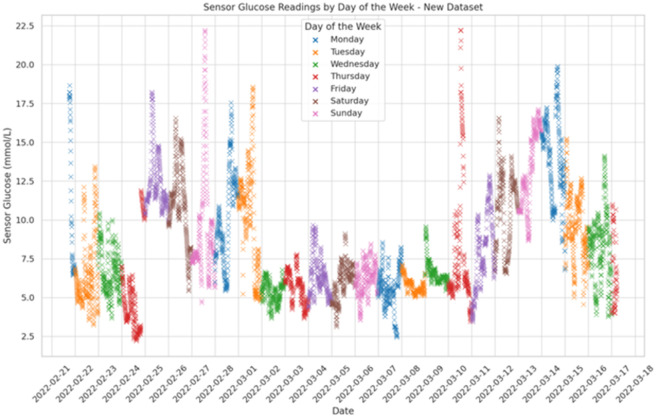
The global prevalence of diabetes is escalating, with estimates indicating that over 536.6 million individuals were afflicted by 2021, accounting for approximately 10.5% of the world's population. Effective management of diabetes, particularly monitoring and prediction of blood glucose levels, remains a significant challenge due to the severe health risks associated with inaccuracies, such as hypoglycemia and hyperglycemia. This study addresses this critical issue by employing a hybrid Transformer-LSTM (Long Short-Term Memory) model designed to enhance the accuracy of future glucose level predictions based on data from Continuous Glucose Monitoring (CGM) systems. This innovative approach aims to reduce the risk of diabetic complications and improve patient outcomes. We utilized a dataset which contain more than 32000 data points comprising CGM data from eight patients collected by Suzhou Municipal Hospital in Jiangsu Province, China. This dataset includes historical glucose readings and equipment calibration values, making it highly suitable for developing predictive models due to its richness and real-time applicability. Our findings demonstrate that the hybrid Transformer-LSTM model significantly outperforms the standard LSTM model, achieving Mean Square Error (MSE) values of 1.18, 1.70, and 2.00 at forecasting intervals of 15, 30, and 45 minutes, respectively. This research underscores the potential of advanced machine learning techniques in the proactive management of diabetes, a critical step toward mitigating its impact.
全球糖尿病患病率不断上升,据估计,2021 年全球有超过 5.366 亿人患病,约占世界人口的 10.5%。由于与不准确相关的严重健康风险,如低血糖和高血糖,糖尿病的有效管理,特别是血糖水平的监测和预测,仍然是一个重大挑战。本研究通过使用混合 Transformer-LSTM(长短期记忆)模型来解决这个关键问题,该模型旨在根据来自连续血糖监测(CGM)系统的数据提高未来血糖水平预测的准确性。这种创新方法旨在降低糖尿病并发症的风险并改善患者的预后。我们使用了一个数据集,其中包含来自中国江苏省苏州市立医院的 8 名患者的超过 32000 个数据点的 CGM 数据。该数据集包括历史血糖读数和设备校准值,由于其丰富性和实时适用性,非常适合开发预测模型。我们的研究结果表明,混合 Transformer-LSTM 模型的表现明显优于标准 LSTM 模型,在预测间隔为 15、30 和 45 分钟时,其均方误差(MSE)值分别为 1.18、1.70 和 2.00。这项研究强调了先进的机器学习技术在糖尿病主动管理中的潜力,这是减轻其影响的关键一步。