Roche Pharma Research and Early Development (pRED), Roche Innovation Center Basel, F. Hoffmann-La Roche Ltd., Basel, Switzerland.
Department of Pharmacy, Ludwig-Maximilians-Universität München, Munich, Germany.
Nat Chem. 2024 Feb;16(2):239-248. doi: 10.1038/s41557-023-01360-5. Epub 2023 Nov 23.
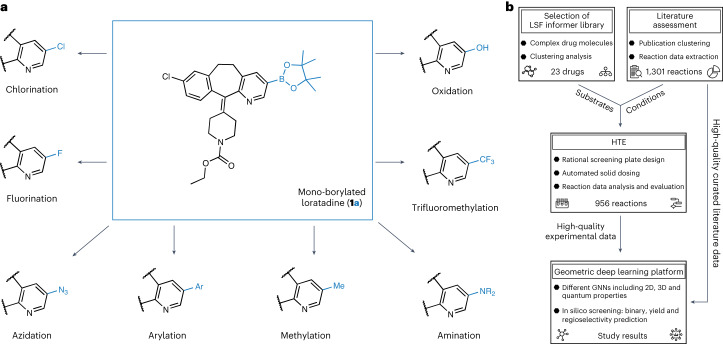
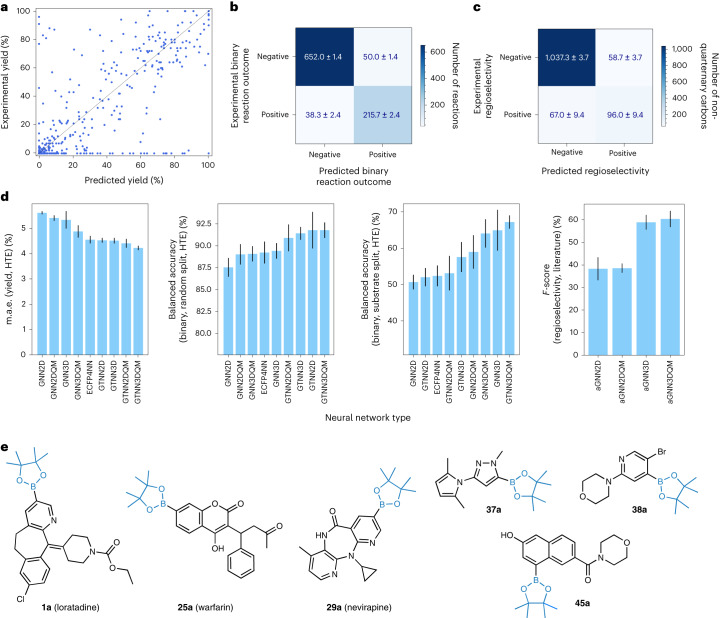
Late-stage functionalization is an economical approach to optimize the properties of drug candidates. However, the chemical complexity of drug molecules often makes late-stage diversification challenging. To address this problem, a late-stage functionalization platform based on geometric deep learning and high-throughput reaction screening was developed. Considering borylation as a critical step in late-stage functionalization, the computational model predicted reaction yields for diverse reaction conditions with a mean absolute error margin of 4-5%, while the reactivity of novel reactions with known and unknown substrates was classified with a balanced accuracy of 92% and 67%, respectively. The regioselectivity of the major products was accurately captured with a classifier F-score of 67%. When applied to 23 diverse commercial drug molecules, the platform successfully identified numerous opportunities for structural diversification. The influence of steric and electronic information on model performance was quantified, and a comprehensive simple user-friendly reaction format was introduced that proved to be a key enabler for seamlessly integrating deep learning and high-throughput experimentation for late-stage functionalization.
后期功能化是优化候选药物性质的一种经济方法。然而,药物分子的化学复杂性通常使得后期多样化具有挑战性。为了解决这个问题,开发了一种基于几何深度学习和高通量反应筛选的后期功能化平台。考虑到硼化作用是后期功能化的关键步骤,计算模型预测了不同反应条件下的反应产率,平均绝对误差幅度为 4-5%,而对具有已知和未知底物的新反应的反应性进行分类的准确率分别为 92%和 67%。主要产物的区域选择性被准确地捕捉到,分类器 F 分数为 67%。当应用于 23 种不同的商业药物分子时,该平台成功地确定了许多结构多样化的机会。还量化了立体和电子信息对模型性能的影响,并引入了一种全面的简单易用的反应格式,这被证明是为后期功能化无缝集成深度学习和高通量实验的关键推动因素。