Polymer Materials Research Department, SRTA-City), Advanced Technology and New Materials Research Institute, City of Scientific Research and Technological Applications, New Borg El-Arab City, Alexandria, 21934, Egypt.
Medical Biotechnology Department, Genetic Engineering and Biotechnology Research Institute, City of Scientific Research and Technological Applications (SRTA-City), New Borg EL-Arab City, Alexandria, 21934, Egypt.
Sci Rep. 2023 Nov 29;13(1):21045. doi: 10.1038/s41598-023-48302-2.
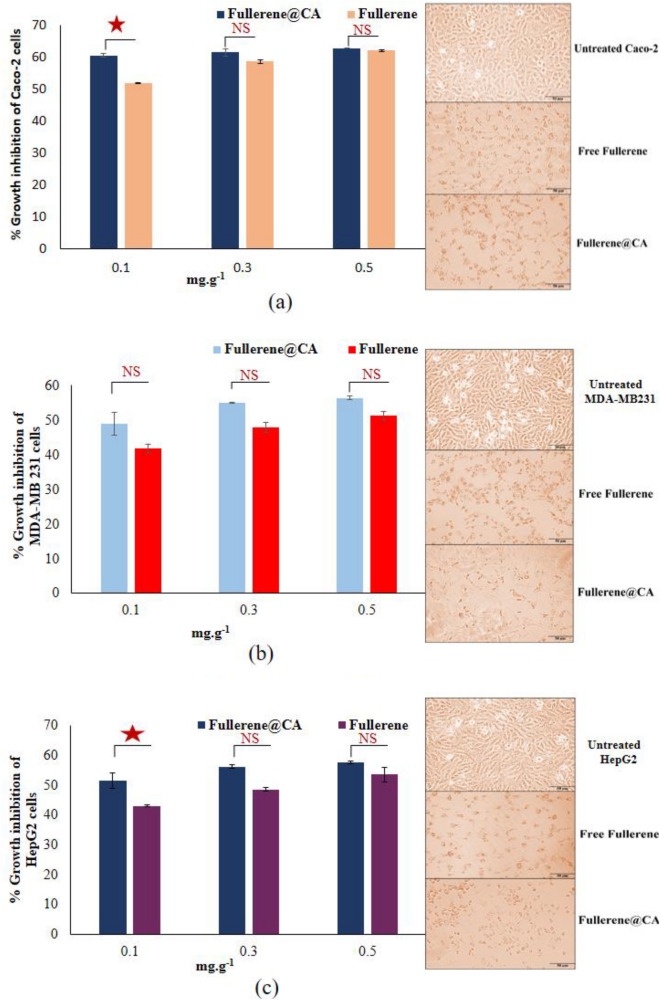
The current prevalence of cancerous diseases necessitates the exploration of materials that can effectively treat these conditions while minimizing the occurrence of adverse side effects. This study aims to identify materials with the potential to inhibit the metastasis of cancerous diseases within the human body while concurrently serving as therapeutic agents for their treatment. A novel approach was employed to enhance the anti-cancer properties of electrospun cellulose fibers by incorporating fullerene nanoparticles (NPs) into cellulose acetate (CA) fibers, resulting in a composite material called Fullerene@CA. This development aimed at utilizing the anti-cancer properties of fullerenes for potential therapeutic applications. This process has been demonstrated in vitro against various types of cancer, and it was found that Fullerene@CA nanocomposite fibers displayed robust anticancer activity. Cancer cells (Caco-2, MDA-MB 231, and HepG-2 cells) were inhibited by 0.3 and 0.5 mg.g fullerene doses by 58.62-62.87%, 47.86-56.43%, and 48.60-57.73%, respectively. The tested cancer cells shrink and lose their spindle shape due to morphological changes. The investigation of the prepared nanocomposite reveals its impact on various genes, such as BCL2, NF-KB, p53, Bax, and p21, highlighting the therapeutic compounds' effectiveness. The experimental results demonstrated that the incorporation of NPs into CA fibers resulted in a significant improvement in their anti-cancer efficacy. Therefore, it is suggested that these modified fibers could be utilized as a novel therapeutic approach for the treatment and prevention of cancer metastasis.
当前癌症疾病的流行情况要求我们探索能够有效治疗这些疾病且尽量减少不良反应发生的材料。本研究旨在寻找具有抑制人体癌症转移潜力并可同时用于治疗的材料。我们采用了一种新方法,通过将富勒烯纳米颗粒(NPs)掺入醋酸纤维素(CA)纤维中,来增强电纺纤维素纤维的抗癌性能,得到了一种名为 Fullerene@CA 的复合材料。这一发展旨在利用富勒烯的抗癌特性进行潜在的治疗应用。我们已经在体外针对各种类型的癌症进行了这项研究,结果表明 Fullerene@CA 纳米复合材料纤维具有强大的抗癌活性。富勒烯剂量为 0.3 和 0.5 mg.g 时,癌细胞(Caco-2、MDA-MB 231 和 HepG-2 细胞)的抑制率分别为 58.62-62.87%、47.86-56.43%和 48.60-57.73%。测试的癌细胞由于形态变化而收缩并失去其纺锤形。对制备的纳米复合材料的研究揭示了其对各种基因(如 BCL2、NF-KB、p53、Bax 和 p21)的影响,突出了治疗化合物的有效性。实验结果表明,将 NPs 掺入 CA 纤维中可显著提高其抗癌功效。因此,建议将这些改性纤维用作治疗和预防癌症转移的新型治疗方法。