Clinical Infection, Microbiology, and Immunology, Institute of Infection, Veterinary and Ecological Sciences, University of Liverpool, Liverpool, L69 7BE, UK.
NIHR Health Protection Research Unit (HPRU) in Emerging and Zoonotic Infections at University of Liverpool, Liverpool, L69 7BE, UK.
Nat Commun. 2023 Dec 22;14(1):8487. doi: 10.1038/s41467-023-42320-4.
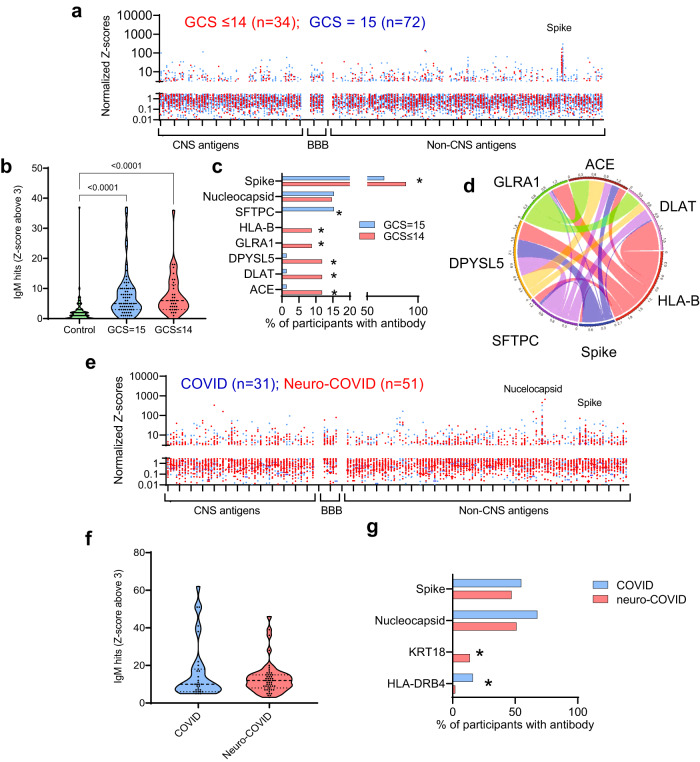
To understand neurological complications of COVID-19 better both acutely and for recovery, we measured markers of brain injury, inflammatory mediators, and autoantibodies in 203 hospitalised participants; 111 with acute sera (1-11 days post-admission) and 92 convalescent sera (56 with COVID-19-associated neurological diagnoses). Here we show that compared to 60 uninfected controls, tTau, GFAP, NfL, and UCH-L1 are increased with COVID-19 infection at acute timepoints and NfL and GFAP are significantly higher in participants with neurological complications. Inflammatory mediators (IL-6, IL-12p40, HGF, M-CSF, CCL2, and IL-1RA) are associated with both altered consciousness and markers of brain injury. Autoantibodies are more common in COVID-19 than controls and some (including against MYL7, UCH-L1, and GRIN3B) are more frequent with altered consciousness. Additionally, convalescent participants with neurological complications show elevated GFAP and NfL, unrelated to attenuated systemic inflammatory mediators and to autoantibody responses. Overall, neurological complications of COVID-19 are associated with evidence of neuroglial injury in both acute and late disease and these correlate with dysregulated innate and adaptive immune responses acutely.
为了更好地了解 COVID-19 的神经并发症,无论是在急性期还是恢复期,我们测量了 203 名住院患者的脑损伤标志物、炎症介质和自身抗体;其中 111 名患者的急性血清(入院后 1-11 天)和 92 名恢复期血清(COVID-19 相关神经系统诊断 56 名)。在这里,我们发现与 60 名未感染对照相比,tTau、GFAP、NfL 和 UCH-L1 在 COVID-19 感染时会在急性期升高,而在有神经系统并发症的患者中,NfL 和 GFAP 明显更高。炎症介质(IL-6、IL-12p40、HGF、M-CSF、CCL2 和 IL-1RA)与意识改变和脑损伤标志物相关。与对照组相比,COVID-19 患者的自身抗体更为常见,一些自身抗体(包括针对 MYL7、UCH-L1 和 GRIN3B)在意识改变时更为常见。此外,有神经系统并发症的恢复期患者表现出升高的 GFAP 和 NfL,与减轻的系统炎症介质和自身抗体反应无关。总体而言,COVID-19 的神经并发症与急性期和晚期疾病中神经胶质损伤的证据有关,这些与急性期失调的先天和适应性免疫反应有关。