
表面声波微流控器件的气溶胶喷射打印
Aerosol jet printing of surface acoustic wave microfluidic devices.
作者信息
Rich Joseph, Cole Brian, Li Teng, Lu Brandon, Fu Hanyu, Smith Brittany N, Xia Jianping, Yang Shujie, Zhong Ruoyu, Doherty James L, Kaneko Kanji, Suzuki Hiroaki, Tian Zhenhua, Franklin Aaron D, Huang Tony Jun
机构信息
Department of Biomedical Engineering, Duke University, Durham, NC 27708 USA.
Department of Electrical and Computer Engineering, Duke University, Durham, NC 27708 USA.
出版信息
Microsyst Nanoeng. 2024 Jan 1;10:2. doi: 10.1038/s41378-023-00606-z. eCollection 2024.
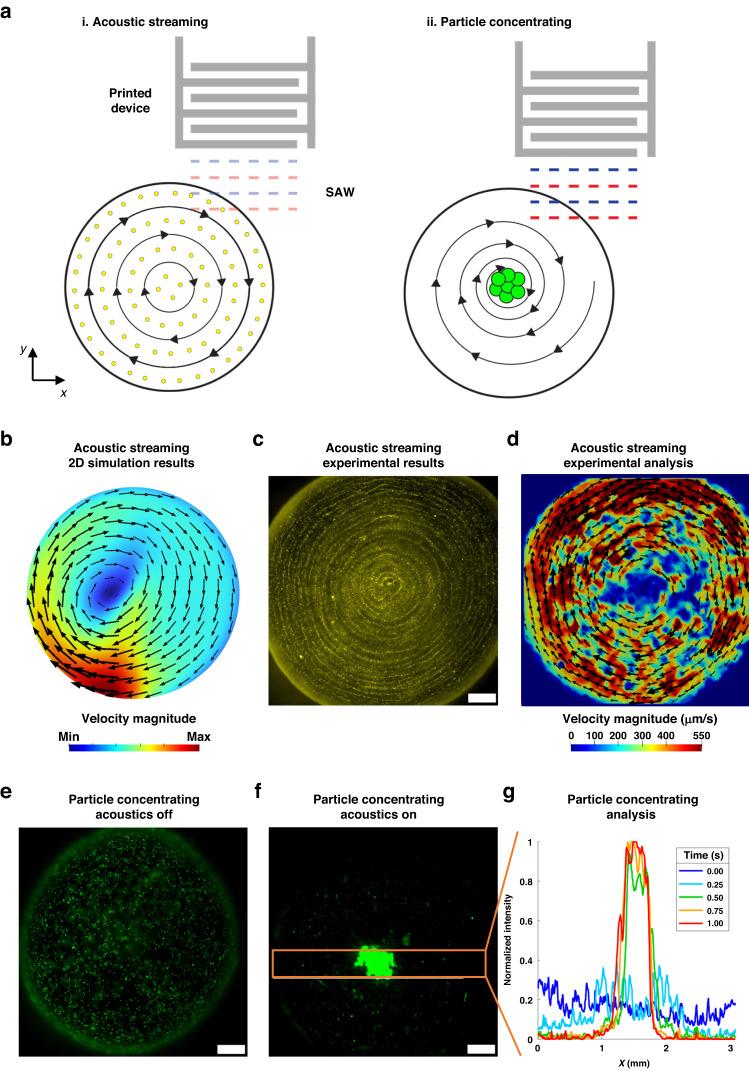
The addition of surface acoustic wave (SAW) technologies to microfluidics has greatly advanced lab-on-a-chip applications due to their unique and powerful attributes, including high-precision manipulation, versatility, integrability, biocompatibility, contactless nature, and rapid actuation. However, the development of SAW microfluidic devices is limited by complex and time-consuming micro/nanofabrication techniques and access to cleanroom facilities for multistep photolithography and vacuum-based processing. To simplify the fabrication of SAW microfluidic devices with customizable dimensions and functions, we utilized the additive manufacturing technique of aerosol jet printing. We successfully fabricated customized SAW microfluidic devices of varying materials, including silver nanowires, graphene, and poly(3,4-ethylenedioxythiophene) polystyrene sulfonate (PEDOT:PSS). To characterize and compare the acoustic actuation performance of these aerosol jet printed SAW microfluidic devices with their cleanroom-fabricated counterparts, the wave displacements and resonant frequencies of the different fabricated devices were directly measured through scanning laser Doppler vibrometry. Finally, to exhibit the capability of the aerosol jet printed devices for lab-on-a-chip applications, we successfully conducted acoustic streaming and particle concentration experiments. Overall, we demonstrated a novel solution-based, direct-write, single-step, cleanroom-free additive manufacturing technique to rapidly develop SAW microfluidic devices that shows viability for applications in the fields of biology, chemistry, engineering, and medicine.
由于其独特而强大的特性,包括高精度操纵、多功能性、可集成性、生物相容性、非接触性质和快速驱动,将表面声波(SAW)技术添加到微流体中极大地推动了芯片实验室应用的发展。然而,SAW微流体装置的开发受到复杂且耗时的微纳制造技术以及进入洁净室设施进行多步光刻和基于真空的处理的限制。为了简化具有可定制尺寸和功能的SAW微流体装置的制造,我们利用了气溶胶喷射打印的增材制造技术。我们成功制造了由不同材料制成的定制SAW微流体装置,包括银纳米线、石墨烯和聚(3,4-乙撑二氧噻吩)聚苯乙烯磺酸盐(PEDOT:PSS)。为了表征和比较这些气溶胶喷射打印的SAW微流体装置与其洁净室制造的对应装置的声驱动性能,通过扫描激光多普勒振动测量法直接测量了不同制造装置的波位移和共振频率。最后,为了展示气溶胶喷射打印装置在芯片实验室应用中的能力,我们成功进行了声流和粒子浓缩实验。总体而言,我们展示了一种基于溶液的、直接写入的、单步的、无需洁净室的增材制造技术,以快速开发SAW微流体装置,该技术在生物学、化学、工程和医学领域的应用中显示出可行性。


 Zotero 插件