Institute of Neuroscience and Medicine (INM-6) and Institute for Advanced Simulation (IAS-6) and JARA-Institute Brain Structure-Function Relationships (INM-10), Jülich Research Centre, Jülich, Germany; Theoretical Systems Neurobiology, RWTH Aachen University, Aachen, Germany.
Istituto Nazionale di Fisica Nucleare (INFN), Sezione di Roma, Rome, Italy.
Cell Rep Methods. 2024 Jan 22;4(1):100681. doi: 10.1016/j.crmeth.2023.100681. Epub 2024 Jan 5.
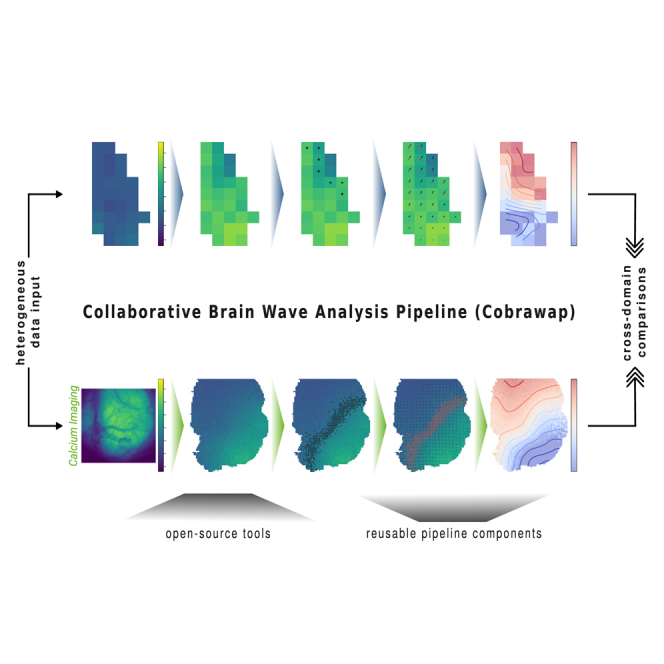
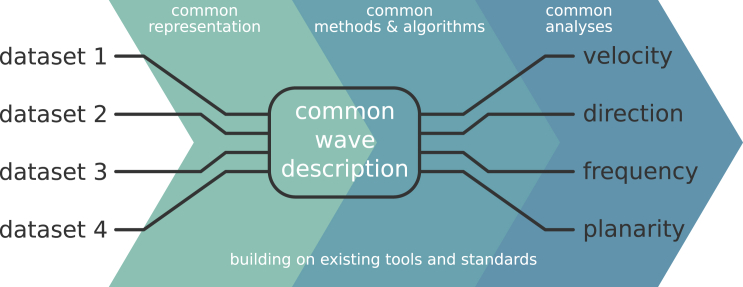
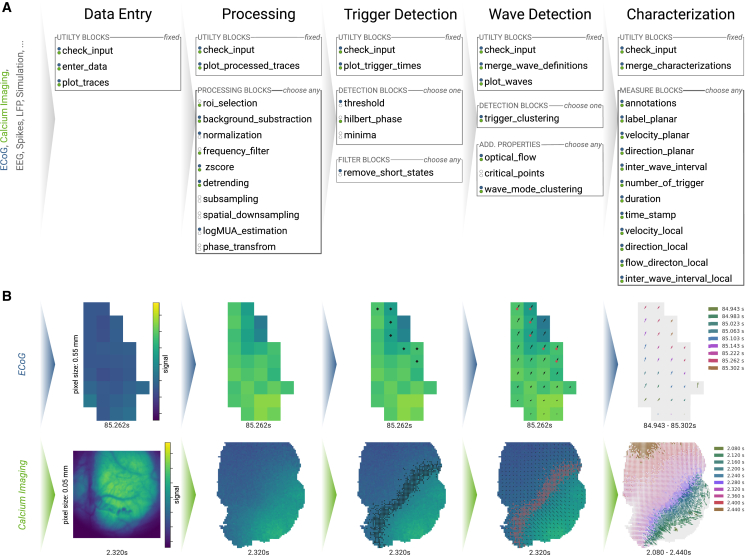
Neuroscience is moving toward a more integrative discipline where understanding brain function requires consolidating the accumulated evidence seen across experiments, species, and measurement techniques. A remaining challenge on that path is integrating such heterogeneous data into analysis workflows such that consistent and comparable conclusions can be distilled as an experimental basis for models and theories. Here, we propose a solution in the context of slow-wave activity (<1 Hz), which occurs during unconscious brain states like sleep and general anesthesia and is observed across diverse experimental approaches. We address the issue of integrating and comparing heterogeneous data by conceptualizing a general pipeline design that is adaptable to a variety of inputs and applications. Furthermore, we present the Collaborative Brain Wave Analysis Pipeline (Cobrawap) as a concrete, reusable software implementation to perform broad, detailed, and rigorous comparisons of slow-wave characteristics across multiple, openly available electrocorticography (ECoG) and calcium imaging datasets.
神经科学正在朝着一个更加综合的学科发展,在这个学科中,要理解大脑功能就需要整合在实验、物种和测量技术中积累的证据。在这条道路上,仍然存在一个挑战,即将这些异构数据整合到分析工作流程中,以便能够作为模型和理论的实验基础,得出一致和可比的结论。在这里,我们在慢波活动(<1 Hz)的背景下提出了一个解决方案,这种活动发生在无意识的大脑状态,如睡眠和全身麻醉期间,并且可以通过各种实验方法观察到。我们通过概念化一个通用的管道设计来解决整合和比较异构数据的问题,该设计可以适应各种输入和应用。此外,我们还提出了协作脑波分析管道(Cobrawap),作为一个具体的、可重复使用的软件实现,以执行多个公开可用的皮层电图(ECoG)和钙成像数据集之间的广泛、详细和严格的慢波特征比较。