Lou Cheng, Chen Zhuo, Bai Yu, Chai Tongjie, Guan Yuling, Wu Bo
Guangdong Provincial Key Laboratory of Animal Molecular Design and Precise Breeding, School of Life Science and Engineering, Foshan University, Foshan 528225, China.
College of Animal Science and Technology, Shandong Agricultural University, Tai'an 271000, China.
Animals (Basel). 2023 Dec 22;14(1):55. doi: 10.3390/ani14010055.
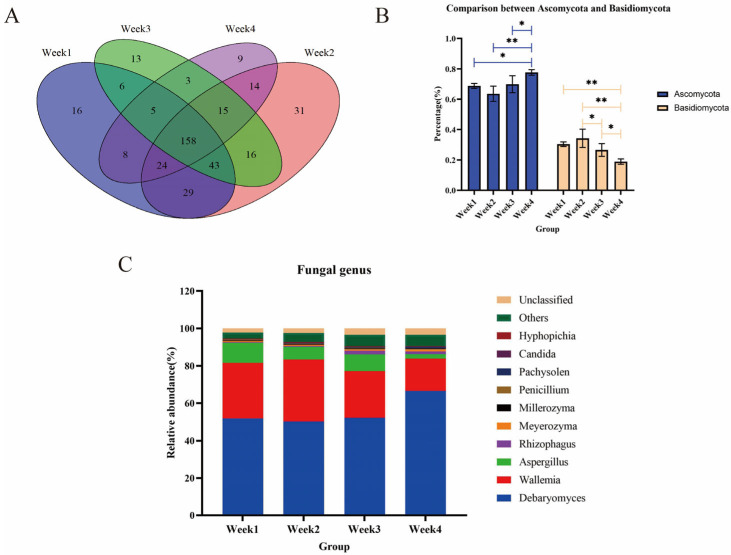
The environmental conditions of chicken houses play an important role in the growth and development of these animals. The chicken house is an essential place for the formation of microbial aerosols. Microbial aerosol pollution and transmission can affect human and animal health. In this work, we continuously monitored fine particulate matter (PM2.5) in the chicken house environment for four weeks and studied the microbial community structure in the aerosols of the chicken house environment through metagenomic sequencing. Our results found that bacteria, fungi, viruses, and archaea were the main components of PM2.5 in the chicken house environment, accounting for 89.80%, 1.08%, 2.06%, and 0.49%, respectively. Conditional pathogens are a type of bacteria that poses significant harm to animals themselves and to farm workers. We screened ten common conditional pathogens and found that had the highest relative abundance, while contained the most microbial species, up to 456. and in fungi showed dramatic changes in relative abundance, and other indexes showed no significant difference. Virulence factors (VF) are also a class of molecules produced by pathogenic microbes that can cause host diseases. The top five virulence factors were found in four groups: FbpABC, HitABC, colibactin, acinetobactin, and capsule, many of which are used for the iron uptake system. In the PM2.5 samples, eight avian viruses were the most significant discoveries, namely Fowl aviadovirus E, Fowl aviadovirus D, Avian leukosis virus, Avian endogenous retrovirus EAV-HP, Avian dependent parvovirus 1, Fowl adenovus, Fowl aviadovirus B, and Avian sarcoma virus. The above results significantly improve our understanding of the microbial composition of PM2.5 in chicken houses, filling a gap on virus composition; they also indicate a potential threat to poultry and to human health. This work provides an important theoretical basis for animal house environmental monitoring and protection.
鸡舍的环境条件对这些动物的生长发育起着重要作用。鸡舍是微生物气溶胶形成的重要场所。微生物气溶胶污染和传播会影响人和动物的健康。在这项工作中,我们连续四周对鸡舍环境中的细颗粒物(PM2.5)进行监测,并通过宏基因组测序研究鸡舍环境气溶胶中的微生物群落结构。我们的结果发现,细菌、真菌、病毒和古菌是鸡舍环境中PM2.5的主要成分,分别占89.80%、1.08%、2.06%和0.49%。条件致病菌是一类对动物自身和养殖场工人都有重大危害的细菌。我们筛选出十种常见的条件致病菌,发现 的相对丰度最高,而 所含的微生物种类最多,多达456种。真菌中的 和 相对丰度变化显著,其他指标无显著差异。毒力因子(VF)也是致病微生物产生的一类可导致宿主疾病的分子。在四组中发现了前五大毒力因子:FbpABC、HitABC、大肠杆菌素、埃希菌素和荚膜,其中许多用于铁摄取系统。在PM2.5样本中,八种禽病毒是最显著的发现,即禽E型腺病毒、禽D型腺病毒、禽白血病病毒、禽内源性逆转录病毒EAV-HP、禽依赖细小病毒1、禽腺病毒、禽B型腺病毒和禽肉瘤病毒。上述结果显著提高了我们对鸡舍中PM2.5微生物组成的认识,填补了病毒组成方面的空白;它们还表明对家禽和人类健康存在潜在威胁。这项工作为动物舍环境监测与保护提供了重要的理论依据。