Division of Clinical Pharmacology, Department of Medicine, Vanderbilt University Medical Center, Nashville, TN, 37232-6602, USA.
Division of Epidemiology, Department of Medicine, Vanderbilt Univiersity Medical Center, Nashville, TN, 37232, USA.
Redox Biol. 2024 Apr;70:103020. doi: 10.1016/j.redox.2023.103020. Epub 2024 Jan 4.
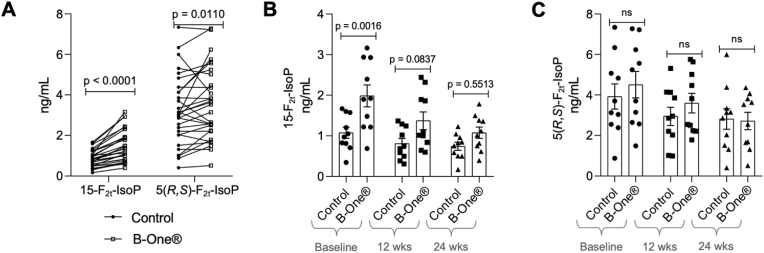
UDP-glucuronosyltransferases (UGTs) catalyze the conjugation of glucuronic acid with endogenous and exogenous lipophilic small molecules to facilitate their inactivation and excretion from the body. This represents approximately 35 % of all phase II metabolic transformations. Fatty acids and their oxidized eicosanoid derivatives can be metabolized by UGTs. F-isoprostanes (F-IsoPs) are eicosanoids formed from the free radical oxidation of arachidonic acid. These molecules are potent vasoconstrictors and are widely used as biomarkers of endogenous oxidative damage. An increasing body of evidence demonstrates the efficacy of measuring the β-oxidation metabolites of F-IsoPs rather than the unmetabolized F-IsoPs to quantify oxidative damage in certain settings. Yet, the metabolism of F-IsoPs is incompletely understood. This study sought to identify and characterize novel phase II metabolites of 15-F-IsoP and 5-epi-5-F-IsoP, two abundantly produced F-IsoPs, in human liver microsomes (HLM). Utilizing liquid chromatography-mass spectrometry, we demonstrated that glucuronide conjugates are the major metabolites of these F-IsoPs in HLM. Further, we showed that these molecules are metabolized by specific UGT isoforms. 15-F-IsoP is metabolized by UGT1A3, 1A9, and 2B7, while 5-epi-5-F-IsoP is metabolized by UGT1A7, 1A9, and 2B7. We identified, for the first time, the formation of intact glucuronide F-IsoPs in human urine and showed that F-IsoP glucuronidation is reduced in people supplemented with eicosapentaenoic and docosahexaenoic acids for 12 weeks. These studies demonstrate that endogenous F-IsoP levels can be modified by factors other than redox mechanisms.
尿苷二磷酸葡萄糖醛酸基转移酶(UGTs)催化将葡萄糖醛酸与内源性和外源性亲脂性小分子缀合,促进其失活并从体内排出。这代表了大约 35%的所有二期代谢转化。脂肪酸及其氧化的类二十烷酸衍生物可被 UGTs 代谢。F-异前列烷(F-IsoPs)是由花生四烯酸的自由基氧化形成的类二十烷酸。这些分子是有效的血管收缩剂,广泛用作内源性氧化损伤的生物标志物。越来越多的证据表明,在某些情况下,测量 F-IsoPs 的β-氧化代谢物而不是未代谢的 F-IsoPs 来量化氧化损伤更有效。然而,F-IsoPs 的代谢仍不完全清楚。本研究旨在鉴定和表征人肝微粒体(HLM)中两种丰富产生的 F-IsoP,即 15-F-IsoP 和 5-epi-5-F-IsoP 的新型二期代谢物。利用液相色谱-质谱联用技术,我们证明了葡萄糖醛酸缀合物是这些 F-IsoPs 在 HLM 中的主要代谢物。此外,我们表明这些分子是由特定的 UGT 同工酶代谢的。15-F-IsoP 由 UGT1A3、1A9 和 2B7 代谢,而 5-epi-5-F-IsoP 由 UGT1A7、1A9 和 2B7 代谢。我们首次在人尿中鉴定出完整的葡萄糖醛酸 F-IsoP 的形成,并表明 F-IsoP 葡萄糖醛酸化在补充二十碳五烯酸和二十二碳六烯酸 12 周的人群中减少。这些研究表明,内源性 F-IsoP 水平可以被除氧化还原机制以外的因素改变。