College of Marine Life Sciences, Institute of Evolution and Marine Biodiversity, MOE Key Laboratory of Evolution and Marine Biodiversity, Frontiers Science Center for Deep Ocean Multispheres and Earth System, Center for Ocean Carbon Neutrality, Ocean University of China, Qingdao, China.
Haide College, Ocean University of China, Qingdao, China.
Microbiol Spectr. 2024 Feb 6;12(2):e0336723. doi: 10.1128/spectrum.03367-23. Epub 2024 Jan 12.
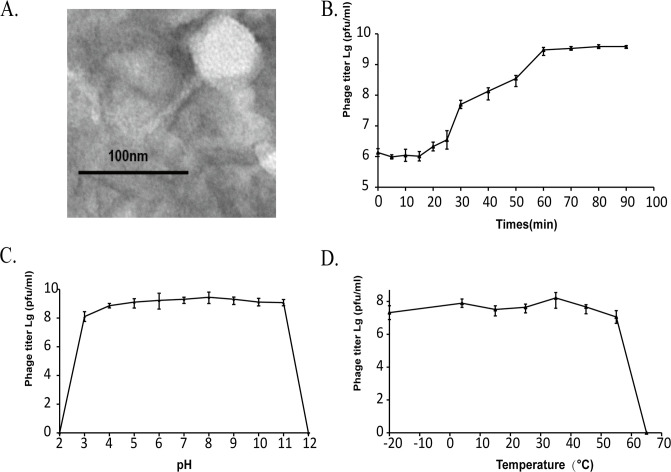
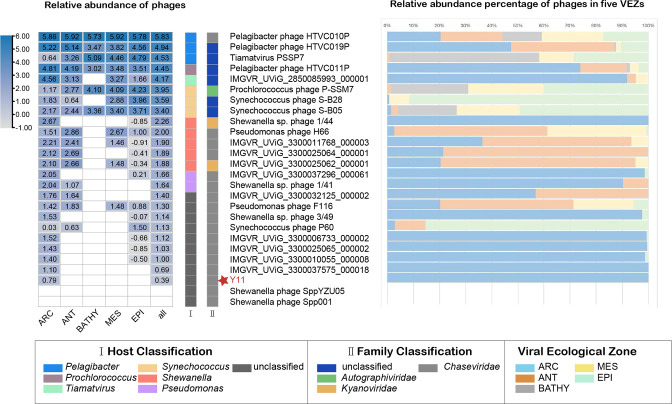
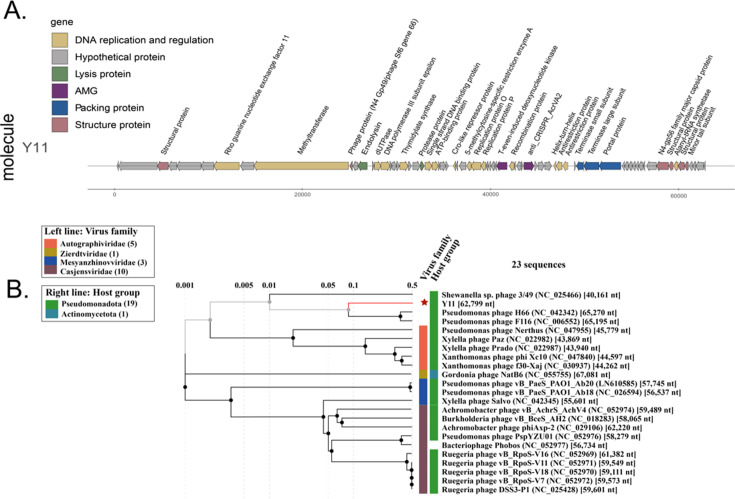
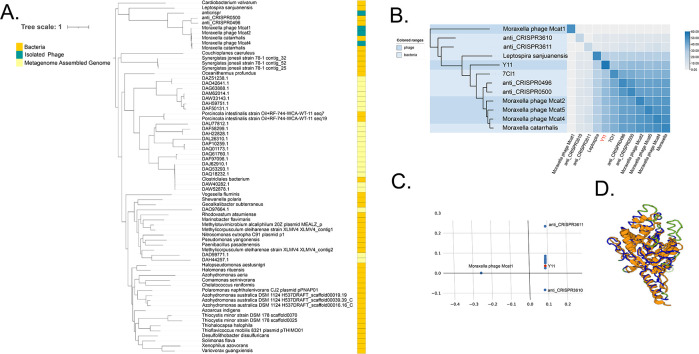
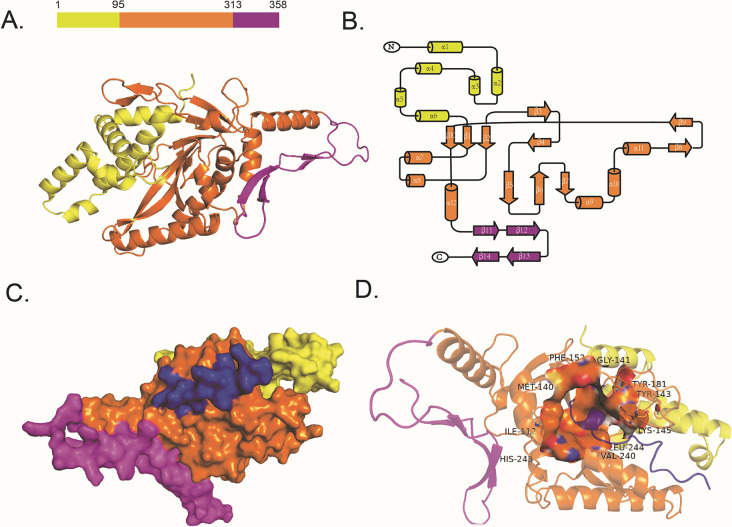
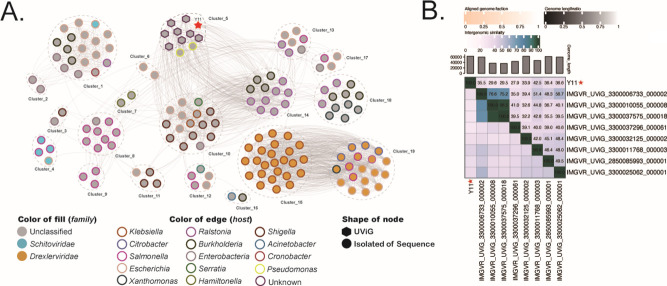
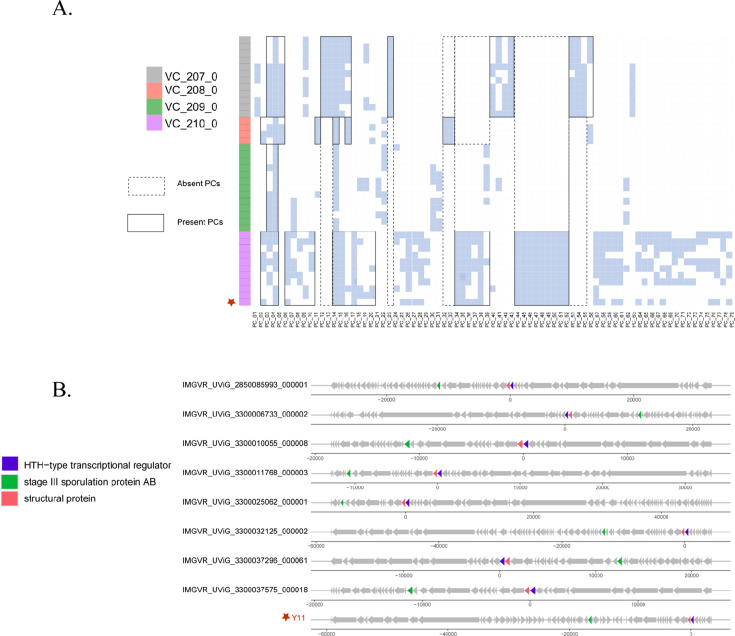
is a prevalent bacterial genus in deep-sea environments including marine sediments, exhibiting diverse metabolic capabilities that indicate its significant contributions to the marine biogeochemical cycles. However, only a few phages were isolated and deposited in the NCBI database. In this study, we report the isolation and characterization of a novel phage, vB_SbaS_Y11, that infects and was isolated from the sewage in Qingdao, China. Transmission electron microscopy revealed that vB_SbaS_Y11 has an icosahedral head and a long tail. The genome of vB_SbaS_Y11 is a linear, double-stranded DNA with a length of 62,799 bp and a G+C content of 46.9%, encoding 71 putative open reading frames. No tRNA genes or integrase-related feature genes were identified. An uncharacterized anti-CRISPR gene was detected in its genome. Phylogenetic analysis based on the amino acid sequences of whole genomes and comparative genomic analyses indicate that vB_SbaS_Y11 has a novel genomic architecture and shares low similarity to virus H66 and phage F116. vB_SbaS_Y11 represents a potential new family-level virus cluster with eight metagenomic assembled viral genomes named .IMPORTANCEThe Gram-negative bacterial genus currently includes about 80 species of mostly aquatic , which were isolated around the globe in a multitude of environments, such as freshwater, seawater, coastal sediments, and the deepest trenches. Here, we present a phage vB_SbaS_Y11 that contains an uncharacterized anti-CRISPR gene and belongs to a potential virus family, . This study will enhance the knowledge about the genome, diversity, taxonomic classification, and global distribution of phage populations.
是深海环境中一种普遍存在的细菌属,具有多样化的代谢能力,表明其对海洋生物地球化学循环有重要贡献。然而,仅有少数噬菌体被分离并保藏在 NCBI 数据库中。本研究报告了一种新型噬菌体 vB_SbaS_Y11 的分离和特性,该噬菌体感染并从中国青岛的污水中分离得到。透射电子显微镜显示,vB_SbaS_Y11 具有二十面体头部和长尾巴。vB_SbaS_Y11 的基因组是一条线性的双链 DNA,长度为 62799bp,GC 含量为 46.9%,编码 71 个可能的开放阅读框。未发现 tRNA 基因或整合酶相关特征基因。在其基因组中检测到一个未表征的抗 CRISPR 基因。基于全基因组的氨基酸序列和比较基因组分析的系统发育分析表明,vB_SbaS_Y11 具有新颖的基因组结构,与噬菌体 H66 和噬菌体 F116 相似度较低。vB_SbaS_Y11 代表一个潜在的新家族水平病毒群,包含八个基于宏基因组组装的病毒基因组,命名为 。
重要性:目前革兰氏阴性 细菌属约包含 80 个种,主要为水生 ,这些种在全球各种环境中被分离出来,如淡水、海水、沿海沉积物和最深的海沟。在这里,我们介绍了一种噬菌体 vB_SbaS_Y11,它含有一个未表征的抗 CRISPR 基因,属于一个潜在的病毒家族 。本研究将提高对噬菌体种群的基因组、多样性、分类学分类和全球分布的认识。