Wang Shidong, Teng Hong, Zhang Lin, Wu Liang
Department of Respiratory Medicine, Shaoxing Second Hospital, Shaoxing, 312000, PR China.
Department of Respiratory and Critical Care Medicine, The Affiliated Cangnan Hospital of Wenzhou Medical University, Cangnan, Zhejiang, 325800, PR China.
World Allergy Organ J. 2024 Jan 4;17(1):100851. doi: 10.1016/j.waojou.2023.100851. eCollection 2024 Jan.
Chronic respiratory diseases (CRDs) pose a significant global health burden. Antioxidant-rich diets have been associated with improved lung health, but the specific relationship with CRDs remains unclear.
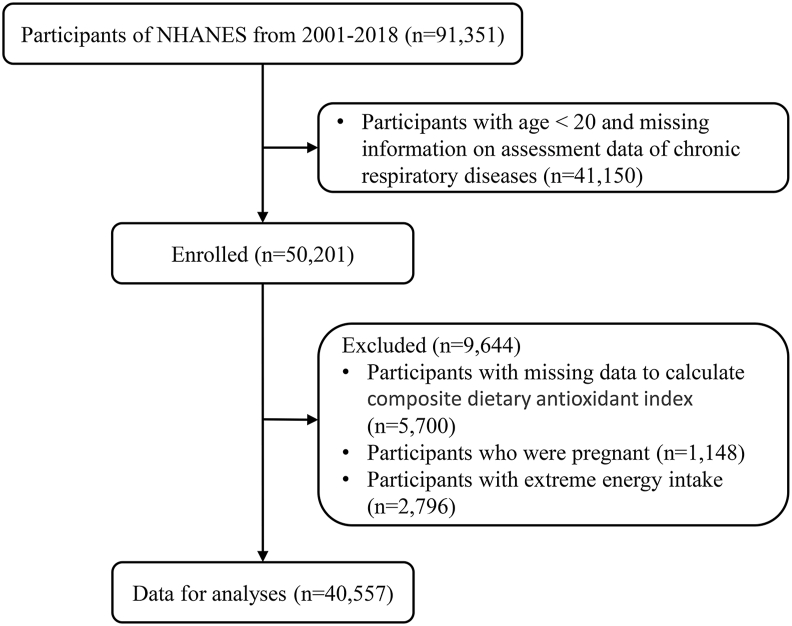
This study examined the relationship between dietary antioxidant intakes and CRDs using data from the 2001-2018 National Health and Nutrition Examination Survey (NHANES). Information on dietary antioxidant intakes, including vitamins A, C, and E, zinc, selenium, and carotenoid, were collected from the 2 24-h recall interviews to calculate composite dietary antioxidant index (CDAI). CRDs were determined based on self-reported physician diagnoses. To examine the relationship between CDAI and CRDs, multivariate logistic regression was used. To study potential non-linear correlations within these associations, restricted cubic spline (RCS) regression was performed.
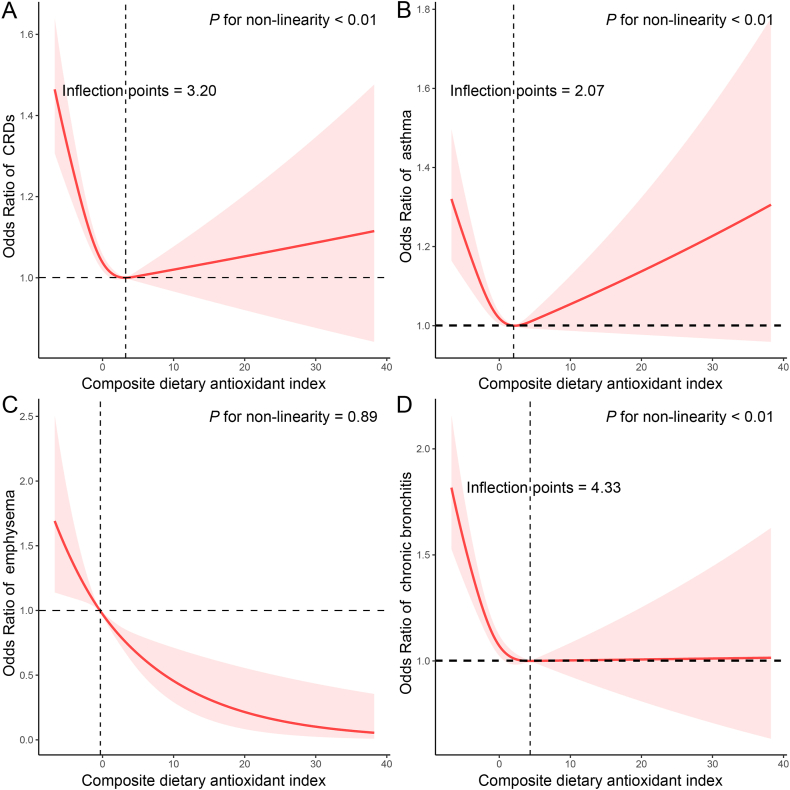
The study involved 40 557 individuals. The median CDAI was -0.09 (-2.05, 2.25). We discovered those who were in the fourth quartile of CDAI scores had a 19% lower prevalence than those in the first quartile (OR = 0.81 [0.72-0.91], < 0.01) after adjusting for all relevant covariates. The fourth quartile of CDAI was linked with a lower prevalence of emphysema (OR = 0.57 [0.40-0.81], < 0.01) and chronic bronchitis (OR = 0.74 [0.62-0.88], < 0.01). RCS regression showed that CDAI was non-linearly related to the prevalence of CRDs, with inflection points of 3.20 ( for non-linearity <0.01). The stratified analysis did not identify variables that significantly affected the results.
Higher dietary antioxidant intakes were related with a lower prevalence of CRDs (particularly emphysema and chronic bronchitis) in general adults.
慢性呼吸道疾病(CRD)给全球健康带来了重大负担。富含抗氧化剂的饮食与改善肺部健康有关,但与CRD的具体关系仍不明确。
本研究使用2001 - 2018年美国国家健康和营养检查调查(NHANES)的数据,研究饮食抗氧化剂摄入量与CRD之间的关系。从两次24小时回忆访谈中收集饮食抗氧化剂摄入量的信息,包括维生素A、C和E、锌、硒和类胡萝卜素,以计算综合饮食抗氧化指数(CDAI)。CRD根据自我报告的医生诊断确定。为了研究CDAI与CRD之间的关系,使用了多因素逻辑回归。为了研究这些关联中的潜在非线性相关性,进行了受限立方样条(RCS)回归。
该研究涉及40557名个体。CDAI的中位数为 -0.09(-2.05,2.25)。我们发现,在调整所有相关协变量后,CDAI得分处于第四四分位数的人群患病率比第一四分位数的人群低19%(OR = 0.81 [0.72 - 0.91],P < 0.01)。CDAI的第四四分位数与肺气肿患病率较低(OR = 0.57 [0.40 - 0.81],P < 0.01)和慢性支气管炎患病率较低(OR = 0.74 [0.62 - 0.88],P < 0.01)相关。RCS回归显示,CDAI与CRD患病率呈非线性关系,拐点为3.20(非线性检验P < 0.01)。分层分析未发现显著影响结果的变量。
一般成年人中,较高的饮食抗氧化剂摄入量与较低的CRD患病率(特别是肺气肿和慢性支气管炎)相关。