Aydemir Yusuf, Aydemir Ozge, Dinleyici Meltem, Saglik Adviye Cakil, Cam Demet, Kaya Tugba Barsan, Canpolat Fuat Emre
Faculty of Medicine Department of Pediatrics, Division of Gastroenterology and Hepatology, Eskisehir Osmangazi University, Meselik, 26040, Eskisehir, Turkey.
Faculty of Medicine Department of Pediatrics, Division of Neonatology, Eskisehir Osmangazi University, Eskisehir, Turkey.
Eur J Pediatr. 2024 May;183(5):2091-2099. doi: 10.1007/s00431-024-05451-4. Epub 2024 Feb 12.
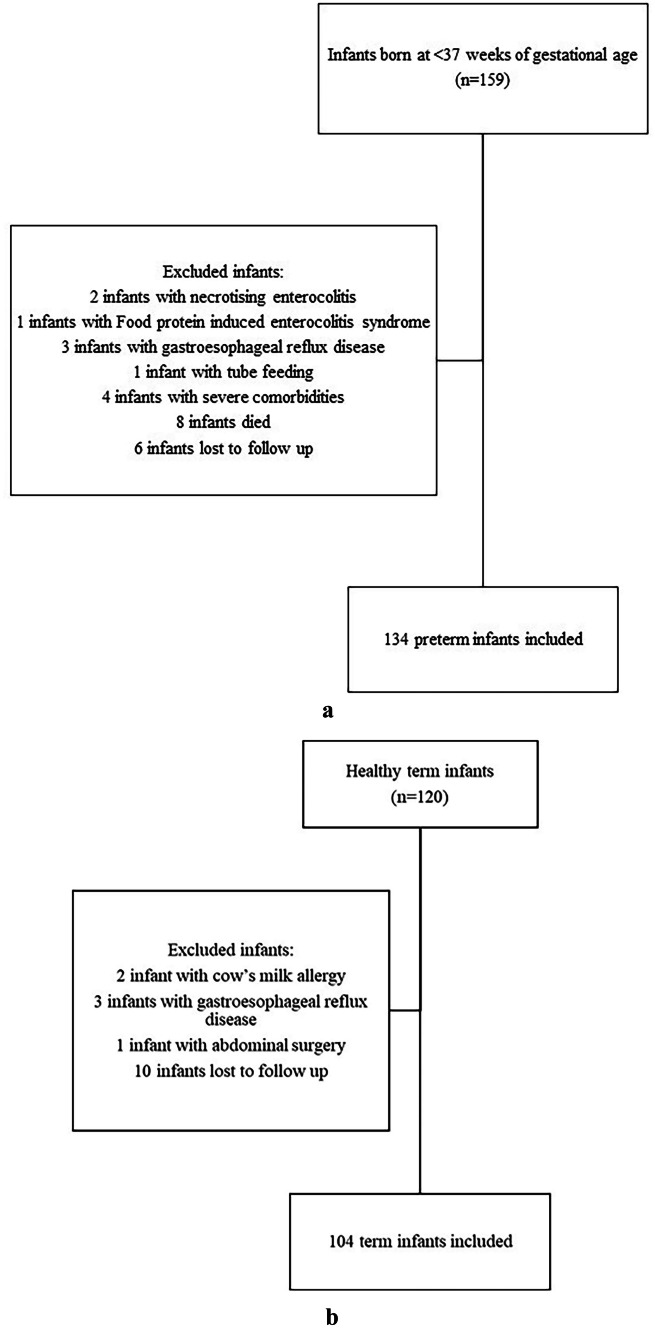
Functional gastrointestinal disorders (FGIDs) are characterized by a variety of symptoms that are frequently age-dependent, chronic, or recurrent and are not explained by structural or biochemical abnormalities. There are studies in the literature reporting different results regarding the relationship between prematurity and FGIDs. The main objective of this study was to compare the frequency of FGIDs between preterm and term infants. The secondary objective was to evaluate whether there was any association between neonatal characteristics and development of FGIDs. A multicenter prospective cohort study that included preterm infants born before 37 weeks of gestation and healthy term infants was carried out. At 1, 2, 4, 6, 9, and 12 months of age, infants were assessed for the presence of FGIDs using the Rome IV criteria. In preterm infants, an additional follow-up visit was made at 12 months corrected age. 134 preterm and 104 term infants were enrolled in the study. Infantile colic, rumination syndrome, functional constipation, and infant dyschezia were more common in preterm infants. Incidence of other FGIDs (infant regurgitation, functional diarrhea and cyclic vomiting syndrome) were similar among preterm and term infants. Preterm infants who are exclusively breastfeed in the first 6 months of life have a lower incidence of infantile colic (18.8% vs 52.1%, p = 0.025). In terms of chronological age, FGIDs symptoms started later in preterm infants; this difference was statistically significant for infantile colic and regurgitation (median age 2 months vs 1 month, p < 0.001). Conclusions: Preterm infants have a higher prevalence of FGIDs compared with term controls. Therefore, especially if they have gastrointestinal complaints, they should be screened for FGIDs. Possibly due to maturational differences, the time of occurrence of FGIDs may differ in preterm infants. Infantile colic incidence decreases with exclusive breastfeeding. What is Known: • The functional gastrointestinal disorders are a very common in infancy. • Data on preterm infants with FGIDs are currently very limited. What is New: • Preterm infants have a higher incidence of infantile colic, rumination syndrome, functional constipation and infant dyschezia when compared to term infants. • Preterm infants who are exclusively breastfed during the first 6 months of life experience a lower incidence of infantile colic.
功能性胃肠疾病(FGIDs)的特征是出现多种症状,这些症状通常与年龄相关、呈慢性或复发性,且无法用结构或生化异常来解释。文献中有研究报告了关于早产与FGIDs之间关系的不同结果。本研究的主要目的是比较早产儿和足月儿中FGIDs的发生率。次要目的是评估新生儿特征与FGIDs发生之间是否存在关联。开展了一项多中心前瞻性队列研究,纳入了妊娠37周前出生的早产儿和健康足月儿。在婴儿1、2、4、6、9和12月龄时,使用罗马IV标准评估是否存在FGIDs。对于早产儿,在矫正年龄12个月时进行了额外的随访。134名早产儿和104名足月儿纳入了本研究。婴儿腹绞痛、反刍综合征、功能性便秘和婴儿排便困难在早产儿中更为常见。其他FGIDs(婴儿反流、功能性腹泻和周期性呕吐综合征)的发生率在早产儿和足月儿中相似。在出生后前6个月纯母乳喂养的早产儿婴儿腹绞痛发生率较低(18.8%对52.1%,p = 0.025)。按实际年龄计算,FGIDs症状在早产儿中出现得较晚;这种差异在婴儿腹绞痛和反流方面具有统计学意义(中位年龄2个月对1个月,p < 0.001)。结论:与足月儿对照组相比,早产儿中FGIDs的患病率更高。因此,尤其是如果他们有胃肠道不适,应进行FGIDs筛查。可能由于成熟度差异,FGIDs在早产儿中的发生时间可能不同。纯母乳喂养可降低婴儿腹绞痛的发生率。已知信息:• 功能性胃肠疾病在婴儿期非常常见。• 目前关于患有FGIDs的早产儿的数据非常有限。新发现:• 与足月儿相比,早产儿中婴儿腹绞痛、反刍综合征、功能性便秘和婴儿排便困难的发生率更高。• 在出生后前6个月纯母乳喂养的早产儿婴儿腹绞痛发生率较低。