Institute for Diagnostic and Interventional Radiology, Universitätsmedizin Göttingen, Göttingen, Germany.
German Centre for Cardiovascular Research (DZHK), Partner Site Göttingen, Göttingen, Germany.
Sci Rep. 2024 Feb 14;14(1):3754. doi: 10.1038/s41598-024-54164-z.
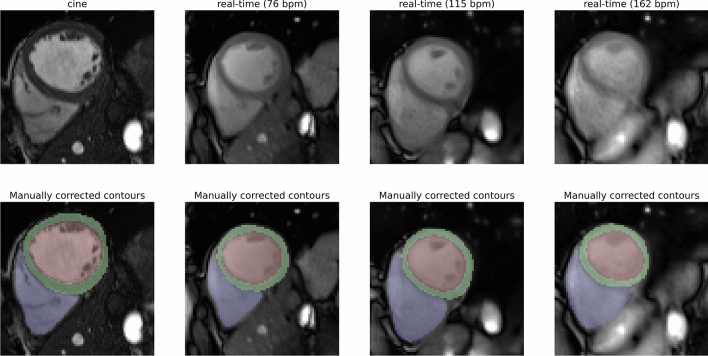
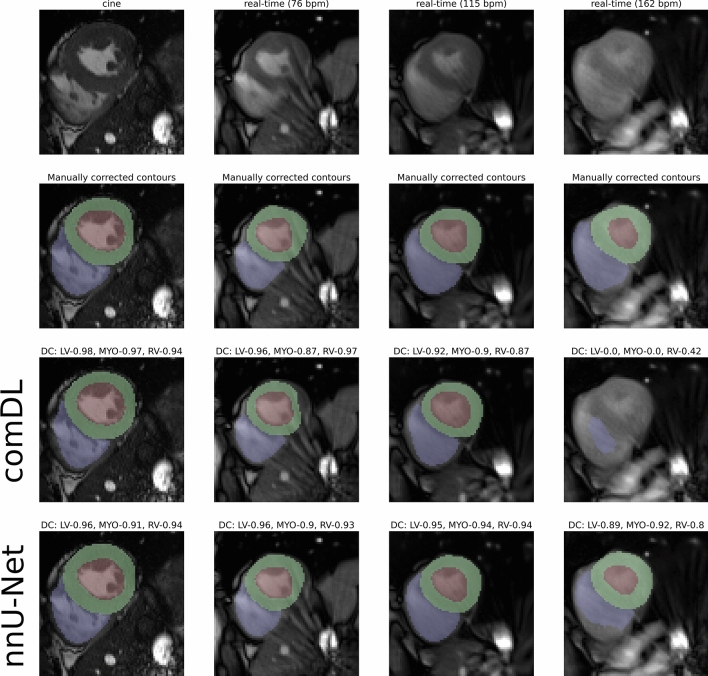
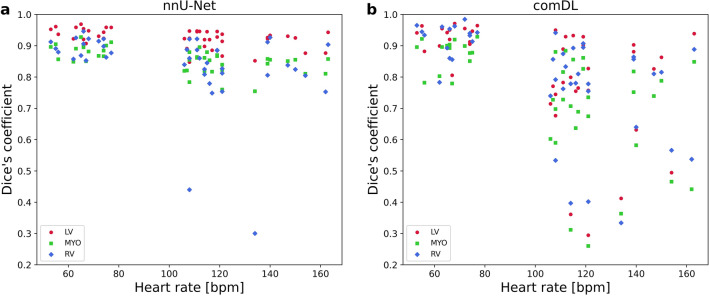
In recent years, a variety of deep learning networks for cardiac MRI (CMR) segmentation have been developed and analyzed. However, nearly all of them are focused on cine CMR under breathold. In this work, accuracy of deep learning methods is assessed for volumetric analysis (via segmentation) of the left ventricle in real-time free-breathing CMR at rest and under exercise stress. Data from healthy volunteers (n = 15) for cine and real-time free-breathing CMR at rest and under exercise stress were analyzed retrospectively. Exercise stress was performed using an ergometer in the supine position. Segmentations of two deep learning methods, a commercially available technique (comDL) and an openly available network (nnU-Net), were compared to a reference model created via the manual correction of segmentations obtained with comDL. Segmentations of left ventricular endocardium (LV), left ventricular myocardium (MYO), and right ventricle (RV) are compared for both end-systolic and end-diastolic phases and analyzed with Dice's coefficient. The volumetric analysis includes the cardiac function parameters LV end-diastolic volume (EDV), LV end-systolic volume (ESV), and LV ejection fraction (EF), evaluated with respect to both absolute and relative differences. For cine CMR, nnU-Net and comDL achieve Dice's coefficients above 0.95 for LV and 0.9 for MYO, and RV. For real-time CMR, the accuracy of nnU-Net exceeds that of comDL overall. For real-time CMR at rest, nnU-Net achieves Dice's coefficients of 0.94 for LV, 0.89 for MYO, and 0.90 for RV and the mean absolute differences between nnU-Net and the reference are 2.9 mL for EDV, 3.5 mL for ESV, and 2.6% for EF. For real-time CMR under exercise stress, nnU-Net achieves Dice's coefficients of 0.92 for LV, 0.85 for MYO, and 0.83 for RV and the mean absolute differences between nnU-Net and reference are 11.4 mL for EDV, 2.9 mL for ESV, and 3.6% for EF. Deep learning methods designed or trained for cine CMR segmentation can perform well on real-time CMR. For real-time free-breathing CMR at rest, the performance of deep learning methods is comparable to inter-observer variability in cine CMR and is usable for fully automatic segmentation. For real-time CMR under exercise stress, the performance of nnU-Net could promise a higher degree of automation in the future.
近年来,已经开发和分析了各种用于心脏 MRI(CMR)分割的深度学习网络。然而,几乎所有这些网络都专注于门控下的电影 CMR。在这项工作中,评估了深度学习方法在静息和运动应激下实时自由呼吸 CMR 的左心室容积分析(通过分割)的准确性。对健康志愿者(n=15)的电影和实时自由呼吸 CMR 在静息和运动应激下的数据进行了回顾性分析。运动应激是在仰卧位使用测力计进行的。比较了两种深度学习方法(一种商业上可用的技术(comDL)和一种公开可用的网络(nnU-Net))的分割结果,以及通过手动校正 comDL 获得的分割结果创建的参考模型。比较了左心室心内膜(LV)、左心室心肌(MYO)和右心室(RV)的分割,用于收缩末期和舒张末期相位,并通过 Dice 系数进行分析。容积分析包括心脏功能参数左心室舒张末期容积(EDV)、左心室收缩末期容积(ESV)和左心室射血分数(EF),并考虑了绝对和相对差异。对于电影 CMR,nnU-Net 和 comDL 对于 LV 和 MYO,RV 的 Dice 系数均超过 0.95。对于实时 CMR,nnU-Net 的准确性总体上超过 comDL。对于静息时的实时 CMR,nnU-Net 对 LV 的 Dice 系数为 0.94,对 MYO 的 Dice 系数为 0.89,对 RV 的 Dice 系数为 0.90,nnU-Net 与参考之间的平均绝对差异为 EDV 为 2.9mL,ESV 为 3.5mL,EF 为 2.6%。对于运动应激下的实时 CMR,nnU-Net 对 LV 的 Dice 系数为 0.92,对 MYO 的 Dice 系数为 0.85,对 RV 的 Dice 系数为 0.83,nnU-Net 与参考之间的平均绝对差异为 EDV 为 11.4mL,ESV 为 2.9mL,EF 为 3.6%。专为电影 CMR 分割设计或训练的深度学习方法可以在实时 CMR 上表现良好。对于静息时的实时自由呼吸 CMR,深度学习方法的性能可与电影 CMR 中的观察者间变异性相媲美,可用于全自动分割。对于运动应激下的实时 CMR,nnU-Net 的性能有望在未来实现更高程度的自动化。