Cortes-Alvarez Salma I, Delgado-Enciso Ivan, Rodriguez-Hernandez Alejandrina, Hernandez-Fuentes Gustavo A, Aurelien-Cabezas Nomely S, Moy-Lopez Norma A, Cortes-Alvarez Nadia Y, Guzman-Muñiz Jorge, Guzman-Esquivel Jose, Rodriguez-Sanchez Iram P, Martinez-Fierro Margarita L, Mokay-Ramirez Karen A, Barajas-Saucedo Carlos E, Sanchez-Ramirez Carmen A
Department of Molecular Medicine and Nutrition Laboratory at School of Medicine, University of Colima, Colima, Colima, Mexico.
Department of Research, Cancerology State Institute, Colima State Health Services, Colima, Colima, Mexico.
J Nutr Metab. 2024 Feb 12;2024:2209581. doi: 10.1155/2024/2209581. eCollection 2024.
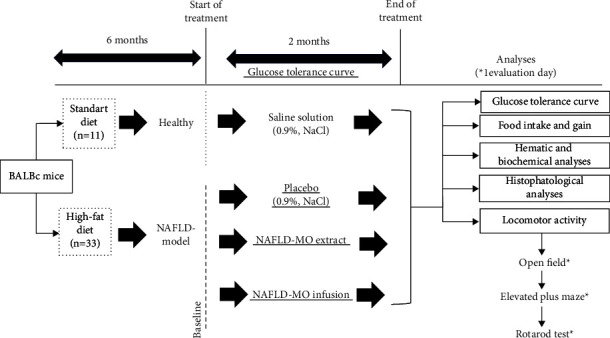
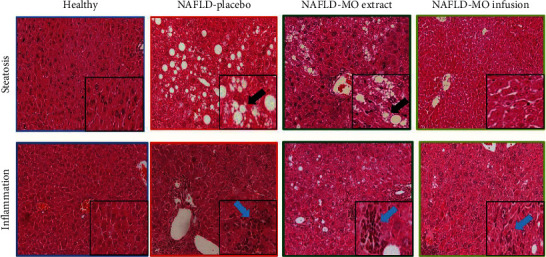
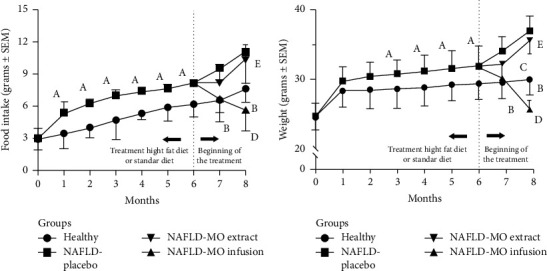
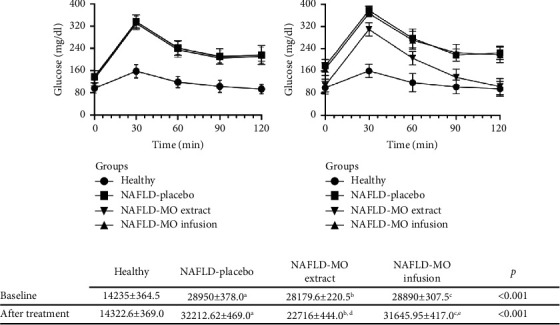
(MO) is a native tree of Asia and is cultivated in some areas of Mexico as part of traditional horticulture. The aim of the present study was to compare the efficacy of MO infusion vs. MO ethanolic extract for the simultaneous treatment of nonalcoholic fatty liver (NAFLD), hyperlipidemia, and hyperglycemia in a murine model fed with a high-fat diet (HFD). BALB/c mice were fed a balanced diet (healthy control) or an HFD for 6 months. With this, the NAFLD model was established before starting a therapeutic intervention with MO for two months. The phytochemical analysis by nuclear magnetic resonance in H and C experiments showed signals for pyrrole alkaloids and triterpenes as the main constituents of the extract and infusion preparation. A significant reduction of SGPT, SGOT, lipids, urea, and glucose in blood among NAFLD groups treated with MO (infusion or extract) was found, when compared to the NAFLD-placebo group. Steatosis and liver inflammation were found to be decreased in the MO groups, as infusion or ethanolic extract. Infusion produced a better therapeutic effect than the extract in all parameters, except glycemic control, where the extract was better. As an additional finding, it is noteworthy that treatment with MO, particularly through infusion, resulted in improved motor activity. Moreover, a reduction in anxiety-like behavior was observed exclusively with the administration of infusion. These observations provide valuable insights into the potential broader effects of beyond the primary aim of the study.
(MO)是一种亚洲本土树木,在墨西哥的一些地区作为传统园艺的一部分进行种植。本研究的目的是比较MO浸液与MO乙醇提取物在高脂饮食(HFD)喂养的小鼠模型中同时治疗非酒精性脂肪性肝病(NAFLD)、高脂血症和高血糖症的疗效。将BALB/c小鼠喂食均衡饮食(健康对照)或HFD 6个月。由此,在开始用MO进行两个月的治疗干预之前建立了NAFLD模型。通过氢和碳实验中的核磁共振进行的植物化学分析显示,吡咯生物碱和三萜类化合物的信号是提取物和浸液制剂的主要成分。与NAFLD安慰剂组相比,在用MO(浸液或提取物)治疗的NAFLD组中,血液中的谷丙转氨酶、谷草转氨酶、脂质、尿素和葡萄糖显著降低。发现MO组(浸液或乙醇提取物)的脂肪变性和肝脏炎症有所减轻。除血糖控制方面提取物更好外,浸液在所有参数上产生的治疗效果均优于提取物。作为一项额外发现,值得注意的是,用MO治疗,特别是通过浸液治疗,可改善运动活动。此外,仅在给予浸液时观察到焦虑样行为减少。这些观察结果为超出研究主要目的的潜在更广泛影响提供了有价值的见解。