Fanshawe Jack B, Sargent Brendan F, Badenoch James B, Saini Aman, Watson Cameron J, Pokrovskaya Aleksandra, Aniwattanapong Daruj, Conti Isabella, Nye Charles, Burchill Ella, Hussain Zain U, Said Khanafi, Kuhoga Elinda, Tharmaratnam Kukatharmini, Pendered Sophie, Mbwele Bernard, Taquet Maxime, Wood Greta K, Rogers Jonathan P, Hampshire Adam, Carson Alan, David Anthony S, Michael Benedict D, Nicholson Timothy R, Paddick Stella-Maria, Leek Charles E
Department of Psychiatry, University of Oxford, Oxford, UK.
Oxford Health NHS Foundation Trust, Oxford, UK.
Eur J Neurol. 2025 Jan;32(1):e16181. doi: 10.1111/ene.16181. Epub 2024 Feb 20.
This review aims to characterize the pattern of post-COVID-19 cognitive impairment, allowing better prediction of impact on daily function to inform clinical management and rehabilitation.
A systematic review and meta-analysis of neurocognitive sequelae following COVID-19 was conducted, following PRISMA-S guidelines. Studies were included if they reported domain-specific cognitive assessment in patients with COVID-19 at >4 weeks post-infection. Studies were deemed high-quality if they had >40 participants, utilized healthy controls, had low attrition rates and mitigated for confounders.
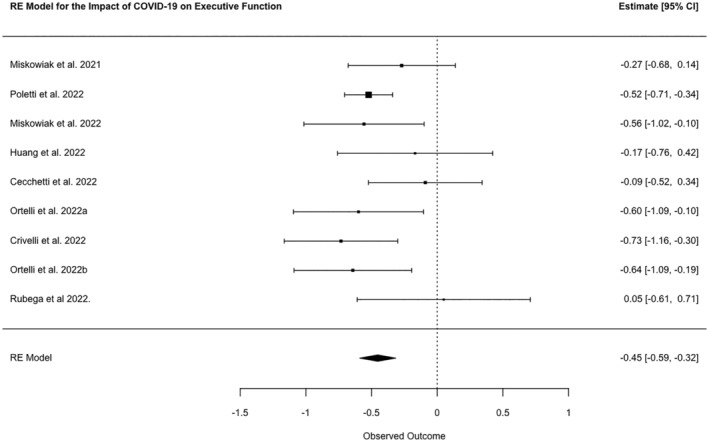
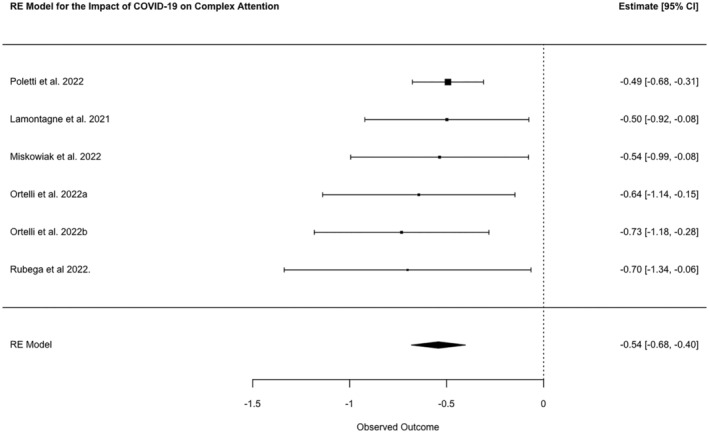
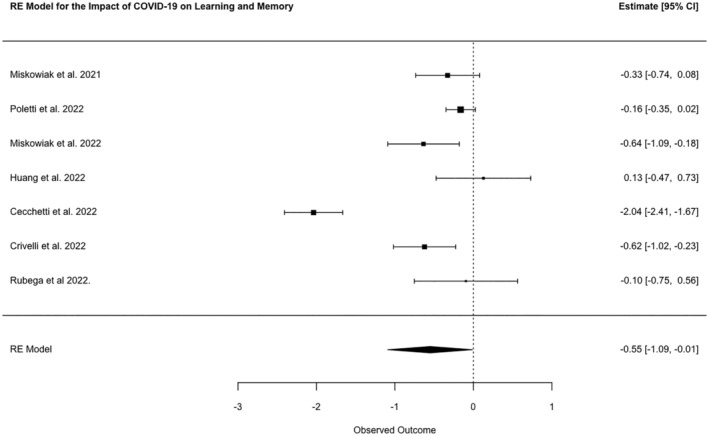
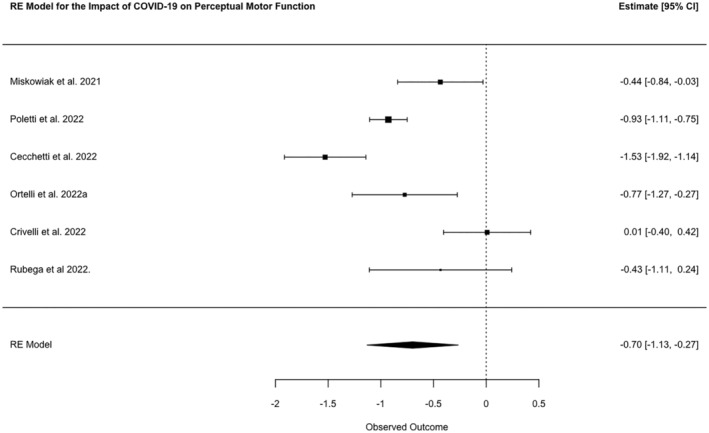
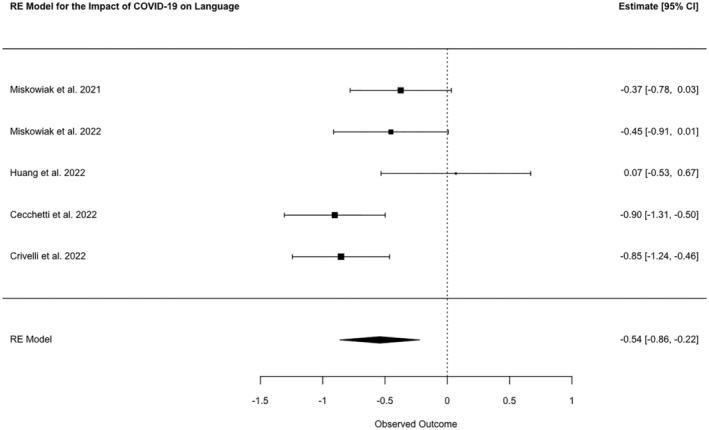
Five of the seven primary Diagnostic and Statistical Manual of Mental Disorders (DSM-5) cognitive domains were assessed by enough high-quality studies to facilitate meta-analysis. Medium effect sizes indicating impairment in patients post-COVID-19 versus controls were seen across executive function (standardised mean difference (SMD) -0.45), learning and memory (SMD -0.55), complex attention (SMD -0.54) and language (SMD -0.54), with perceptual motor function appearing to be impacted to a greater degree (SMD -0.70). A narrative synthesis of the 56 low-quality studies also suggested no obvious pattern of impairment.
This review found moderate impairments across multiple domains of cognition in patients post-COVID-19, with no specific pattern. The reported literature was significantly heterogeneous, with a wide variety of cognitive tasks, small sample sizes and disparate initial disease severities limiting interpretability. The finding of consistent impairment across a range of cognitive tasks suggests broad, as opposed to domain-specific, brain dysfunction. Future studies should utilize a harmonized test battery to facilitate inter-study comparisons, whilst also accounting for the interactions between COVID-19, neurological sequelae and mental health, the interplay between which might explain cognitive impairment.
本综述旨在描述新冠病毒感染后认知障碍的模式,以便更好地预测其对日常功能的影响,为临床管理和康复提供依据。
按照PRISMA-S指南,对新冠病毒感染后的神经认知后遗症进行系统综述和荟萃分析。纳入的研究需报告感染后4周以上的新冠患者特定领域的认知评估。若研究参与者超过40名、使用了健康对照、损耗率低且对混杂因素进行了控制,则被视为高质量研究。
七项主要的《精神疾病诊断与统计手册》(第五版,DSM-5)认知领域中的五项,有足够数量的高质量研究进行评估,便于进行荟萃分析。在执行功能(标准化均数差(SMD)-0.45)、学习和记忆(SMD -0.55)、复杂注意力(SMD -0.54)和语言(SMD -0.54)方面,发现新冠病毒感染后患者与对照组相比存在中度效应大小的损害,感知运动功能似乎受到更大程度的影响(SMD -0.70)。对56项低质量研究的叙述性综合分析也未发现明显的损害模式。
本综述发现新冠病毒感染后患者在多个认知领域存在中度损害,且无特定模式。所报告的文献存在显著异质性,认知任务种类繁多、样本量小以及初始疾病严重程度各异,限制了可解释性。在一系列认知任务中发现一致的损害表明存在广泛的而非特定领域的脑功能障碍。未来的研究应采用统一的测试组合以促进研究间的比较,同时还要考虑新冠病毒感染、神经后遗症和心理健康之间的相互作用,它们之间的相互影响可能解释认知障碍。