Department of Optometry, Faculty of Rehabilitation, Shahid Beheshti University of Medical Sciences, Imam Hossein Square, Damavand Avenue, Opposite to Bouali Hospital, Tehran, 1616913111, Iran.
School of Optometry and Vision Science, Medicine & Health, University of New South Wales, Kensington, NSW, Australia.
BMC Ophthalmol. 2024 Feb 22;24(1):83. doi: 10.1186/s12886-024-03350-8.
To investigate and compare the vision-related quality of life (QOL) in different types of refractive error (RE).
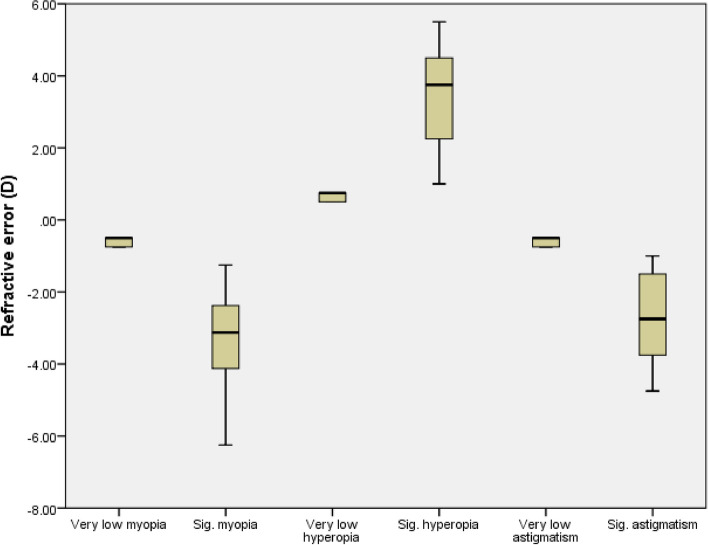
This cross-sectional study was performed on 200 subjects, categorized into four groups of 50 each, consisting of subjects with myopia, hyperopia, astigmatism, and emmetropia, the latter being the control group. The mean age of the participants was 23.88 ± 5.87 (range, 15 to 38: 110 females and 90 males). RE was defined as myopia, spherical equivalent (SE) < -0.25 diopters (D), hyperopia, SE > + 0.25 D, astigmatism, cylinder < -0.25 D, and emmetropia (-0.25 ≤ SE(D) ≤ + 0.25, cylinder ≥ -0.25). Groups are subdivided into very low magnitudes of RE (0.50 and 0.75) and significant RE (1.00 ≤). Vision-related QOL was assessed using the Persian version of the 25-item National Eye Institute Visual Functioning Questionnaire (NEI-VFQ-25). The NEI-VFQ was scored as visual function and socioemotional scales using Rasch analysis.
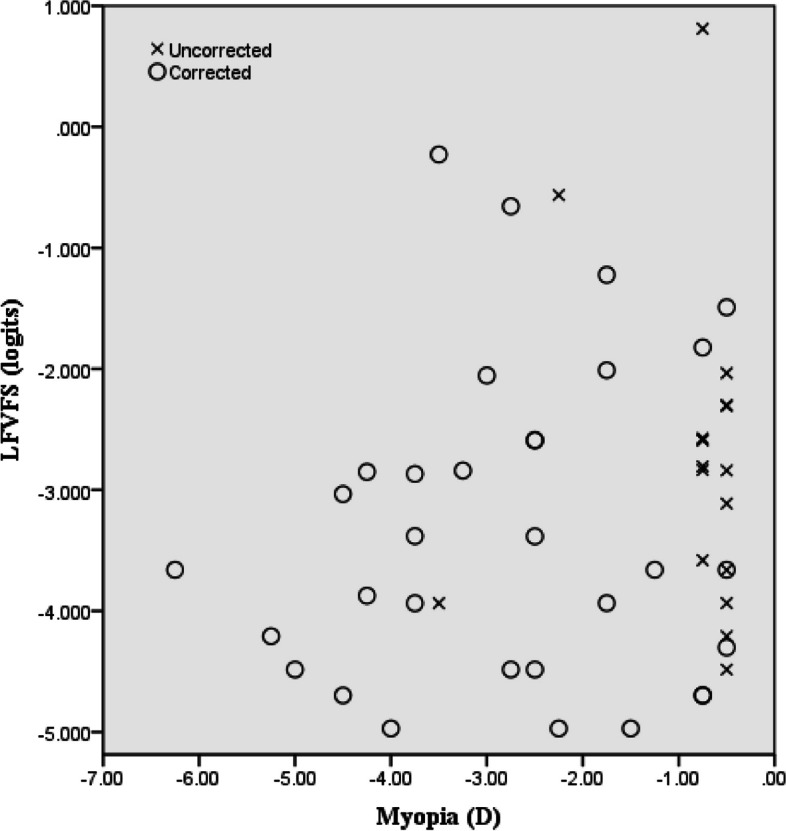
Corrected myopia, astigmatism, uncorrected myopia, and hyperopia had a lower vision-related QOL than emmetropes. (P < 0.001). Vision-related QOL in myopic subjects was lower than that in astigmatic participants. Very low myopes, who often do not use correction, had a significantly lower QOL than other groups.
Individuals with refractive errors experience a lower QOL score than those without. Notably, the adverse impact on QOL score is significantly greater in myopic cases, particularly very low myopia, compared to other refractive errors. Therefore, it is strongly recommended not to neglect managing very low myopia since it may improve participants' QOL.
研究和比较不同类型屈光不正(RE)的视觉相关生活质量(QOL)。
本横断面研究纳入 200 名受试者,分为 4 组,每组 50 人,包括近视、远视、散光和正视组,后者为对照组。参与者的平均年龄为 23.88 ± 5.87 岁(范围为 15 至 38 岁:110 名女性和 90 名男性)。RE 定义为近视,等效球镜(SE)< -0.25 屈光度(D),远视,SE > + 0.25 D,散光,柱镜 < -0.25 D,正视(-0.25 ≤ SE(D)≤ + 0.25,柱镜≥-0.25)。各组进一步分为低度数 RE(0.50 和 0.75)和高度数 RE(1.00 ≤)。使用波斯语版 25 项国家眼科研究所视觉功能问卷(NEI-VFQ-25)评估与视觉相关的 QOL。使用 Rasch 分析对 NEI-VFQ 进行视觉功能和社会情感量表评分。
矫正近视、散光、未矫正近视和远视的与视觉相关的 QOL 低于正视者。(P < 0.001)。近视患者的视觉相关 QOL 低于散光患者。很少使用矫正的低度近视患者的 QOL 明显低于其他组。
与正视者相比,屈光不正患者的 QOL 评分较低。值得注意的是,与其他屈光不正相比,近视患者的 QOL 评分下降幅度更大,尤其是非常低度近视。因此,强烈建议不要忽视管理非常低度近视,因为这可能会提高参与者的 QOL。