Mohebbi Elaheh, Pavoni Eleonora, Pierantoni Luca, Stipa Pierluigi, Hemmetter Andreas, Laudadio Emiliano, Mencarelli Davide
Department of Science and Engineering of Matter, Environment and Urban Planning (SIMAU), Marche Polytechnic University 60131 Ancona Italy
Information Engineering Department, Marche Polytechnic University 60131 Ancona Italy.
Nanoscale Adv. 2024 Feb 19;6(5):1548-1555. doi: 10.1039/d3na00603d. eCollection 2024 Feb 27.
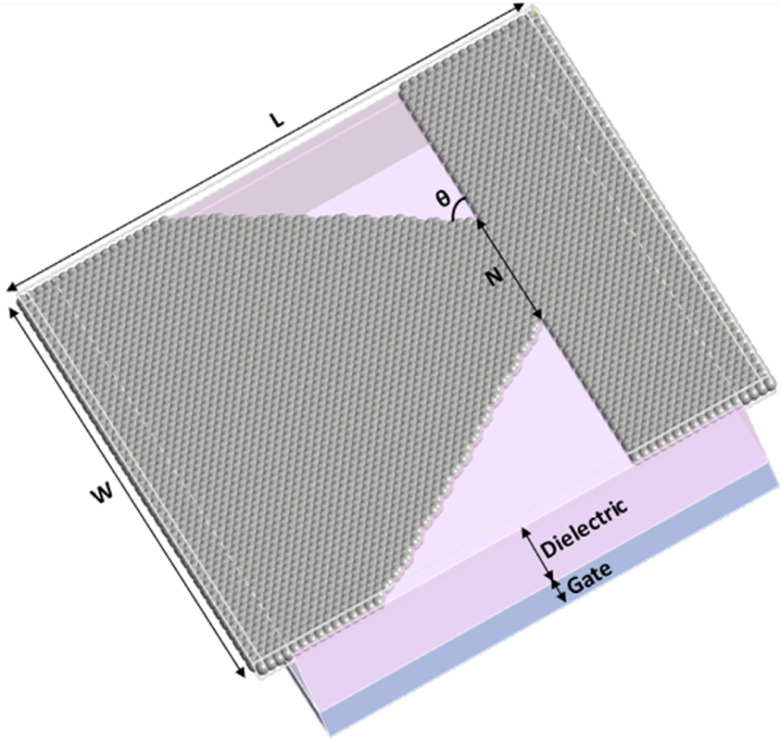
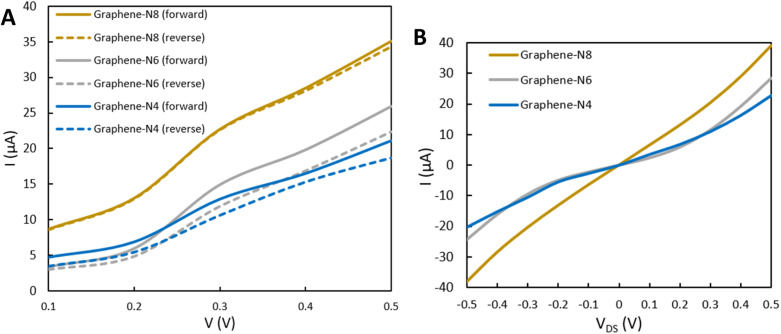
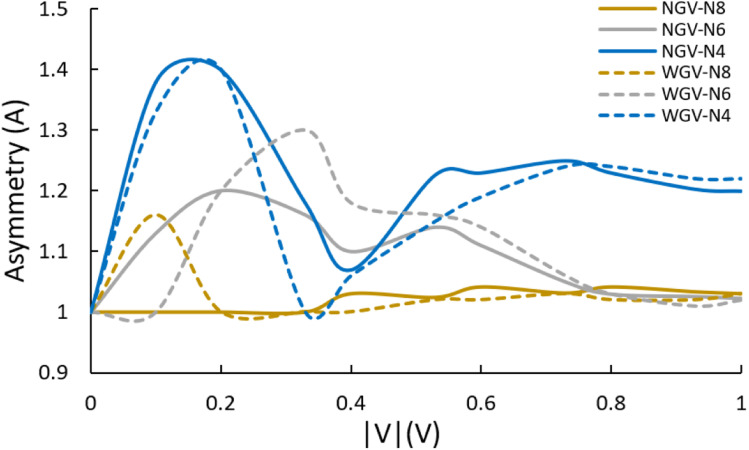
Self-consistent charge density functional tight-binding (DFTB) calculations have been performed to investigate the electrical properties and transport behavior of asymmetric graphene devices (AGDs). Three different nanodevices constructed of different necks of 8 nm, 6 nm and 4 nm, named Graphene-N8, Graphene-N6 and Graphene-N4, respectively, have been proposed. All devices have been tested under two conditions of zero gate voltage and an applied gate voltage of +20 V using a dielectric medium of 3.9 epsilon interposed between the graphene and the metallic gate. As expected, the results of AGD diodes exhibited strong asymmetric () characteristic curves in good agreement with the available experimental data. Our predictions implied that Graphene-N4 would achieve great asymmetry () of 1.40 at || = 0.2 V with maximum transmittance () of 6.72 in the energy range 1.30 eV. More importantly, while the of Graphene-N4 was slightly changed by applying the gate voltage, Graphene-N6/Graphene-N8 showed a significant effect with their increased from 1.20/1.03 under no gate voltage (NGV) to 1.30/1.16 under gate voltage (WGV) conditions. Our results open up unprecedented numerical prospects for designing tailored geometric diodes.
已进行自洽电荷密度泛函紧束缚(DFTB)计算,以研究不对称石墨烯器件(AGD)的电学性质和输运行为。提出了三种由8纳米、6纳米和4纳米不同颈部构成的不同纳米器件,分别命名为石墨烯-N8、石墨烯-N6和石墨烯-N4。所有器件均在零栅极电压和+20 V外加栅极电压这两种条件下进行测试,使用置于石墨烯和金属栅极之间的介电常数为3.9ε的电介质。正如预期的那样,AGD二极管的结果显示出强烈的不对称()特性曲线,与现有实验数据高度吻合。我们的预测表明,石墨烯-N4在|| = 0.2 V时将实现1.40的极大不对称(),在1.30 eV能量范围内最大透射率()为6.72。更重要的是,虽然石墨烯-N4的 通过施加栅极电压略有变化,但石墨烯-N6/石墨烯-N8显示出显著影响,其 在无栅极电压(NGV)下从1.20/1.03增加到栅极电压(WGV)条件下的1.30/1.16。我们的结果为设计定制几何二极管开辟了前所未有的数值前景。