Yamazaki Yuriko, Ito Tomoka, Tamai Masakazu, Nakagawa Seitaro, Nakamura Yuumi
Cutaneous Allergy and Host Defense, Immunology Frontier Research Center, Osaka, University, Osaka, 565-0871, Japan.
Department of Dermatology, Osaka University Graduate School of Medicine, Osaka, 565-0871, Japan.
Inflamm Regen. 2024 Mar 1;44(1):9. doi: 10.1186/s41232-024-00323-8.
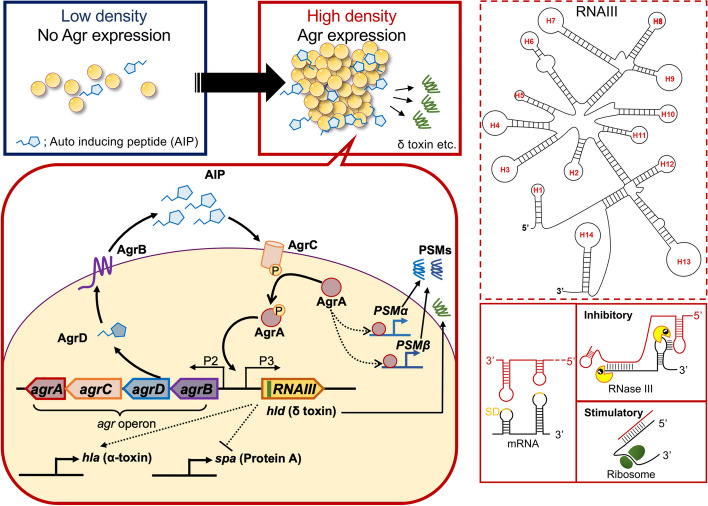
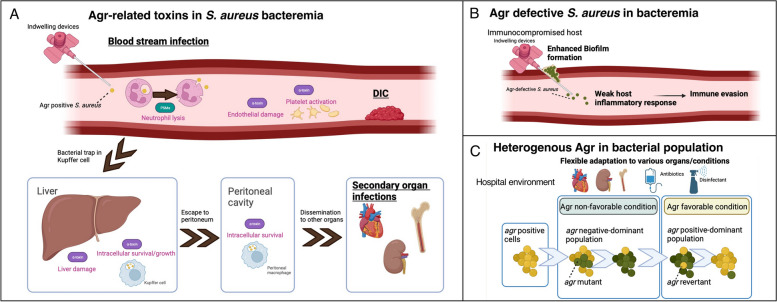
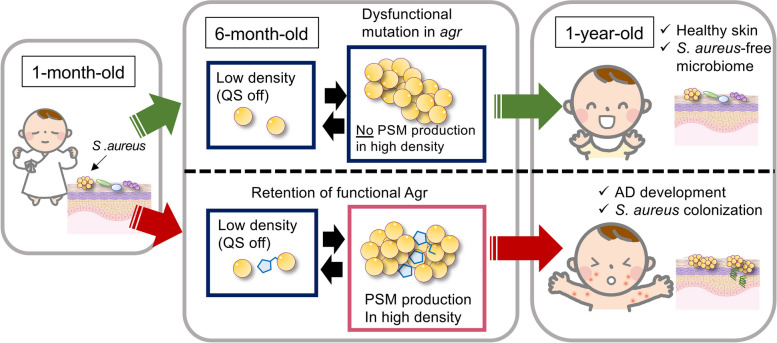
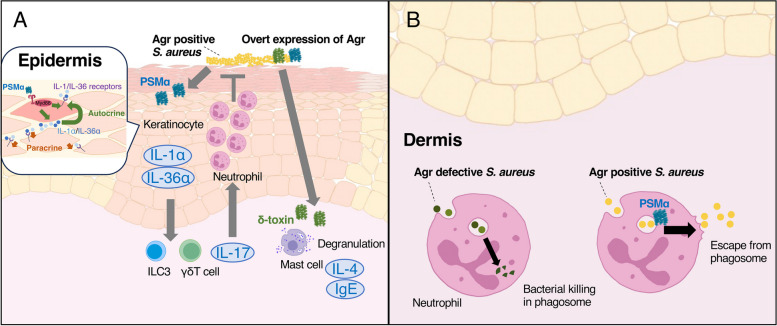
Staphylococcus aureus is a leading cause of human bacterial infections worldwide. It is the most common causative agent of skin and soft tissue infections, and can also cause various other infections, including pneumonia, osteomyelitis, as well as life-threatening infections, such as sepsis and infective endocarditis. The pathogen can also asymptomatically colonize human skin, nasal cavity, and the intestine. S. aureus colonizes approximately 20-30% of human nostrils, being an opportunistic pathogen for subsequent infection. Its strong ability to silently spread via human contact makes it difficult to eradicate S. aureus. A major concern with S. aureus is its capacity to develop antibiotic resistance and adapt to diverse environmental conditions. The variability in the accessory gene regulator (Agr) region of the genome contributes to a spectrum of phenotypes within the bacterial population, enhancing the likelihood of survival in different environments. Agr functions as a central quorum sensing (QS) system in S. aureus, allowing bacteria to adjust gene expression in response to population density. Depending on Agr expression, S. aureus secretes various toxins, contributing to virulence in infectious diseases. Paradoxically, expressing Agr may be disadvantageous in certain situations, such as in hospitals, causing S. aureus to generate Agr mutants responsible for infections in healthcare settings.
This review aims to demonstrate the molecular mechanisms governing the diverse phenotypes of S. aureus, ranging from a harmless colonizer to an organism capable of infecting various human organs. Emphasis will be placed on QS and its role in orchestrating S. aureus behavior across different contexts.
The pathophysiology of S. aureus infection is substantially influenced by phenotypic changes resulting from factors beyond Agr. Future studies are expected to give the comprehensive understanding of S. aureus overall profile in various settings.
金黄色葡萄球菌是全球人类细菌感染的主要病因。它是皮肤和软组织感染最常见的病原体,还可引起各种其他感染,包括肺炎、骨髓炎,以及败血症和感染性心内膜炎等危及生命的感染。该病原体也可无症状地定植于人类皮肤、鼻腔和肠道。金黄色葡萄球菌定植于约20%-30%的人类鼻孔,是后续感染的机会致病菌。其通过人际接触进行隐匿传播的强大能力使得金黄色葡萄球菌难以根除。金黄色葡萄球菌的一个主要问题是其产生抗生素耐药性并适应多种环境条件的能力。基因组中辅助基因调节因子(Agr)区域的变异性导致细菌群体内出现一系列表型,增加了在不同环境中生存的可能性。Agr在金黄色葡萄球菌中作为核心群体感应(QS)系统发挥作用,使细菌能够根据群体密度调整基因表达。根据Agr的表达情况,金黄色葡萄球菌分泌各种毒素,这有助于其在传染病中发挥毒力。矛盾的是,在某些情况下,如在医院环境中,表达Agr可能是不利的,会导致金黄色葡萄球菌产生负责医院感染的Agr突变体。
本综述旨在阐明控制金黄色葡萄球菌从无害定植菌到能够感染人类各种器官的生物体的多种表型的分子机制。重点将放在群体感应及其在协调金黄色葡萄球菌在不同环境中的行为方面的作用。
金黄色葡萄球菌感染的病理生理学在很大程度上受Agr以外的因素导致的表型变化影响。未来的研究有望全面了解金黄色葡萄球菌在各种环境中的整体情况。