• 文献检索
  • 文档翻译
  • 深度研究
  • 学术资讯
  • Suppr Zotero 插件Zotero 插件
  • 邀请有礼
  • 套餐&价格
  • 历史记录
应用&插件
Suppr Zotero 插件Zotero 插件浏览器插件Mac 客户端Windows 客户端微信小程序
定价
高级版会员购买积分包购买API积分包
服务
文献检索文档翻译深度研究API 文档MCP 服务
关于我们
关于 Suppr公司介绍联系我们用户协议隐私条款
关注我们

Suppr 超能文献

核心技术专利:CN118964589B侵权必究
粤ICP备2023148730 号-1Suppr @ 2026

文献检索

告别复杂PubMed语法,用中文像聊天一样搜索,搜遍4000万医学文献。AI智能推荐,让科研检索更轻松。

立即免费搜索

文件翻译

保留排版,准确专业,支持PDF/Word/PPT等文件格式,支持 12+语言互译。

免费翻译文档

深度研究

AI帮你快速写综述,25分钟生成高质量综述,智能提取关键信息,辅助科研写作。

立即免费体验

老年人和初级保健医生对使用、开处和停用阿片类药物治疗慢性疼痛的看法。

Older Adult and Primary Care Practitioner Perspectives on Using, Prescribing, and Deprescribing Opioids for Chronic Pain.

机构信息

Division of General Internal Medicine, University of Pittsburgh, Pittsburgh, Pennsylvania.

Center for Pharmaceutical Policy and Prescribing, Department of Medicine, University of Pittsburgh, Pittsburgh, Pennsylvania.

出版信息

JAMA Netw Open. 2024 Mar 4;7(3):e241342. doi: 10.1001/jamanetworkopen.2024.1342.

DOI:10.1001/jamanetworkopen.2024.1342
PMID:38446478
原文链接:https://pmc.ncbi.nlm.nih.gov/articles/PMC10918495/
Abstract

IMPORTANCE

Guidelines recommend deprescribing opioids in older adults due to risk of adverse effects, yet little is known about patient-clinician opioid deprescribing conversations.

OBJECTIVE

To understand the experiences of older adults and primary care practitioners (PCPs) with using opioids for chronic pain and discussing opioid deprescribing.

DESIGN, SETTING, AND PARTICIPANTS: This qualitative study conducted semistructured individual qualitative interviews with 18 PCPs and 29 adults 65 years or older prescribed opioids between September 15, 2022, and April 26, 2023, at a Boston-based academic medical center. The PCPs were asked about their experiences prescribing and deprescribing opioids to older adults. Patients were asked about their experiences using and discussing opioid medications with PCPs.

MAIN OUTCOME AND MEASURES

Shared and conflicting themes between patients and PCPs regarding perceptions of opioid prescribing and barriers to deprescribing.

RESULTS

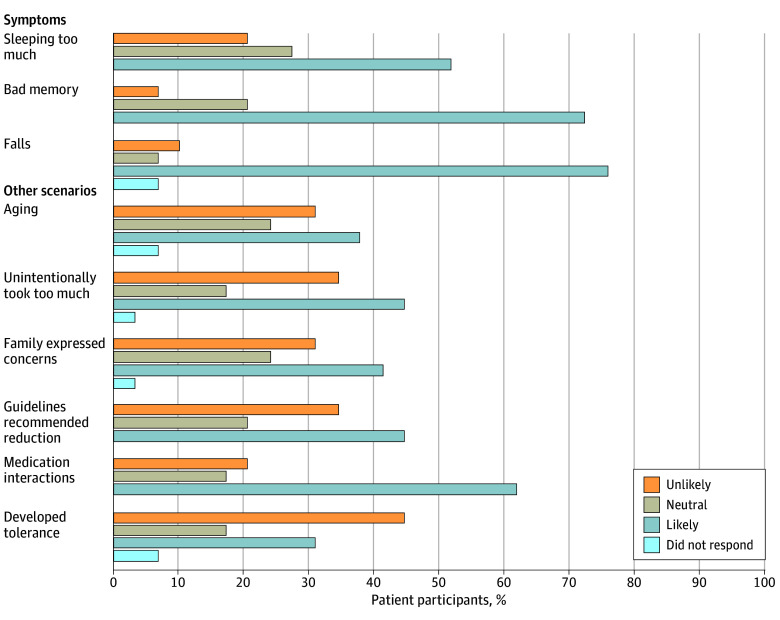
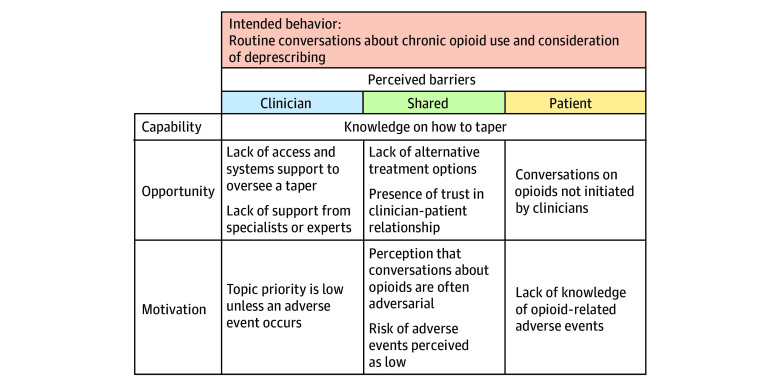
In total, 18 PCPs (12 [67%] younger that 50 years; 10 [56%] female; and 14 [78%] based at an academic practice) and 29 patients (mean [SD] age, 72 [5] years; 19 [66%] female) participated. Participants conveyed that conversations between PCPs and patients on opioid use for chronic pain were typically challenging and that conversations regarding opioid risks and deprescribing were uncommon. Three common themes related to experiences with opioids for chronic pain emerged in both patient and PCP interviews: opioids were used as a last resort, opioids were used to improve function and quality of life, and trust was vital in a clinician-patient relationship. Patients and PCPs expressed conflicting views on risks of opioids, with patients focusing on addiction and PCPs focusing on adverse drug events. Both groups felt deprescribing conversations were often unsuccessful but had conflicting views on barriers to successful conversations. Patients felt deprescribing was often unnecessary unless an adverse event occurred, and many patients had prior negative experiences tapering. The PCPs described gaps in knowledge on how to taper, a lack of clinical access to monitor patients during tapering, and concerns about patient resistance.

CONCLUSIONS AND RELEVANCE

In this qualitative study, PCPs and older adults receiving long-term opioid therapy viewed the use of opioids as a beneficial last resort for treating chronic pain but expressed dissonant views on the risks associated with opioids, which made deprescribing conversations challenging. Interventions, such as conversation aids, are needed to support collaborative discussion about deprescribing opioids.

摘要

重要性

由于不良反应的风险,指南建议为老年人减少阿片类药物的使用,但对于老年人和初级保健医生(PCP)使用阿片类药物治疗慢性疼痛和讨论减少阿片类药物使用的情况知之甚少。

目的

了解老年人和初级保健医生(PCP)使用阿片类药物治疗慢性疼痛以及讨论减少阿片类药物使用的经验。

设计、地点和参与者:这是一项定性研究,于 2022 年 9 月 15 日至 2023 年 4 月 26 日在波士顿的一家学术医疗中心对 18 名 PCP 和 29 名 65 岁或以上服用阿片类药物的成年人进行了半结构式个体定性访谈。PCP 被要求描述他们为老年人开阿片类药物和减少阿片类药物使用的经验。患者被要求描述他们与 PCP 就阿片类药物使用进行讨论的经历。

主要结果和措施

患者和 PCP 对阿片类药物处方和减少阿片类药物使用的障碍的看法,存在共同和冲突的主题。

结果

共有 18 名 PCP(12 名[67%]年龄小于 50 岁;10 名[56%]为女性;14 名[78%]在学术机构工作)和 29 名患者(平均[标准差]年龄,72[5]岁;19 名[66%]为女性)参与了研究。参与者表示,PCP 和患者之间关于慢性疼痛使用阿片类药物的讨论通常具有挑战性,并且关于阿片类药物风险和减少阿片类药物使用的讨论并不常见。患者和 PCP 的访谈中都出现了与慢性疼痛使用阿片类药物相关的三个常见主题:阿片类药物是最后的治疗手段;阿片类药物用于改善功能和生活质量;在医患关系中信任至关重要。患者和 PCP 对阿片类药物的风险表达了相互冲突的观点,患者关注成瘾,而 PCP 关注药物不良反应。两组都认为减少阿片类药物使用的对话往往不成功,但对成功对话的障碍有不同的看法。患者认为减少阿片类药物使用通常是不必要的,除非出现不良反应,而且许多患者以前在减少药物剂量时都有过负面经历。PCP 描述了在如何减少剂量方面知识的差距,在减少剂量期间缺乏临床途径来监测患者,以及对患者抵制的担忧。

结论和相关性

在这项定性研究中,接受长期阿片类药物治疗的 PCP 和老年人将阿片类药物作为治疗慢性疼痛的有益的最后手段,但对与阿片类药物相关的风险表达了不同的看法,这使得减少阿片类药物使用的讨论具有挑战性。需要干预措施,如对话辅助工具,以支持关于减少阿片类药物使用的协作讨论。
https://cdn.ncbi.nlm.nih.gov/pmc/blobs/0fba/10918495/846e1699d647/jamanetwopen-e241342-g002.jpg
https://cdn.ncbi.nlm.nih.gov/pmc/blobs/0fba/10918495/24940ea94753/jamanetwopen-e241342-g001.jpg
https://cdn.ncbi.nlm.nih.gov/pmc/blobs/0fba/10918495/846e1699d647/jamanetwopen-e241342-g002.jpg
https://cdn.ncbi.nlm.nih.gov/pmc/blobs/0fba/10918495/24940ea94753/jamanetwopen-e241342-g001.jpg
https://cdn.ncbi.nlm.nih.gov/pmc/blobs/0fba/10918495/846e1699d647/jamanetwopen-e241342-g002.jpg

相似文献

1
Older Adult and Primary Care Practitioner Perspectives on Using, Prescribing, and Deprescribing Opioids for Chronic Pain.老年人和初级保健医生对使用、开处和停用阿片类药物治疗慢性疼痛的看法。
JAMA Netw Open. 2024 Mar 4;7(3):e241342. doi: 10.1001/jamanetworkopen.2024.1342.
2
Exploring the facilitators and barriers in opioid deprescribing for non-cancer pain treatment experienced by general practitioners: A qualitative study.探讨全科医生在非癌性疼痛治疗中减少阿片类药物使用的促进因素和障碍:一项定性研究。
Eur J Pain. 2024 Aug;28(7):1101-1115. doi: 10.1002/ejp.2243. Epub 2024 Jan 30.
3
Determinants of successful opioid deprescribing: Insights from French pain physicians-A qualitative study.阿片类药物成功减药的决定因素:来自法国疼痛科医生的见解——一项定性研究。
Pain Pract. 2025 Jan;25(1):e13409. doi: 10.1111/papr.13409. Epub 2024 Aug 28.
4
Evaluation of a benzodiazepine deprescribing quality improvement initiative for older adults in primary care.基层医疗中针对老年人的苯二氮䓬类药物减药质量改进举措评估
J Am Geriatr Soc. 2024 Apr;72(4):1234-1241. doi: 10.1111/jgs.18728. Epub 2023 Dec 26.
5
Barriers, facilitators and needs to deprescribe benzodiazepines and other sedatives in older adults: a mixed methods study of primary care provider perspectives.在老年人中减少苯二氮䓬类药物和其他镇静剂的使用:初级保健提供者观点的混合方法研究中的障碍、促进因素和需求。
BMC Geriatr. 2024 May 4;24(1):396. doi: 10.1186/s12877-024-05027-9.
6
Barriers and facilitators to opioid deprescribing among Advanced Nurse Practitioners: A qualitative interview study.高级执业护师在减少阿片类药物使用方面的障碍和促进因素:一项定性访谈研究。
J Adv Nurs. 2024 Jun;80(6):2500-2511. doi: 10.1111/jan.15995. Epub 2023 Dec 11.
7
Beliefs and attitudes about opioid prescribing and chronic pain management: survey of primary care providers.关于阿片类药物处方和慢性疼痛管理的信念与态度:初级保健提供者调查
J Opioid Manag. 2014 Nov-Dec;10(6):375-82. doi: 10.5055/jom.2014.0234.
8
Healthcare provider-related perceptions toward deprescribing inappropriate medications among older adult outpatients.医疗机构相关人员对老年门诊患者中停用不适当药物的看法。
PLoS One. 2024 Nov 12;19(11):e0312762. doi: 10.1371/journal.pone.0312762. eCollection 2024.
9
Opioid deprescribing: Qualitative perspectives from those with chronic non-cancer pain.阿片类药物减用:慢性非癌痛患者的定性观点。
Res Social Adm Pharm. 2022 Dec;18(12):4083-4091. doi: 10.1016/j.sapharm.2022.07.043. Epub 2022 Aug 5.
10
Patient and Physician Perspectives of Deprescribing Potentially Inappropriate Medications in Older Adults with a History of Falls: a Qualitative Study.患者和医生对有跌倒史的老年人停用潜在不适当药物的看法:一项定性研究。
J Gen Intern Med. 2021 Oct;36(10):3015-3022. doi: 10.1007/s11606-020-06493-8. Epub 2021 Jan 19.

引用本文的文献

1
Comparing Fourteen Behavioral Science Electronic Health Record Deprescribing Tools in Older Adults: NUDGE-EHR Adaptive Trial.比较针对老年人的十四种行为科学电子健康记录减药工具:NUDGE-EHR适应性试验
J Am Geriatr Soc. 2025 Jul 4. doi: 10.1111/jgs.19609.
2
Chasing the Pendulum: The Past, Present, and Future of Opioids and Older Adults.追寻钟摆:阿片类药物与老年人的过去、现在和未来
Innov Aging. 2025 May 6;9(6):igaf040. doi: 10.1093/geroni/igaf040. eCollection 2025.
3
Clinical Benefits of Ibuprofen Arginine: A Narrative Review.精氨酸布洛芬的临床益处:一篇叙述性综述。

本文引用的文献

1
Patient Perceptions of Opioids and Benzodiazepines and Attitudes Toward Deprescribing.患者对阿片类药物和苯二氮䓬类药物的认知以及对减药的态度。
Drugs Aging. 2023 Dec;40(12):1113-1122. doi: 10.1007/s40266-023-01071-z. Epub 2023 Oct 4.
2
Centers for Disease Control and Prevention Guideline for Prescribing Opioids, 2022-Need for Integrating Dosing Benchmarks With Shared Decision-Making.疾病控制与预防中心《2022年阿片类药物处方指南——将剂量基准与共同决策相结合的必要性》
JAMA Intern Med. 2023 Sep 1;183(9):899-900. doi: 10.1001/jamainternmed.2023.2847.
3
Clinical practice guideline for deprescribing opioid analgesics: summary of recommendations.
Pain Ther. 2025 Jun;14(3):891-912. doi: 10.1007/s40122-025-00735-5. Epub 2025 Apr 23.
4
A Qualitative Study of the Effects of Opioids on Chronic Pain, Function, and Cognition in Community-Dwelling Older Adults.一项关于阿片类药物对社区居住老年人慢性疼痛、功能和认知影响的定性研究。
J Appl Gerontol. 2025 Apr 1:7334648251326347. doi: 10.1177/07334648251326347.
5
Minimising Harm and Managing Pain: Deprescribing Opioids in Older Adults.最小化伤害和管理疼痛:老年人群中减少阿片类药物的使用。
Drugs Aging. 2024 Nov;41(11):863-871. doi: 10.1007/s40266-024-01154-5. Epub 2024 Oct 29.
6
Impact of adverse childhood experiences on analgesia-related outcomes: a systematic review.童年不良经历对镇痛相关结局的影响:一项系统综述
Br J Anaesth. 2025 Feb;134(2):461-491. doi: 10.1016/j.bja.2024.09.015. Epub 2024 Oct 22.
7
Systematic Review on Mortality in the Elderly on Methadone Maintenance Treatment.美沙酮维持治疗老年患者死亡率的系统评价
Cureus. 2024 Sep 7;16(9):e68910. doi: 10.7759/cureus.68910. eCollection 2024 Sep.
临床实践指南:减少阿片类镇痛药剂量的建议摘要。
Med J Aust. 2023 Jul 17;219(2):80-89. doi: 10.5694/mja2.52002. Epub 2023 Jun 25.
4
Pragmatic Delphi study aimed at determining practical components for a tool designed to assist Dutch primary care-givers in opioid deprescribing for non-cancer pain.实用德尔菲研究旨在确定一种工具的实用组成部分,该工具旨在帮助荷兰初级保健提供者减少非癌症疼痛的阿片类药物。
Fam Pract. 2023 Dec 22;40(5-6):827-843. doi: 10.1093/fampra/cmad058.
5
TANGO: Development of Consumer Information Leaflets to Support TAperiNG of Opioids in Older Adults with Low Back Pain and Hip and Knee Osteoarthritis.TANGO:制定消费者信息传单以支持低腰背痛和髋膝关节骨关节炎老年患者阿片类药物的 TAPERI NG。
Drugs Aging. 2023 Apr;40(4):343-354. doi: 10.1007/s40266-023-01011-x. Epub 2023 Mar 27.
6
Identifying barriers and facilitators to deprescribing benzodiazepines and sedative hypnotics in the hospital setting using the Theoretical Domains Framework and the Capability, Opportunity, Motivation and Behaviour (COM-B) Model: a qualitative study.使用理论领域框架和能力、机会、动机和行为(COM-B)模型识别医院环境中减少苯二氮䓬类药物和镇静催眠药使用的障碍和促进因素:一项定性研究。
BMJ Open. 2023 Feb 22;13(2):e066234. doi: 10.1136/bmjopen-2022-066234.
7
Provider knowledge, beliefs, and self-efficacy to deprescribe opioids and sedative-hypnotics.提供者对减少开处阿片类药物和镇静催眠药物的知识、信念和自我效能感。
J Am Geriatr Soc. 2023 May;71(5):1580-1586. doi: 10.1111/jgs.18202. Epub 2022 Dec 22.
8
Patient and Provider Perspectives on Benefits and Harms of Continuing, Tapering, and Discontinuing Long-Term Opioid Therapy.患者和提供者对长期阿片类药物治疗持续、逐渐减少和停止的获益和危害的看法。
J Gen Intern Med. 2023 Jun;38(8):1802-1811. doi: 10.1007/s11606-022-07880-z. Epub 2022 Nov 14.
9
CDC Clinical Practice Guideline for Prescribing Opioids for Pain - United States, 2022.美国疾病预防控制中心 2022 年《疼痛阿片类药物处方临床实践指南》。
MMWR Recomm Rep. 2022 Nov 4;71(3):1-95. doi: 10.15585/mmwr.rr7103a1.
10
Opioid deprescribing: Qualitative perspectives from those with chronic non-cancer pain.阿片类药物减用:慢性非癌痛患者的定性观点。
Res Social Adm Pharm. 2022 Dec;18(12):4083-4091. doi: 10.1016/j.sapharm.2022.07.043. Epub 2022 Aug 5.