Department of Chemical Engineering, University of Washington, Seattle, WA, 98105, USA.
Department of Bioengineering, University of Washington, Seattle, WA, 98105, USA.
Adv Sci (Weinh). 2024 Jun;11(24):e2301708. doi: 10.1002/advs.202301708. Epub 2024 Mar 13.
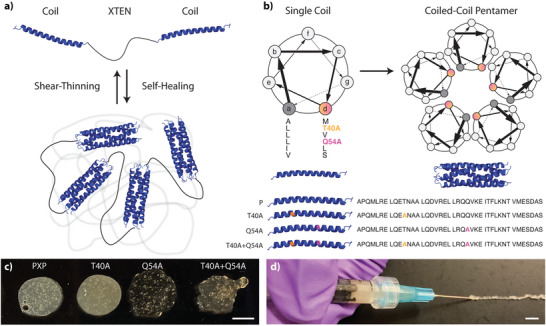
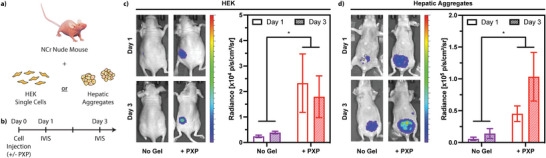
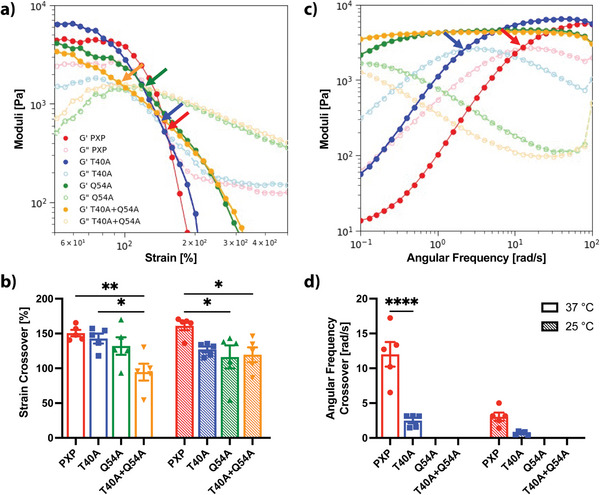
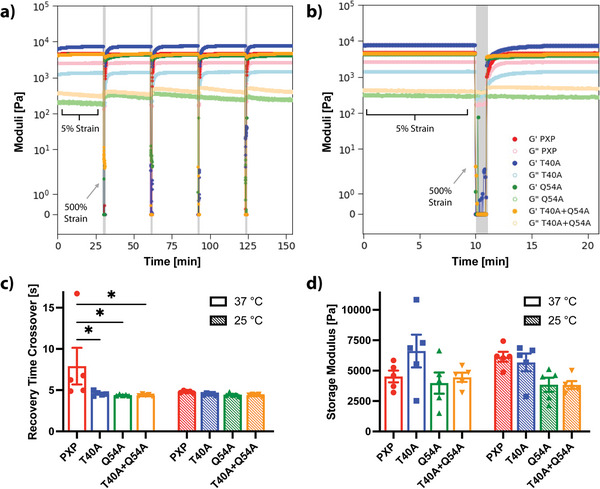
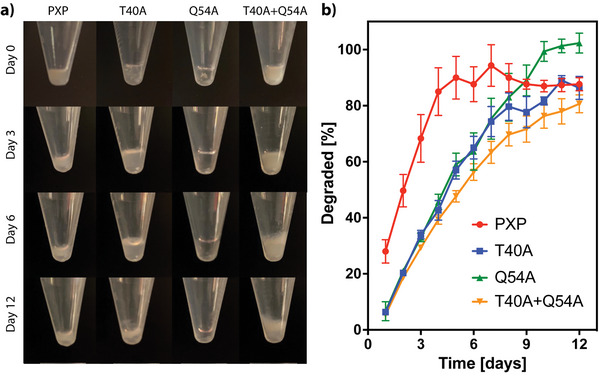
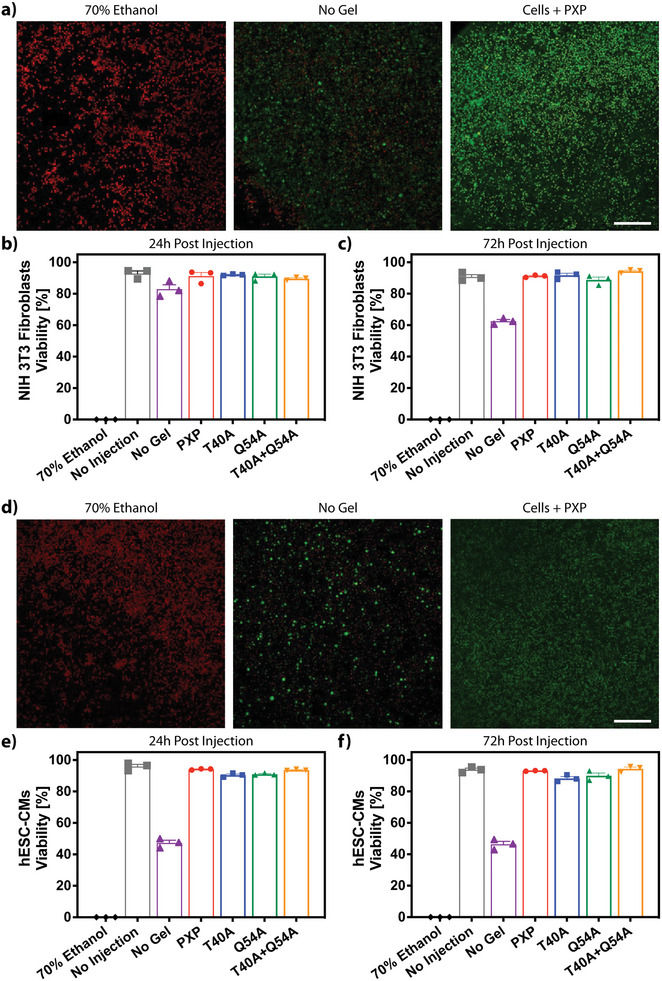
While direct cell transplantation holds great promise in treating many debilitating diseases, poor cell survival and engraftment following injection have limited effective clinical translation. Though injectable biomaterials offer protection against membrane-damaging extensional flow and supply a supportive 3D environment in vivo that ultimately improves cell retention and therapeutic costs, most are created from synthetic or naturally harvested polymers that are immunogenic and/or chemically ill-defined. This work presents a shear-thinning and self-healing telechelic recombinant protein-based hydrogel designed around XTEN - a well-expressible, non-immunogenic, and intrinsically disordered polypeptide previously evolved as a genetically encoded alternative to PEGylation to "eXTENd" the in vivo half-life of fused protein therapeutics. By flanking XTEN with self-associating coil domains derived from cartilage oligomeric matrix protein, single-component physically crosslinked hydrogels exhibiting rapid shear thinning and self-healing through homopentameric coiled-coil bundling are formed. Individual and combined point mutations that variably stabilize coil association enables a straightforward method to genetically program material viscoelasticity and biodegradability. Finally, these materials protect and sustain viability of encapsulated human fibroblasts, hepatocytes, embryonic kidney (HEK), and embryonic stem-cell-derived cardiomyocytes (hESC-CMs) through culture, injection, and transcutaneous implantation in mice. These injectable XTEN-based hydrogels show promise for both in vitro cell culture and in vivo cell transplantation applications.
虽然直接细胞移植在治疗许多使人衰弱的疾病方面具有巨大的潜力,但注射后细胞存活率和植入率低,限制了其有效的临床转化。尽管可注射生物材料提供了对膜损伤拉伸流的保护,并在体内提供了支持 3D 环境,最终提高了细胞保留率和治疗效果,但大多数可注射生物材料是由合成或天然聚合物制成的,这些聚合物具有免疫原性和/或化学定义不明确。本工作提出了一种剪切变稀和自修复的端基重组蛋白基水凝胶,该水凝胶是围绕 XTEN 设计的 - XTEN 是一种可表达、非免疫原性和固有无序的多肽,最初是作为聚乙二醇化的基因编码替代物进化而来,以“eXTENd”融合蛋白治疗剂的体内半衰期。通过将 XTEN 与软骨寡聚基质蛋白衍生的自缔合卷曲结构域相连接,形成了单组分物理交联水凝胶,其具有快速的剪切变稀和自修复特性,这是通过同源五聚体卷曲螺旋束的捆绑实现的。单个和组合的点突变可以不同程度地稳定卷曲结构域的缔合,从而可以通过基因编程来控制材料的粘弹性和生物降解性。最后,这些材料通过培养、注射和在小鼠体内经皮植入,保护和维持了包封的人成纤维细胞、肝细胞、胚胎肾(HEK)和胚胎干细胞衍生的心肌细胞(hESC-CMs)的活力。这些可注射的基于 XTEN 的水凝胶在体外细胞培养和体内细胞移植应用中都有应用前景。