Shanghai Institute of Nutrition and Health, CAS Key Laboratory of Tissue Microenvironment and Tumor, Chinese Academy of Sciences, Shanghai, China.
University of Chinese Academy of Sciences, Chinese Academy of Sciences (CAS), Beijing, China.
J Cancer Res Clin Oncol. 2024 Mar 15;150(3):129. doi: 10.1007/s00432-024-05645-1.
T cells are key players in the tumor immune microenvironment (TIME), as they can recognize and eliminate cancer cells that express neoantigens derived from somatic mutations. However, the diversity and specificity of T-cell receptors (TCRs) that recognize neoantigens are largely unknown, due to the high variability of TCR sequences among individuals.
To address this challenge, we applied GLIPH2, a novel algorithm that groups TCRs based on their predicted antigen specificity and HLA restriction, to cluster the TCR repertoire of 1,702 patients with digestive tract cancer. The patients were divided into five groups based on whether they carried tumor-infiltrating or clonal-expanded TCRs and calculated their TCR diversity. The prognosis, tumor subtype, gene mutation, gene expression, and immune microenvironment of these groups were compared. Viral specificity inference and immunotherapy relevance analysis performed for the TCR groups.
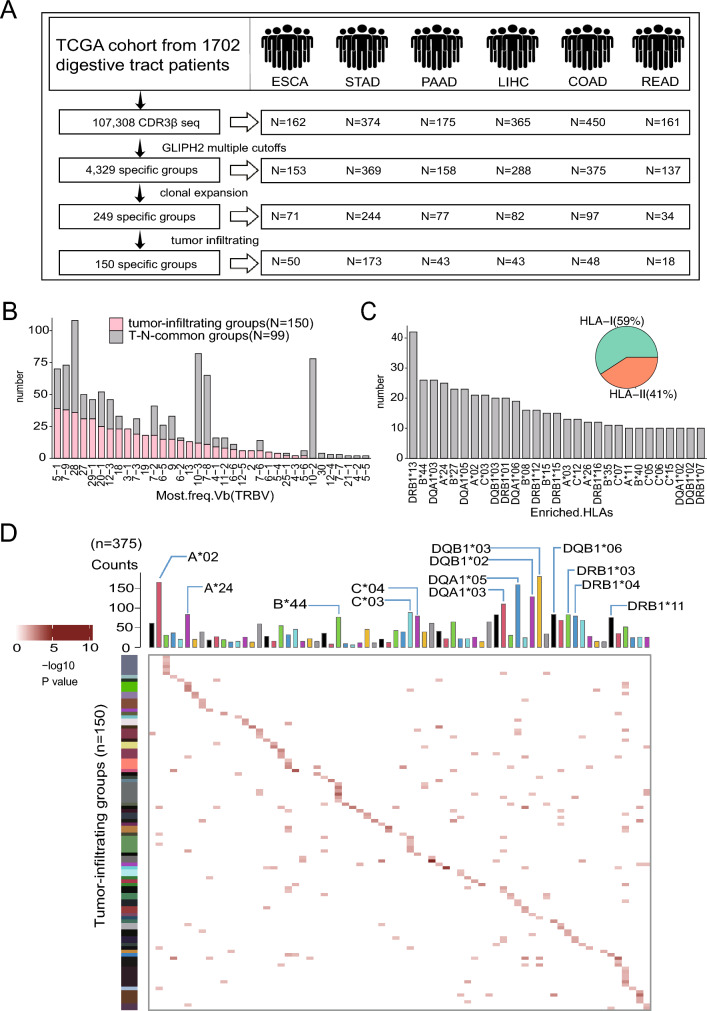
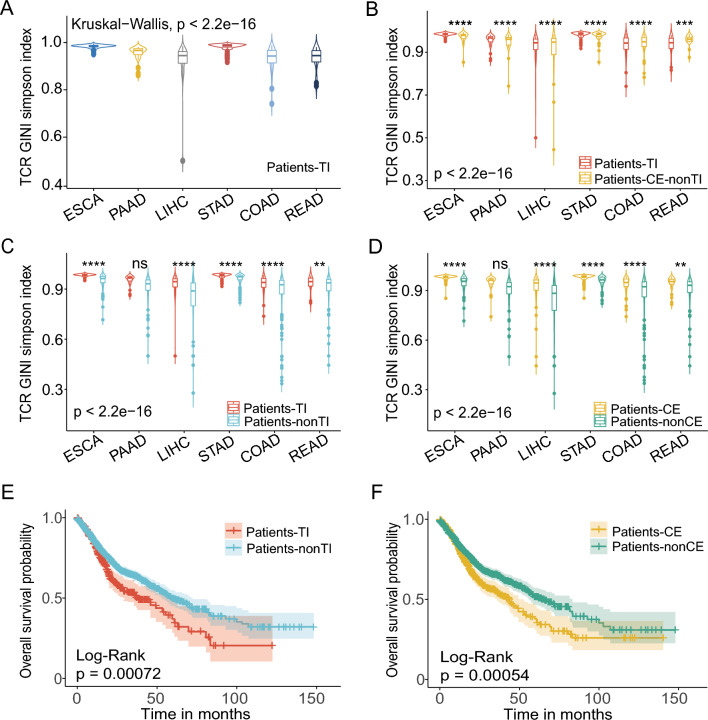
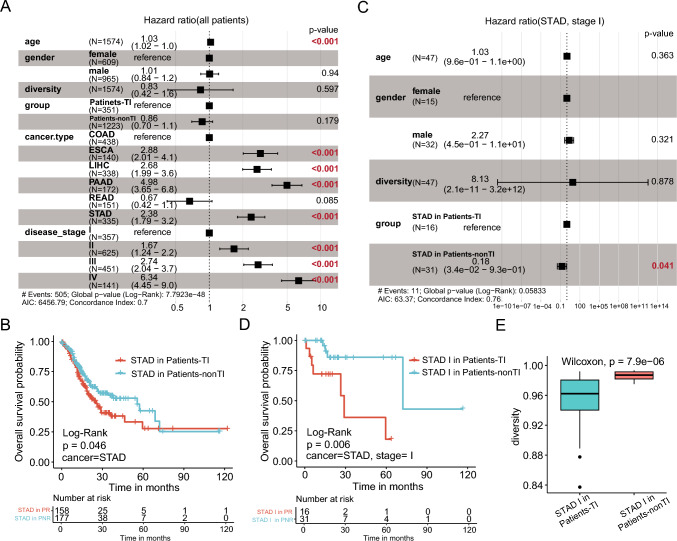
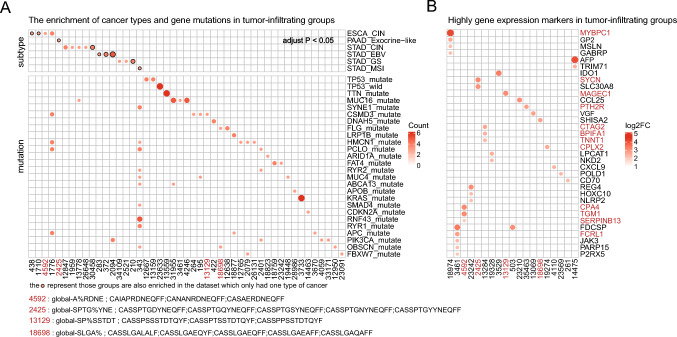
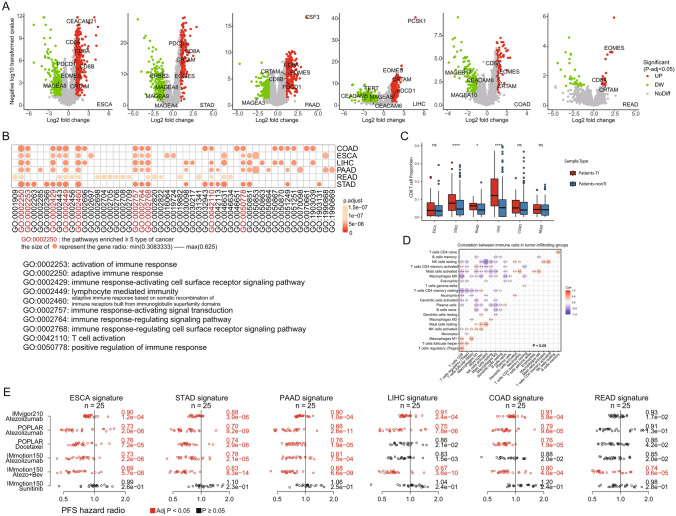
This approach reduced the complexity of TCR sequences to 249 clonally expanded and 150 tumor-infiltrating TCR groups, which revealed distinct patterns of TRBV usage, HLA association, and TCR diversity. In gastric adenocarcinoma (STAD), patients with tumor-infiltrating TCRs (Patients-TI) had significantly worse prognosis than other patients (Patients-nonTI). Patients-TI had richer CD8+ T cells in the immune microenvironment, and their gene expression features were positively correlated with immunotherapy response. We also found that tumor-infiltrating TCR groups were associated with four distinct tumor subtypes, 26 common gene mutations, and 39 gene expression signatures. We discovered that tumor-infiltrating TCRs had cross-reactivity with viral antigens, indicating a possible link between viral infections and tumor immunity.
By applying GLIPH2 to TCR sequences from digestive tract tumors, we uncovered novel insights into the tumor immune landscape and identified potential candidates for shared TCRs and neoantigens.
T 细胞是肿瘤免疫微环境(TIME)中的关键参与者,因为它们可以识别和消除表达来自体细胞突变的新抗原的癌细胞。然而,由于个体之间 TCR 序列的高度变异性,识别新抗原的 T 细胞受体(TCR)的多样性和特异性在很大程度上是未知的。
为了解决这一挑战,我们应用了 GLIPH2,这是一种新的算法,它根据 TCR 的预测抗原特异性和 HLA 限制对 TCR 进行分组,以对 1702 例消化道癌患者的 TCR 库进行聚类。根据患者是否携带肿瘤浸润或克隆扩增的 TCR,将患者分为五组,并计算他们的 TCR 多样性。比较这些组的预后、肿瘤亚型、基因突变、基因表达和免疫微环境。对 TCR 组进行病毒特异性推断和免疫治疗相关性分析。
这种方法将 TCR 序列的复杂性降低到 249 个克隆扩增和 150 个肿瘤浸润 TCR 组,揭示了 TRBV 利用、HLA 关联和 TCR 多样性的不同模式。在胃腺癌(STAD)中,肿瘤浸润 TCR 患者(Patients-TI)的预后明显比其他患者(Patients-nonTI)差。Patients-TI 患者的免疫微环境中 CD8+T 细胞更为丰富,其基因表达特征与免疫治疗反应呈正相关。我们还发现肿瘤浸润 TCR 组与四种不同的肿瘤亚型、26 个常见基因突变和 39 个基因表达特征有关。我们发现肿瘤浸润 TCR 与病毒抗原具有交叉反应性,表明病毒感染与肿瘤免疫之间可能存在联系。
通过将 GLIPH2 应用于消化道肿瘤的 TCR 序列,我们揭示了肿瘤免疫景观的新见解,并确定了共享 TCR 和新抗原的潜在候选者。