Department of Animal Physiology, Federal University of Agriculture, Abeokuta, Nigeria.
Centre of Excellence in Poultry Sciences, University of Lome, Lome, Togo.
Vet Med Sci. 2024 May;10(3):e1416. doi: 10.1002/vms3.1416.
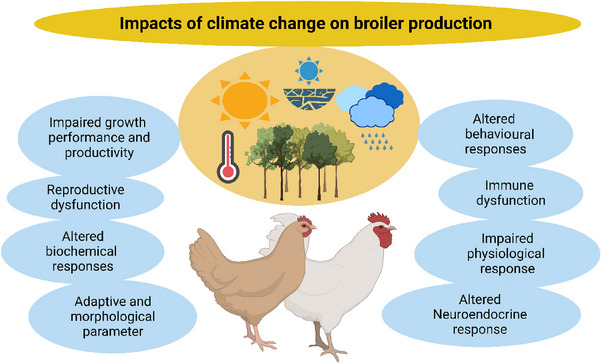
Climate change has emerged as a significant occurrence that adversely affects broiler production, especially in tropical climates. Broiler chickens, bred for rapid growth and high meat production, rely heavily on optimal environmental conditions to achieve their genetic potential. However, climate change disrupts these conditions and poses numerous challenges for broiler production. One of the primary impacts of climate change on broiler production is the decreased ability of birds to attain their genetic potential for faster growth. Broilers are bred to possess specific genetic traits that enable them to grow rapidly and efficiently convert feed into meat. However, in tropical climates affected by climate change, the consequent rise in daily temperatures, increased humidity and altered precipitation patterns create an unfavourable environment for broilers. These conditions impede their growth and development, preventing them from reaching their maximum genetic influence, which is crucial for achieving desirable production outcomes. Furthermore, climate change exacerbates the existing challenges faced by broiler production systems. Higher feed costs impact the industry's economic viability and limit the availability of quality nutrition for the birds, further hampering their growth potential. In addition to feed scarcity, climate change also predisposes broiler chickens to thermal stress. This review collates existing information on climate change and its impact on broiler production, including nutrition, immune function, health and disease susceptibility. It also summarizes the challenges of broiler production under hot and humid climate conditions with different approaches to ameliorating the effects of harsh climatic conditions in poultry.
气候变化已成为一个重大事件,对肉鸡生产产生不利影响,尤其是在热带气候下。肉鸡经过选育,生长速度快、出肉率高,它们的生长潜力很大程度上依赖于最佳的环境条件。然而,气候变化打乱了这些条件,给肉鸡生产带来了许多挑战。气候变化对肉鸡生产的主要影响之一是肉鸡实现其快速生长的遗传潜力的能力下降。肉鸡经过选育,具有特定的遗传特征,能够快速生长,并有效地将饲料转化为肉。然而,在受气候变化影响的热带气候下,每日温度升高、湿度增加和降水模式改变,为肉鸡创造了不利的环境。这些条件阻碍了它们的生长和发育,使它们无法达到最大的遗传影响,而这对实现理想的生产结果至关重要。此外,气候变化加剧了肉鸡生产系统面临的现有挑战。饲料成本的增加影响了该行业的经济可行性,并限制了鸟类获得优质营养的机会,进一步限制了它们的生长潜力。除了饲料短缺之外,气候变化还使肉鸡容易受到热应激的影响。本综述收集了有关气候变化及其对肉鸡生产的影响的现有信息,包括营养、免疫功能、健康和疾病易感性。它还总结了在炎热和潮湿气候条件下肉鸡生产面临的挑战,并概述了不同方法来缓解家禽在恶劣气候条件下的影响。