School of Nursing, Fujian Medical University, 1 Xue Yuan Road, University Town, Fuzhou, 350122, China.
Department of Nursing, Zhuhai People's Hospital (Zhuhai Clinical Medical College of Jinan University), Guangdong, Zhuhai, China.
BMC Public Health. 2024 Mar 27;24(1):908. doi: 10.1186/s12889-024-18324-0.
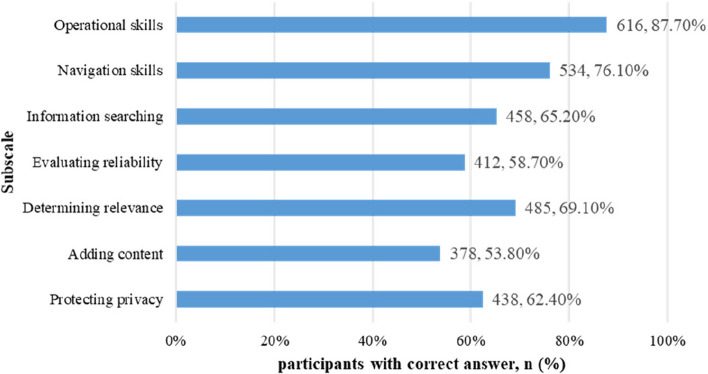
As the internet develops and 5G technology becomes increasingly prominent, the internet has become a major source of health-related information. Increasingly, people use the internet to find health-related information, and digital health literacy is now a set of essential capabilities to improve their health in the digital era. However, little is known about the factors that influencing digital health literacy. This study aimed to assess digital health literacy scores and identify its influencing factors among internet users in China. Additionally, this study explored the participant's actual skills using an additional set of performance-based items from the Digital Health Literacy Instrument (DHLI).
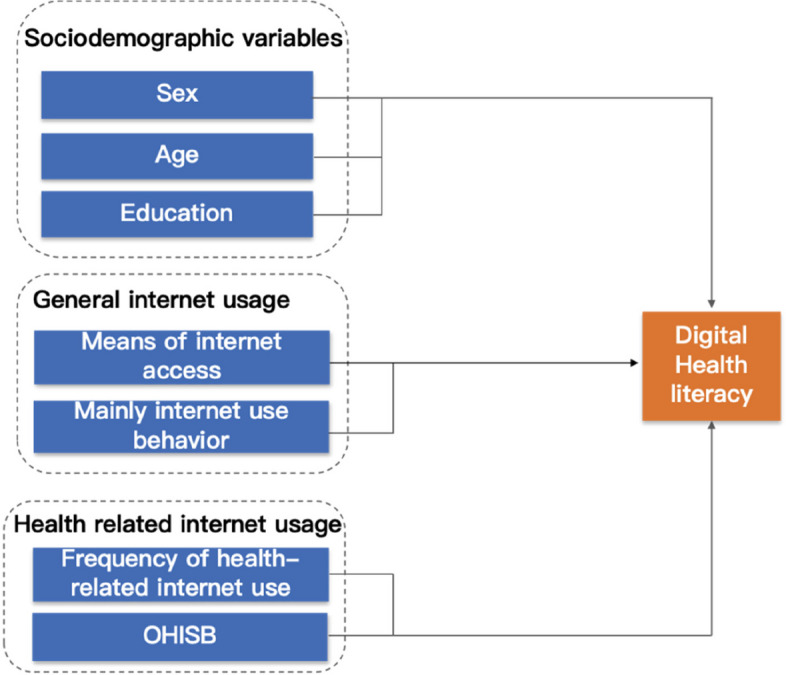
An online cross-sectional study was conducted in August 2022. Participants aged ≥18 years were recruited to complete the survey. Data were collected using the Chinese revised version of the DHLI, the self-reported internet use questionnaire, and the sociodemographic questionnaire. We conducted multivariate linear regression analyses to explore the relationships among the sociodemographic variables, behavior of internet use, and the digital health literacy scores.
In total, 702 participants completed the survey. The mean DHLI score was 2.69 ± 0.61. Multivariate linear regression analyses showed that the age groups 35-49 (β = - 0.08, P = 0.033), 50-64 (β = - 0.161, P < 0.001), and ≥ 65 (β = - 0.138, P < 0.001) were negatively associated with DHL scores. However, education level, including bachelor's or associate degree (β = 0.255, P = 0.002) and master's degree and above (β = 0.256, P < 0.001), frequency of health-related Internet usage (β = 0.192, P < 0.001), the number of digital devices used (β = 0.129, P = 0.001), and OHISB (β = 0.103, P = 0.006) showed a positive relationship with DHL scores.
The study findings demonstrate that age, educational levels, number of technological devices used, and greater use of the web for health information were independently associated with DHL scores. Healthcare providers should consider providing training programs tailored to specific sociodemographic factors to improve the ability that find and use accurate information online to meet digital health services, which contributes to enhance their self-management and reduce health disparities.
随着互联网的发展和 5G 技术的日益突出,互联网已成为获取健康相关信息的主要来源。越来越多的人使用互联网查找健康相关信息,数字健康素养现已成为提高数字时代健康水平的必备能力之一。然而,目前对于影响数字健康素养的因素知之甚少。本研究旨在评估中国互联网用户的数字健康素养评分,并确定其影响因素。此外,本研究还通过使用数字健康素养量表(DHLI)中的另一组基于绩效的项目,探讨了参与者的实际技能。
2022 年 8 月进行了一项在线横断面研究。招募年龄≥18 岁的参与者完成调查。使用中文修订版 DHLI、自我报告的互联网使用问卷和社会人口学问卷收集数据。我们进行了多元线性回归分析,以探讨社会人口统计学变量、互联网使用行为与数字健康素养评分之间的关系。
共有 702 名参与者完成了调查。DHLI 平均得分为 2.69±0.61。多元线性回归分析表明,年龄在 35-49 岁组(β=-0.08,P=0.033)、50-64 岁组(β=-0.161,P<0.001)和≥65 岁组(β=-0.138,P<0.001)与 DHL 评分呈负相关。然而,教育水平,包括本科或副学士学位(β=0.255,P=0.002)和硕士及以上学位(β=0.256,P<0.001)、健康相关互联网使用频率(β=0.192,P<0.001)、使用的数字设备数量(β=0.129,P=0.001)和 OHISB(β=0.103,P=0.006)与 DHL 评分呈正相关。
研究结果表明,年龄、教育水平、使用的技术设备数量以及更多地使用网络获取健康信息与 DHL 评分独立相关。医疗保健提供者应考虑提供针对特定社会人口统计学因素的培训计划,以提高在线查找和使用准确信息的能力,以满足数字健康服务的需求,这有助于增强自我管理能力并减少健康差距。