Else Kroener Fresenius Center for Digital Health, Medical Faculty Carl Gustav Carus, TUD Dresden University of Technology, Dresden, Germany.
Department of Medicine I, University Hospital Dresden, Dresden, Germany.
Genome Med. 2024 Mar 27;16(1):44. doi: 10.1186/s13073-024-01315-6.
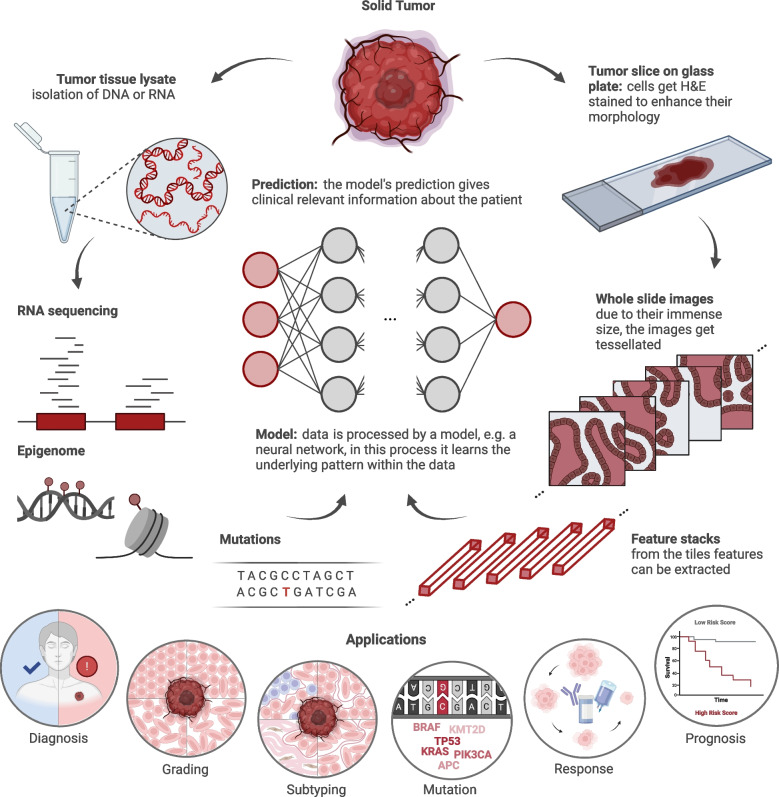
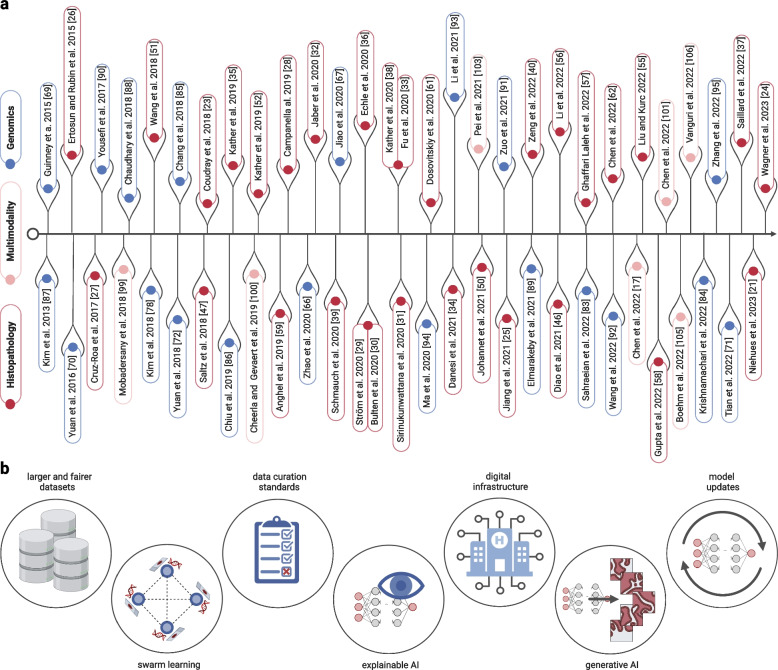
Histopathology and genomic profiling are cornerstones of precision oncology and are routinely obtained for patients with cancer. Traditionally, histopathology slides are manually reviewed by highly trained pathologists. Genomic data, on the other hand, is evaluated by engineered computational pipelines. In both applications, the advent of modern artificial intelligence methods, specifically machine learning (ML) and deep learning (DL), have opened up a fundamentally new way of extracting actionable insights from raw data, which could augment and potentially replace some aspects of traditional evaluation workflows. In this review, we summarize current and emerging applications of DL in histopathology and genomics, including basic diagnostic as well as advanced prognostic tasks. Based on a growing body of evidence, we suggest that DL could be the groundwork for a new kind of workflow in oncology and cancer research. However, we also point out that DL models can have biases and other flaws that users in healthcare and research need to know about, and we propose ways to address them.
组织病理学和基因组分析是精准肿瘤学的基石,通常用于癌症患者。传统上,组织病理学切片由经过高度培训的病理学家进行手动检查。另一方面,基因组数据由经过设计的计算管道进行评估。在这两种应用中,现代人工智能方法(特别是机器学习 (ML) 和深度学习 (DL))的出现为从原始数据中提取可操作的见解开辟了一条全新的途径,这可能会增强并可能取代传统评估工作流程的某些方面。在这篇综述中,我们总结了深度学习在组织病理学和基因组学中的当前和新兴应用,包括基本诊断和高级预后任务。基于越来越多的证据,我们认为深度学习可能是肿瘤学和癌症研究中一种新工作流程的基础。然而,我们也指出,深度学习模型可能存在偏见和其他缺陷,医疗保健和研究领域的用户需要了解这些缺陷,我们提出了一些解决这些问题的方法。