• 文献检索
  • 文档翻译
  • 深度研究
  • 学术资讯
  • Suppr Zotero 插件Zotero 插件
  • 邀请有礼
  • 套餐&价格
  • 历史记录
应用&插件
Suppr Zotero 插件Zotero 插件浏览器插件Mac 客户端Windows 客户端微信小程序
定价
高级版会员购买积分包购买API积分包
服务
文献检索文档翻译深度研究API 文档MCP 服务
关于我们
关于 Suppr公司介绍联系我们用户协议隐私条款
关注我们

Suppr 超能文献

核心技术专利:CN118964589B侵权必究
粤ICP备2023148730 号-1Suppr @ 2026

文献检索

告别复杂PubMed语法,用中文像聊天一样搜索,搜遍4000万医学文献。AI智能推荐,让科研检索更轻松。

立即免费搜索

文件翻译

保留排版,准确专业,支持PDF/Word/PPT等文件格式,支持 12+语言互译。

免费翻译文档

深度研究

AI帮你快速写综述,25分钟生成高质量综述,智能提取关键信息,辅助科研写作。

立即免费体验

利用深度神经网络在毛发和头皮疾病的诊断中实现前所未有的精度。

Leveraging deep neural networks to uncover unprecedented levels of precision in the diagnosis of hair and scalp disorders.

机构信息

Computer Science and Engineering, American International University-Bangladesh, Dhaka, Bangladesh.

Department of Computer Science, College of Computer and Information Sciences, King Saud University, Riyadh, Saudi Arabia.

出版信息

Skin Res Technol. 2024 Apr;30(4):e13660. doi: 10.1111/srt.13660.

DOI:10.1111/srt.13660
PMID:38545843
原文链接:https://pmc.ncbi.nlm.nih.gov/articles/PMC10974725/
Abstract

BACKGROUND

Hair and scalp disorders present a significant challenge in dermatology due to their clinical diversity and overlapping symptoms, often leading to misdiagnoses. Traditional diagnostic methods rely heavily on clinical expertise and are limited by subjectivity and accessibility, necessitating more advanced and accessible diagnostic tools. Artificial intelligence (AI) and deep learning offer a promising solution for more accurate and efficient diagnosis.

METHODS

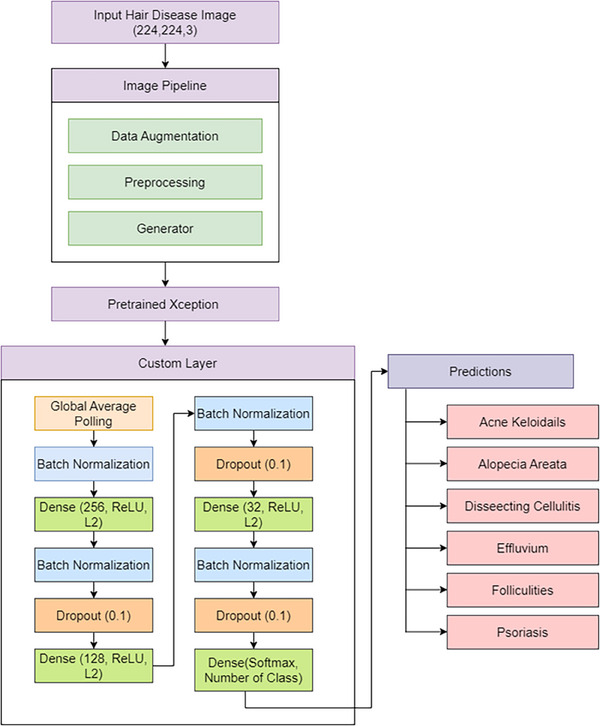
The research employs a modified Xception model incorporating ReLU activation, dense layers, global average pooling, regularization and dropout layers. This deep learning approach is evaluated against existing models like VGG19, Inception, ResNet, and DenseNet for its efficacy in accurately diagnosing various hair and scalp disorders.

RESULTS

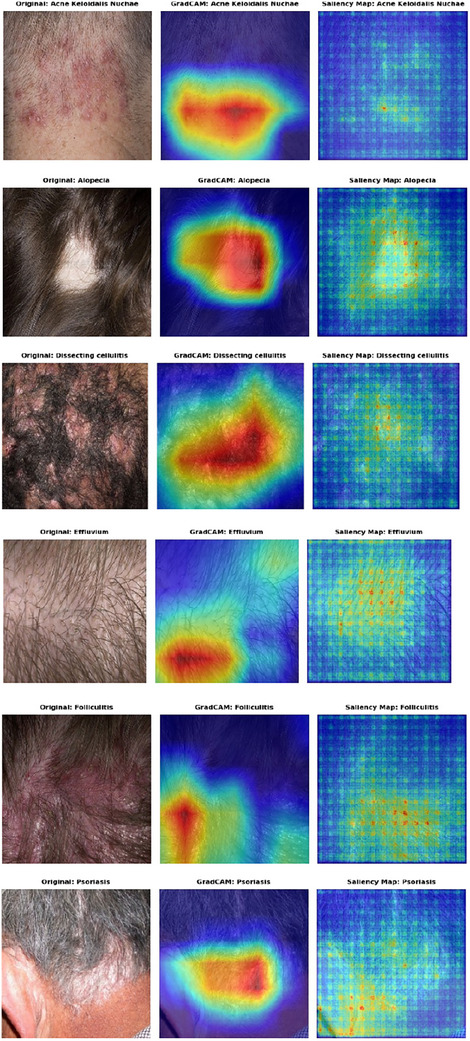
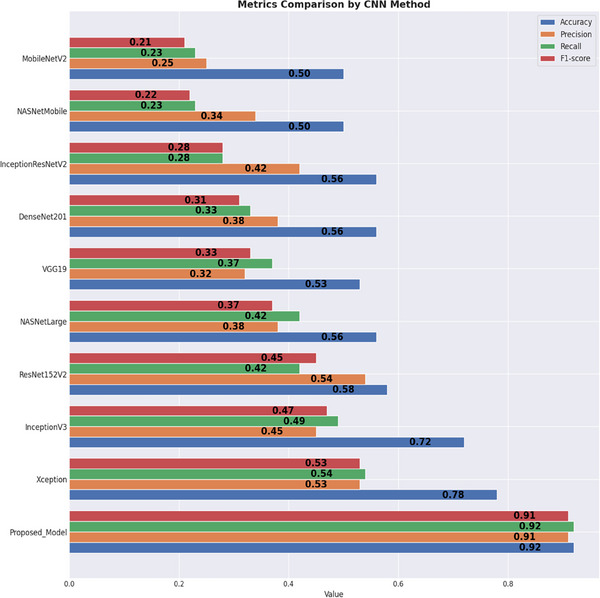
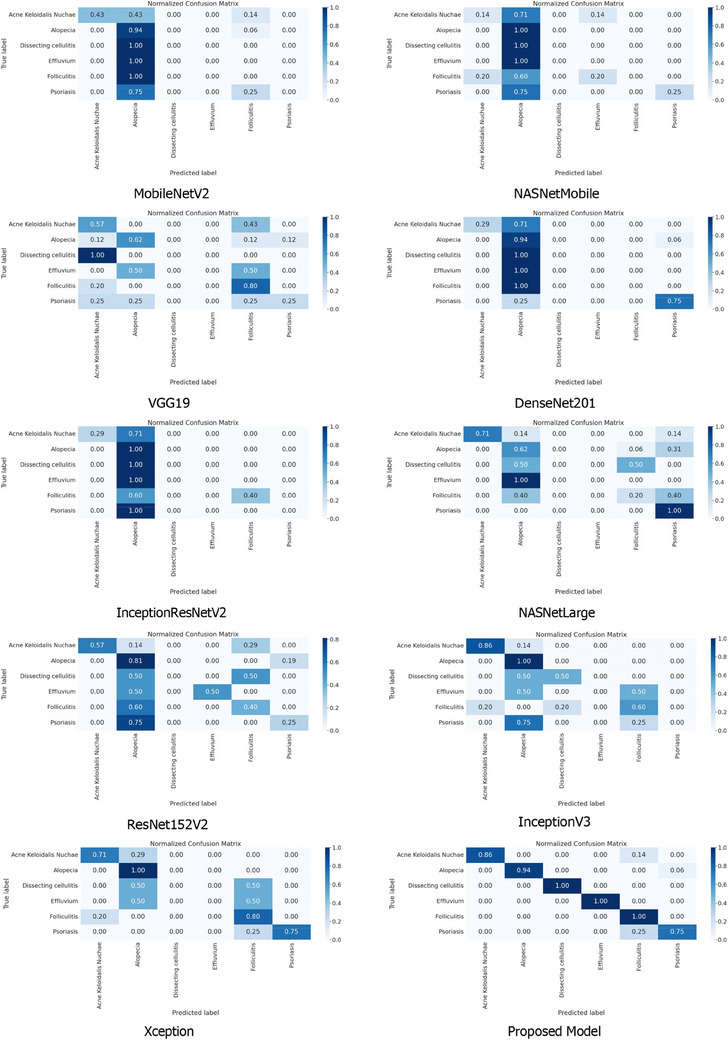
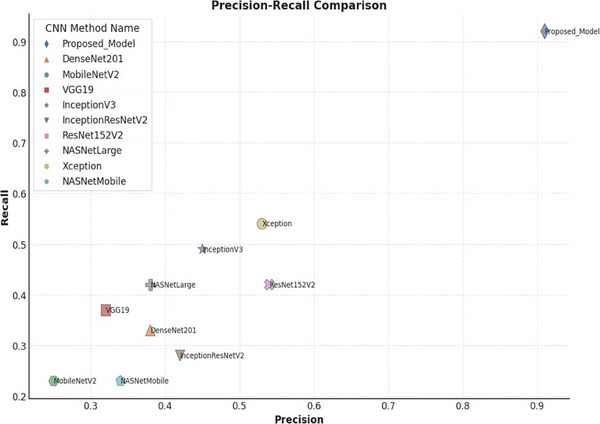
The model achieved a 92% accuracy rate, significantly outperforming the comparative models, with accuracies ranging from 50% to 80%. Explainable AI techniques like Gradient-weighted Class Activation Mapping (Grad-CAM) and Saliency Map provided deeper insights into the model's decision-making process.

CONCLUSION

This study emphasizes the potential of AI in dermatology, particularly in accurately diagnosing hair and scalp disorders. The superior accuracy and interpretability of the model represents a significant advancement in dermatological diagnostics, promising more reliable and accessible diagnostic methods.

摘要

背景

由于头发和头皮疾病的临床表现多样且症状重叠,皮肤科医生在诊断时经常会遇到困难,导致误诊。传统的诊断方法主要依赖临床医生的专业知识,容易受到主观性和可及性的限制,因此需要更先进和更便捷的诊断工具。人工智能(AI)和深度学习为更准确和高效的诊断提供了有前途的解决方案。

方法

本研究采用了一种经过改进的 Xception 模型,其中包含 ReLU 激活、密集层、全局平均池化、正则化和 dropout 层。该深度学习方法与现有的模型(如 VGG19、Inception、ResNet 和 DenseNet)进行了比较,以评估其在准确诊断各种头发和头皮疾病方面的效果。

结果

该模型的准确率达到 92%,明显优于其他比较模型(准确率在 50%到 80%之间)。可解释 AI 技术(如 Gradient-weighted Class Activation Mapping(Grad-CAM)和显著性图)提供了对模型决策过程的更深入了解。

结论

本研究强调了 AI 在皮肤科中的应用潜力,特别是在准确诊断头发和头皮疾病方面。该模型具有较高的准确性和可解释性,代表了皮肤科诊断领域的重大进展,有望提供更可靠和便捷的诊断方法。
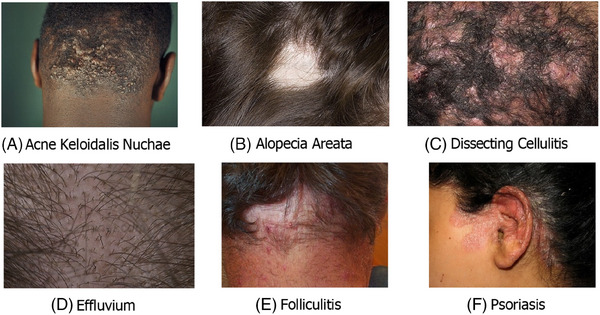
https://cdn.ncbi.nlm.nih.gov/pmc/blobs/f123/10974725/9bd83e2a639f/SRT-30-e13660-g004.jpg
https://cdn.ncbi.nlm.nih.gov/pmc/blobs/f123/10974725/640d1d83d50a/SRT-30-e13660-g008.jpg
https://cdn.ncbi.nlm.nih.gov/pmc/blobs/f123/10974725/545b27f59f6d/SRT-30-e13660-g010.jpg
https://cdn.ncbi.nlm.nih.gov/pmc/blobs/f123/10974725/a546e0b2b2d5/SRT-30-e13660-g009.jpg
https://cdn.ncbi.nlm.nih.gov/pmc/blobs/f123/10974725/77bf0197592f/SRT-30-e13660-g005.jpg
https://cdn.ncbi.nlm.nih.gov/pmc/blobs/f123/10974725/f5116ab483df/SRT-30-e13660-g003.jpg
https://cdn.ncbi.nlm.nih.gov/pmc/blobs/f123/10974725/a902cf12531d/SRT-30-e13660-g002.jpg
https://cdn.ncbi.nlm.nih.gov/pmc/blobs/f123/10974725/684bb71e3e5c/SRT-30-e13660-g001.jpg
https://cdn.ncbi.nlm.nih.gov/pmc/blobs/f123/10974725/74582fbdf150/SRT-30-e13660-g007.jpg
https://cdn.ncbi.nlm.nih.gov/pmc/blobs/f123/10974725/15dfd0bd6718/SRT-30-e13660-g006.jpg
https://cdn.ncbi.nlm.nih.gov/pmc/blobs/f123/10974725/9bd83e2a639f/SRT-30-e13660-g004.jpg
https://cdn.ncbi.nlm.nih.gov/pmc/blobs/f123/10974725/640d1d83d50a/SRT-30-e13660-g008.jpg
https://cdn.ncbi.nlm.nih.gov/pmc/blobs/f123/10974725/545b27f59f6d/SRT-30-e13660-g010.jpg
https://cdn.ncbi.nlm.nih.gov/pmc/blobs/f123/10974725/a546e0b2b2d5/SRT-30-e13660-g009.jpg
https://cdn.ncbi.nlm.nih.gov/pmc/blobs/f123/10974725/77bf0197592f/SRT-30-e13660-g005.jpg
https://cdn.ncbi.nlm.nih.gov/pmc/blobs/f123/10974725/f5116ab483df/SRT-30-e13660-g003.jpg
https://cdn.ncbi.nlm.nih.gov/pmc/blobs/f123/10974725/a902cf12531d/SRT-30-e13660-g002.jpg
https://cdn.ncbi.nlm.nih.gov/pmc/blobs/f123/10974725/684bb71e3e5c/SRT-30-e13660-g001.jpg
https://cdn.ncbi.nlm.nih.gov/pmc/blobs/f123/10974725/74582fbdf150/SRT-30-e13660-g007.jpg
https://cdn.ncbi.nlm.nih.gov/pmc/blobs/f123/10974725/15dfd0bd6718/SRT-30-e13660-g006.jpg
https://cdn.ncbi.nlm.nih.gov/pmc/blobs/f123/10974725/9bd83e2a639f/SRT-30-e13660-g004.jpg

相似文献

1
Leveraging deep neural networks to uncover unprecedented levels of precision in the diagnosis of hair and scalp disorders.利用深度神经网络在毛发和头皮疾病的诊断中实现前所未有的精度。
Skin Res Technol. 2024 Apr;30(4):e13660. doi: 10.1111/srt.13660.
2
A novel approach of brain-computer interfacing (BCI) and Grad-CAM based explainable artificial intelligence: Use case scenario for smart healthcare.一种新的脑机接口 (BCI) 和基于 Grad-CAM 的可解释人工智能方法:智能医疗保健用例场景。
J Neurosci Methods. 2024 Aug;408:110159. doi: 10.1016/j.jneumeth.2024.110159. Epub 2024 May 7.
3
An Explainable AI Paradigm for Alzheimer's Diagnosis Using Deep Transfer Learning.一种基于深度迁移学习的可解释人工智能阿尔茨海默病诊断范式。
Diagnostics (Basel). 2024 Feb 5;14(3):345. doi: 10.3390/diagnostics14030345.
4
Utilizing heat maps as explainable artificial intelligence for detecting abnormalities on wrist and elbow radiographs.利用热图作为可解释的人工智能来检测手腕和肘部 X 光片上的异常。
Radiography (Lond). 2023 Oct;29(6):1132-1138. doi: 10.1016/j.radi.2023.09.012. Epub 2023 Oct 6.
5
Revolutionizing breast ultrasound diagnostics with EfficientNet-B7 and Explainable AI.利用 EfficientNet-B7 和可解释 AI 技术革新乳腺超声诊断。
BMC Med Imaging. 2024 Sep 2;24(1):230. doi: 10.1186/s12880-024-01404-3.
6
An XAI-enhanced efficientNetB0 framework for precision brain tumor detection in MRI imaging.一种用于磁共振成像中精确脑肿瘤检测的基于可解释人工智能增强的EfficientNetB0框架。
J Neurosci Methods. 2024 Oct;410:110227. doi: 10.1016/j.jneumeth.2024.110227. Epub 2024 Jul 20.
7
Enhancing brain tumor detection in MRI images through explainable AI using Grad-CAM with Resnet 50.利用基于 Resnet 50 的 Grad-CAM 的可解释人工智能增强 MRI 图像中的脑瘤检测。
BMC Med Imaging. 2024 May 11;24(1):107. doi: 10.1186/s12880-024-01292-7.
8
Enhancing the Diagnostic Accuracy of Sacroiliitis: A Machine Learning Approach Applied to Computed Tomography Imaging.提高骶髂关节炎诊断准确性的研究:基于机器学习的 CT 影像学分析。
Br J Hosp Med (Lond). 2024 Aug 30;85(8):1-13. doi: 10.12968/hmed.2024.0228.
9
Deep convolutional neural network and IoT technology for healthcare.用于医疗保健的深度卷积神经网络和物联网技术。
Digit Health. 2024 Jan 17;10:20552076231220123. doi: 10.1177/20552076231220123. eCollection 2024 Jan-Dec.
10
Deep learning ensemble approach with explainable AI for lung and colon cancer classification using advanced hyperparameter tuning.采用先进超参数调优的深度学习集成方法与可解释人工智能用于肺癌和结肠癌分类
BMC Med Inform Decis Mak. 2024 Aug 7;24(1):222. doi: 10.1186/s12911-024-02628-7.

引用本文的文献

1
EnSLDe: an enhanced short-range and long-range dependent system for brain tumor classification.EnSLDe:一种用于脑肿瘤分类的增强型短程和长程相关系统。
Front Oncol. 2025 Apr 11;15:1512739. doi: 10.3389/fonc.2025.1512739. eCollection 2025.

本文引用的文献

1
Scalp atrophy secondary to steroid use in patients with scarring alopecia: are topical steroids superior to topical calcineurin inhibitors?瘢痕性脱发患者因使用类固醇导致的头皮萎缩:外用类固醇优于外用钙调神经磷酸酶抑制剂吗?
Int J Dermatol. 2024 Jan;63(1):102-104. doi: 10.1111/ijd.16918. Epub 2023 Nov 21.
2
Invasive Diagnostic Procedures from Bronchoscopy to Surgical Biopsy-Optimization of Non-Small Cell Lung Cancer Samples for Molecular Testing.经支气管镜检查和外科活检的侵袭性诊断程序-非小细胞肺癌样本的分子检测优化。
Medicina (Kaunas). 2023 Sep 27;59(10):1723. doi: 10.3390/medicina59101723.
3
Recent omics advances in hair aging biology and hair biomarkers analysis.
头发衰老生物学和毛发生物标志物分析的最新组学进展。
Ageing Res Rev. 2023 Nov;91:102041. doi: 10.1016/j.arr.2023.102041. Epub 2023 Aug 25.
4
Deep Learning Based Classification of Dermatological Disorders.基于深度学习的皮肤病分类
Biomed Eng Comput Biol. 2023 Jul 31;14:11795972221138470. doi: 10.1177/11795972221138470. eCollection 2023.
5
Diagnosis and differential diagnosis of tertiary androgenetic alopecia with severe alopecia areata based on high-resolution MRI.基于高分辨率 MRI 的三级雄激素性脱发与严重斑秃的诊断和鉴别诊断。
Skin Res Technol. 2023 Jul;29(7):e13393. doi: 10.1111/srt.13393.
6
Detection of Monkeypox Disease from Human Skin Images with a Hybrid Deep Learning Model.使用混合深度学习模型从人体皮肤图像中检测猴痘疾病
Diagnostics (Basel). 2023 May 17;13(10):1772. doi: 10.3390/diagnostics13101772.
7
A Transfer Learning Approach for Clinical Detection Support of Monkeypox Skin Lesions.一种用于猴痘皮肤病变临床检测支持的迁移学习方法。
Diagnostics (Basel). 2023 Apr 21;13(8):1503. doi: 10.3390/diagnostics13081503.
8
Classification of Monkeypox Images Using LIME-Enabled Investigation of Deep Convolutional Neural Network.基于启用LIME的深度卷积神经网络研究的猴痘图像分类
Diagnostics (Basel). 2023 May 5;13(9):1639. doi: 10.3390/diagnostics13091639.
9
MonkeyNet: A robust deep convolutional neural network for monkeypox disease detection and classification.猴痘病毒检测与分类的稳健深度卷积神经网络 MonkeyNet
Neural Netw. 2023 Apr;161:757-775. doi: 10.1016/j.neunet.2023.02.022. Epub 2023 Feb 22.
10
Hair Follicle Classification and Hair Loss Severity Estimation Using Mask R-CNN.使用Mask R-CNN进行毛囊分类和脱发严重程度估计
J Imaging. 2022 Oct 14;8(10):283. doi: 10.3390/jimaging8100283.