Di Trani Michela, Mariani Rachele, Ferri Rosa, De Berardinis Daniela, Frigo Maria G
Department of Dynamic and Clinical Psychology, and Health Studies, Sapienza University of Rome, Rome, Italy.
U.O. of Clinical Psychology, Fatebenefratelli Hospital, Rome, Italy.
Front Psychol. 2021 Apr 16;12:646435. doi: 10.3389/fpsyg.2021.646435. eCollection 2021.
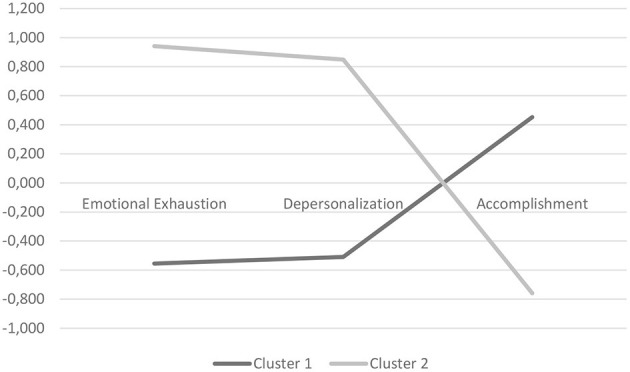
The COVID-19 outbreak has placed extraordinary demands upon healthcare systems worldwide. Italy's hospitals have been among the most severely overwhelmed, and as a result, Italian healthcare workers' (HCWs) well-being has been at risk. The aim of this study is to explore the relationships between dimensions of burnout and various psychological features among Italian healthcare workers (HCWs) during the COVID-19 emergency. A group of 267 HCWs from a hospital in the Lazio Region completed self-administered questionnaires online through Google Forms, including the Maslach Burnout Inventory (MBI), Resilience Scale, and Intolerance of Uncertainty Scale Short Form (IU). Cluster analysis highlighted two opposite burnout risk profiles: low burnout and high-risk burnout. The high-risk group had lower resilience and greater difficulties in tolerating the uncertainty than the low-burnout group. A set of general linear models confirmed that both IU subscales, prospective and inhibition, moderated the relationship between resilience and burnout (specifically in the depersonalization dimension). In conclusion, the results showed that individual levels of resilience and one's ability to tolerate uncertainty have been significant factors in determining the impact of the COVID-19 emergency on HCWs. The use of emotional strategies that allow individuals to stay in a critical situation without the need to control it appears to protect against burnout in these circumstances.
新冠疫情给全球医疗系统带来了巨大压力。意大利的医院是受影响最严重的,因此,意大利医护人员的健康面临风险。本研究旨在探讨新冠疫情期间,意大利医护人员职业倦怠各维度与各种心理特征之间的关系。来自拉齐奥地区一家医院的267名医护人员通过谷歌表单在线完成了自填式问卷,包括马氏职业倦怠量表(MBI)、复原力量表和不确定性不耐受量表简表(IU)。聚类分析突出了两种相反的职业倦怠风险特征:低职业倦怠和高风险职业倦怠。高风险组的复原力低于低职业倦怠组,在容忍不确定性方面也有更大困难。一组一般线性模型证实,IU的两个子量表,即前瞻性和抑制性,调节了复原力与职业倦怠之间的关系(特别是在去个性化维度)。总之,结果表明,个人的复原力水平和容忍不确定性的能力是决定新冠疫情对医护人员影响的重要因素。在这种情况下,使用能让个人在危急情况下无需控制就能保持状态的情绪策略,似乎可以预防职业倦怠。