Hou Dongyao, Liao Haitang, Hao Shuai, Liu Ruixue, Huang He, Duan Chenyang
Department of Anesthesiology, The Second Affiliated Hospital of Chongqing Medical University, Chongqing, 400010, China.
Department of Anesthesiology, Taihe Hospital, Hubei University of Medicine, Shiyan, 442000, China.
Heliyon. 2024 Mar 28;10(7):e28501. doi: 10.1016/j.heliyon.2024.e28501. eCollection 2024 Apr 15.
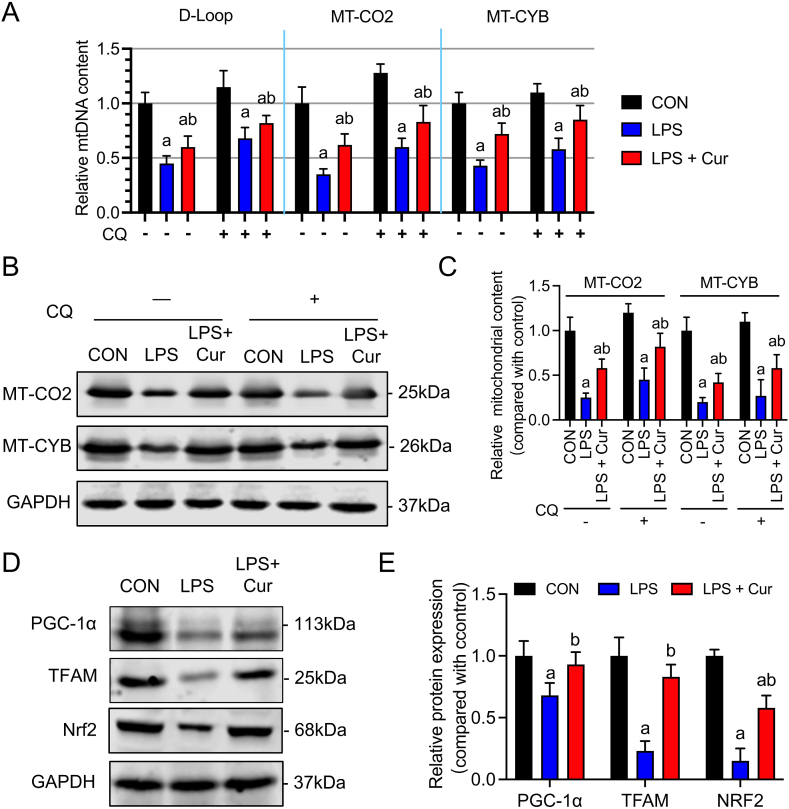
Septic cardiomyopathy (SCM) is associated with an imbalance in mitochondrial quality and high mortality rates, with no effective treatment developed to date. Curcumin provides antioxidant, anti-inflammatory, cardiovascular, and mitochondrial protection. However, curcumin has not been confirmed to improve cardiac dysfunction in sepsis. We hypothesized that curcumin can reduce abnormal inflammatory responses by improving mitochondrial function as a novel mechanism to improve SCM. To explore this hypothesis, we used an male C57BL/6 mouse sepsis model and an model of lipopolysaccharide-stimulated HL-1 cells. The effects of curcumin on sepsis-induced cardiac dysfunction, inflammatory responses, and mitochondrial quality of cardiac cells were observed using quantitative polymerase chain reaction, western blotting, echocardiography, and transmission electron microscopy. Curcumin activated sirtuin 1 (SIRT1); increased expression of the mitochondrial biogenesis-related genes , , and reduced dynamin-related protein 1 translocation from the cytoplasm to mitochondria; and restored the mitochondrial morphology and function in cardiac cells. Accordingly, curcumin protected heart function after septic shock and alleviated the effects of SCM. SIRT1 knockdown reversed the protective effects of curcumin on mitochondria. Therefore, curcumin promotes mitochondrial biogenesis and inhibits mitochondrial fragmentation by activating SIRT1, thereby improving the mitochondrial quality and reducing oxidative stress in cardiomyocytes and sepsis-induced cardiac dysfunction. These findings provide new evidence supporting the use of curcumin to treat SCM.
脓毒症性心肌病(SCM)与线粒体质量失衡及高死亡率相关,迄今为止尚未开发出有效的治疗方法。姜黄素具有抗氧化、抗炎、心血管保护和线粒体保护作用。然而,姜黄素改善脓毒症时心脏功能障碍的作用尚未得到证实。我们假设姜黄素可通过改善线粒体功能来减少异常炎症反应,这是改善SCM的一种新机制。为探究这一假设,我们使用了雄性C57BL/6小鼠脓毒症模型和脂多糖刺激的HL-1细胞模型。通过定量聚合酶链反应、蛋白质印迹法、超声心动图和透射电子显微镜观察姜黄素对脓毒症诱导的心脏功能障碍、炎症反应和心脏细胞线粒体质量的影响。姜黄素激活了沉默调节蛋白1(SIRT1);增加了线粒体生物合成相关基因、和的表达;减少了发动蛋白相关蛋白1从细胞质向线粒体的转位;并恢复了心脏细胞中的线粒体形态和功能。因此,姜黄素在脓毒症休克后保护了心脏功能,并减轻了SCM的影响。SIRT1基因敲低逆转了姜黄素对线粒体的保护作用。因此,姜黄素通过激活SIRT1促进线粒体生物合成并抑制线粒体分裂,从而改善线粒体质量,减轻心肌细胞中的氧化应激及脓毒症诱导的心脏功能障碍。这些发现为支持使用姜黄素治疗SCM提供了新证据。