Wang Hao, Zhu Li-Shuang, Pang Chen-Jiu, Fan Qi
Department of Refractive Surgery, Henan Provincial People's Hospital, Henan Eye Hospital, People's Hospital Affiliated to Zhengzhou University, People's Hospital Affiliated to Henan University, NO.7 Weiwu Road, 450003, Zhengzhou, China.
Department of Blood Transfusion, Zhengzhou People's Hospital, NO.33 Huanghe Road, 450003, Zhengzhou, China.
BMC Ophthalmol. 2024 Apr 22;24(1):182. doi: 10.1186/s12886-024-03448-z.
The precision of anterior segment biometric measurements in eyes has become increasingly important in refractive surgery. The purpose of this study is to assess the repeatability of the automatic measurements provided by a new spectral-domain optical coherence tomograph (SD-OCT)/Placido topographer (MS-39, CSO) and its agreement with a swept-source OCT (SS-OCT) biometer (CASIA SS-1000, Tomey) in patients with myopia.
The right eye of 235 subjects was scanned 3 times with both devices. The evaluated parameters included central corneal radius of the steep meridian, central corneal radius of the flat meridian, mean central corneal radius, thinnest corneal thickness, central corneal thickness, anterior chamber depth, corneal volume and diameter. The intraobserver repeatability of the MS-39 measurements was calculated using intraclass correlation coefficient (ICC), within subject standard deviation, coefficient of repeatability, coefficient of variation and repeated-measures analysis of variance of the 3 repeated measurements. The agreement between the two devices was evaluated by 95% limits of agreement (LoA).
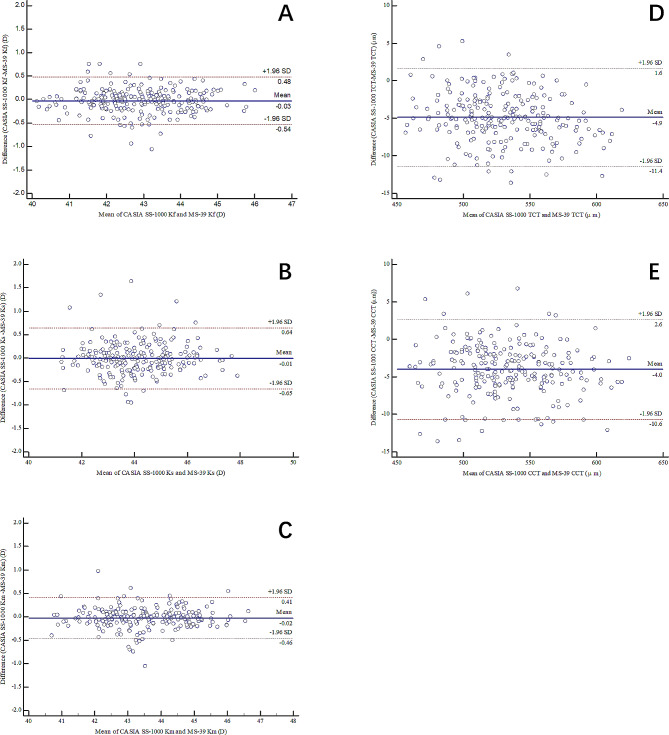
The majority of the parameters acquired from MS-39 showed high repeatability. The repeatability of corneal diameter was slightly lower than the other measurements, although the ICC remained high. Agreement with the CASIA SS-1000 was good, indicated by the Bland-Altman plots with narrow 95% LoA values for all parameters assessed.
The high repeatability of automatic measurements by the new device supports its clinical application in eyes with myopia, and the good agreement between the two devices indicates they could be used interchangeably for the parameters evaluated.
眼前节生物测量的精度在屈光手术中变得越来越重要。本研究的目的是评估一种新型光谱域光学相干断层扫描仪(SD-OCT)/Placido角膜地形图仪(MS-39,CSO)提供的自动测量的可重复性,及其与扫频源OCT(SS-OCT)生物测量仪(CASIA SS-1000,Tomey)在近视患者中的一致性。
用这两种设备对235名受试者的右眼进行3次扫描。评估的参数包括陡峭子午线的中央角膜半径、平坦子午线的中央角膜半径、平均中央角膜半径、最薄角膜厚度、中央角膜厚度、前房深度、角膜体积和直径。使用组内相关系数(ICC)、受试者内标准差、重复性系数、变异系数以及对3次重复测量的重复测量方差分析来计算MS-39测量的观察者内可重复性。通过95%一致性界限(LoA)评估两种设备之间的一致性。
从MS-39获得的大多数参数显示出高可重复性。角膜直径的可重复性略低于其他测量值,尽管ICC仍然很高。与CASIA SS-1000的一致性良好,所有评估参数的Bland-Altman图显示95%LoA值较窄表明了这一点。
新设备自动测量的高可重复性支持其在近视眼中的临床应用,并且两种设备之间的良好一致性表明它们在评估的参数方面可以互换使用。