Department of Psychiatry, Columbia University Irving Medical Center, New York, New York, USA.
Division of Geriatric Psychiatry, New York State Psychiatric Institute, New York, New York, USA.
Alzheimers Dement. 2024 Jun;20(6):4020-4031. doi: 10.1002/alz.13802. Epub 2024 May 1.
The effects of sleep-wake behavior on perceived fatigability and cognitive abilities when performing daily activities have not been investigated across levels of cognitive reserve (CR).
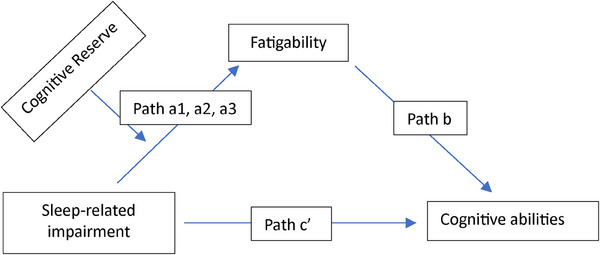
CR Index Questionnaire (CRIq) data were collected and subjected to moderated mediation analysis.
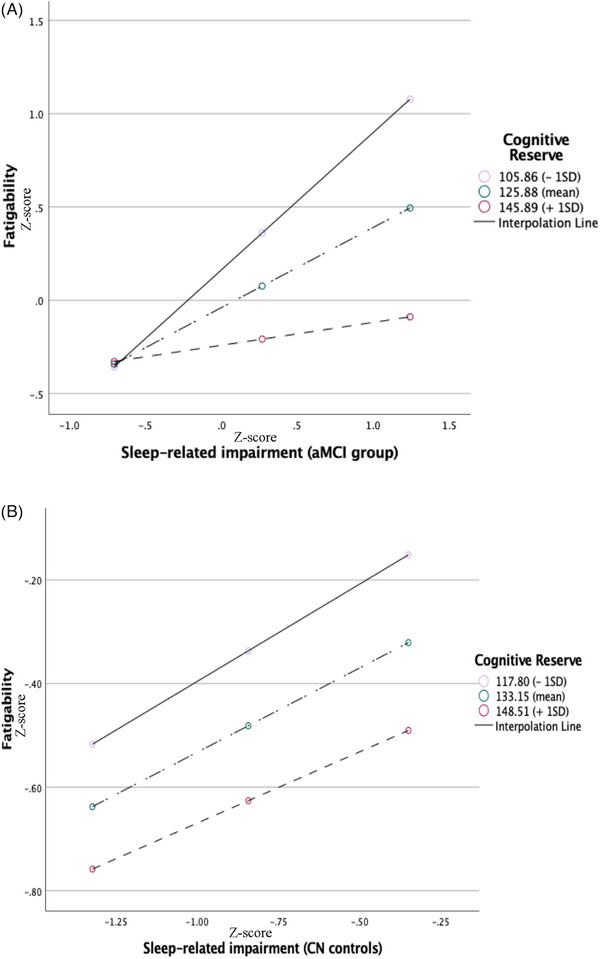
In amnestic mild cognitive impairment (aMCI; n = 41), CR moderated sleep-related impairments (SRIs), and fatigability at low CR (CRIq < 105.8, p = 0.004) and mean CR (CRIq = 126.9, p = 0.03) but not high CR (CRIq > 145.9, p = 0.65) levels. SRI affected cognitive abilities mediated by fatigability at low CR (p < 0.001) and mean CR (p = 0.003) levels. In healthy controls (n = 13), SRI in fatigability did not alter cognitive abilities across CR levels; controls had higher leisure scores than patients with aMCI (p = 0.003, effect size = 0.93).
SRI can amplify impaired cognitive abilities through exacerbation of fatigability in patients with aMCI with below-mean CR. Therefore, improving sleep-wake regulation and leisure activities may protect against fatigability and cognitive decline.
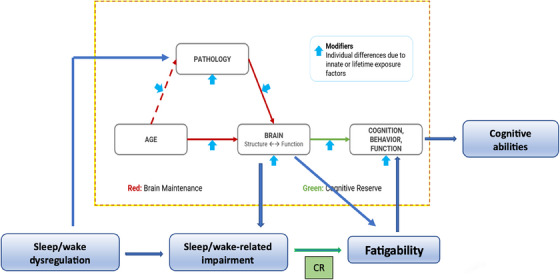
Clinical fatigue and fatigability cannot be alleviated by rest. Clinical fatigability disrupts daily activities during preclinical Alzheimer's. High cognitive reserve mitigates sleep-wake disturbance effects. High cognitive reserve attenuates clinical fatigability effects on daily functioning. Untreated obstructive sleep apnea potentiates Alzheimer's pathology in the brain.
当进行日常活动时,睡眠-觉醒行为对感知疲劳和认知能力的影响尚未在认知储备(CR)的各个水平上进行研究。
收集认知储备指数问卷(CRIq)数据,并进行调节中介分析。
在遗忘型轻度认知障碍(aMCI;n=41)中,CR 调节了与睡眠相关的损害(SRIs)和低 CR(CRIq<105.8,p=0.004)和平均 CR(CRIq=126.9,p=0.03)但不是高 CR(CRIq>145.9,p=0.65)水平的疲劳。低 CR(p<0.001)和平均 CR(p=0.003)水平的疲劳通过 SRI 影响认知能力。在健康对照组(n=13)中,CR 水平下的 SRI 并未改变认知能力;对照组的休闲分数高于 aMCI 患者(p=0.003,效应量=0.93)。
在 CR 低于平均值的 aMCI 患者中,SRI 可能通过加剧疲劳来放大认知能力受损。因此,改善睡眠-觉醒调节和休闲活动可能有助于预防疲劳和认知能力下降。
临床疲劳和疲劳不能通过休息缓解。临床疲劳会在临床前阿尔茨海默病期间扰乱日常活动。高认知储备减轻睡眠-觉醒障碍的影响。高认知储备减轻临床疲劳对日常功能的影响。未经治疗的阻塞性睡眠呼吸暂停会加剧大脑中的阿尔茨海默病病理。