Ahn Sun-Ju, Lee Sungin, Kwon Dayeon, Oh Sejeong, Park Chihye, Jeon Sooyeon, Lee Jin Hee, Kim Tae Sung, Oh Il Ung
Department of Biophysics, Sungkyunkwan University, Suwon, Korea.
Institute of Quantum Biophysics, Sungkyunkwan University, Suwon, Korea.
Int J Stem Cells. 2024 May 30;17(2):102-112. doi: 10.15283/ijsc24047. Epub 2024 May 20.
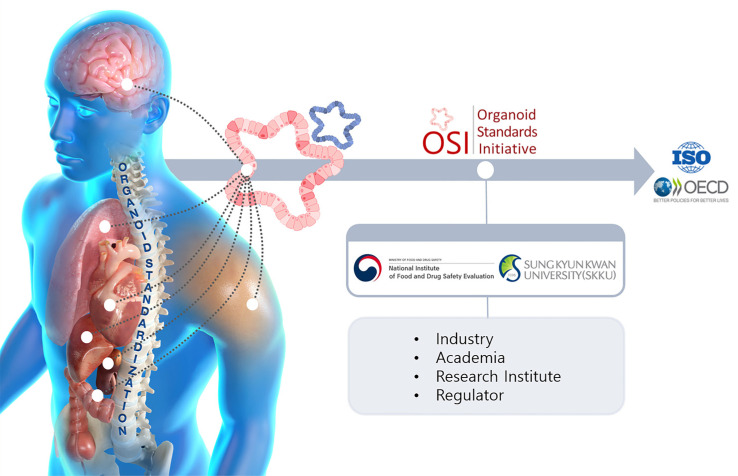
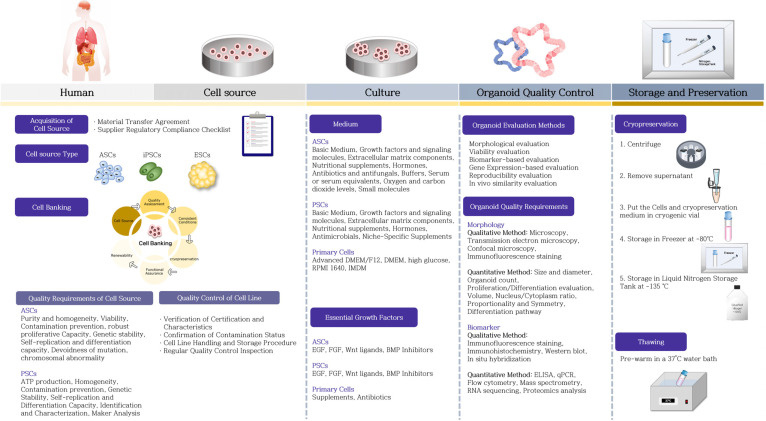
An organoid is a self-organized three-dimensional structure derived from stem cells that mimics the structure, cell composition, and functional characteristics of specific organs and tissues and is used for evaluating the safety and effectiveness of drugs and the toxicity of industrial chemicals. Organoid technology is a new methodology that could replace testing on animals testing and accelerate development of precision and regenerative medicine. However, large variations in production can occur between laboratories with low reproducibility of the production process and no internationally agreed standards for quality evaluation factors at endpoints. To overcome these barriers that hinder the regulatory acceptance and commercialization of organoids, Korea established the Organoid Standards Initiative in September 2023 with various stakeholders, including industry, academia, regulatory agencies, and standard development experts, through public and private partnerships. This developed general guidelines for organoid manufacturing and quality evaluation and for quality evaluation guidelines for organoid-specific manufacturing for the liver, intestines, and heart through extensive evidence analysis and consensus among experts. This report is based on the common standard guideline v1.0, which is a general organoid manufacturing and quality evaluation to promote the practical use of organoids. This guideline does not focus on specific organoids or specific contexts of use but provides guidance to organoid makers and users on materials, procedures, and essential quality assessment methods at end points that are essential for organoid production applicable at the current technology level.
类器官是一种由干细胞衍生而来的自组织三维结构,它模仿特定器官和组织的结构、细胞组成及功能特征,用于评估药物的安全性和有效性以及工业化学品的毒性。类器官技术是一种新方法,有望取代动物实验并加速精准医学和再生医学的发展。然而,不同实验室之间的生产差异可能很大,生产过程的可重复性较低,且在终点质量评估因素方面没有国际公认的标准。为克服这些阻碍类器官获得监管认可和商业化的障碍,韩国于2023年9月通过公私合作,与包括行业、学术界、监管机构和标准制定专家在内的各利益相关方共同发起了类器官标准倡议。通过广泛的证据分析和专家共识,该倡议制定了类器官制造和质量评估的一般指南,以及肝脏、肠道和心脏等特定类器官制造的质量评估指南。本报告基于通用标准指南v1.0,这是一份促进类器官实际应用的类器官制造和质量评估通用指南。该指南并非侧重于特定的类器官或特定的使用场景,而是为类器官制造商和使用者提供有关材料、程序以及在当前技术水平下类器官生产所需的终点基本质量评估方法的指导。