Bommelé Jeroen, Cremers Hans, Den Hollander Wouter, Troelstra Sigrid, Geuke Gemma, Dam Wiebe, Willemse Eefje, Hopman Petra, Hipple Walters Bethany, Willemsen Marc
The Netherlands Expertise Centre for Tobacco Control, Trimbos Institute, Utrecht, The Netherlands.
National Institute for Public Health and the Environment, Bilthoven, Τhe Netherlands.
Tob Induc Dis. 2024 May 17;22. doi: 10.18332/tid/186952. eCollection 2024.
While secondhand smoke exposure in outdoor spaces has been investigated before, no data on outdoor secondhand smoke exposure have been collected in the Netherlands. Such data could help policymakers gain support for smoke-free outdoor public spaces.
Between May and November 2021, we visited 25 outdoor locations across the Netherlands. At each location, we conducted four measurements with smokers and one measurement without smokers. During each measurement, we counted the number of smokers present and we rated tobacco smell intensity on a five-point scale. Airborne nicotine and 3-ethenylpyridine (3-EP) data were collected through active sampling on thermal desorption tubes. The contents of these tubes were later analyzed using gas chromatography-mass spectrometry. Using linear mixed models, we investigated the association between levels of nicotine and the presence of smokers, the number of smokers, and the intensity of tobacco smell. We also investigated these association with levels of 3-EP.
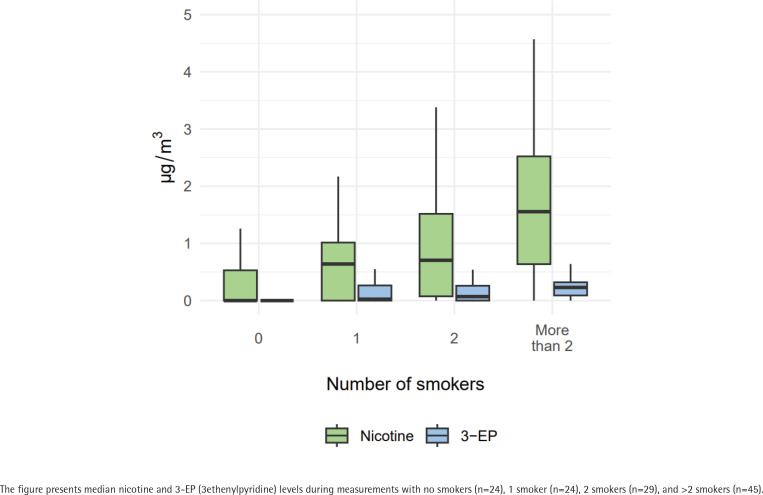
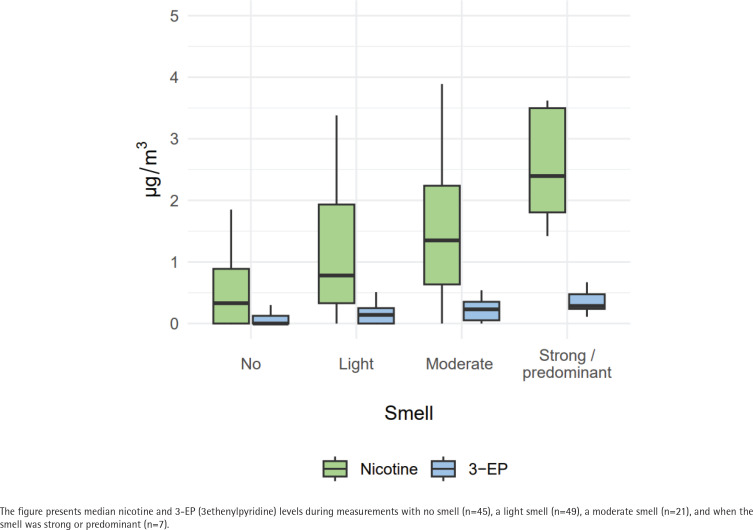
Nicotine levels were higher when smokers were present (B=1.40; 95% CI: 0.69-2.11, p<0.001). For each additional smoker present, we measured higher levels of nicotine (B=0.23; 95% CI: 0.10-0.37, p=0.001). When the smell of tobacco smoke was noted to be stronger by the researchers, higher levels of nicotine were measured through sampling (B=0.85; 95% CI: 0.44-1.26, p<0.001). We found similar results for 3-EP levels.
This study showed that both nicotine and 3-EP are useful in quantifying levels of secondhand smoke in various outdoor locations. The level of nicotine exposure outdoors was positively associated with the number of smokers nearby. The intensity of the tobacco smell was also related to nicotine exposure: the stronger the smell of tobacco smoke, the more nicotine was measured in the air.
虽然此前已对户外空间的二手烟暴露情况进行过调查,但荷兰尚未收集有关户外二手烟暴露的数据。这些数据有助于政策制定者获得对无烟户外公共场所的支持。
在2021年5月至11月期间,我们走访了荷兰的25个户外场所。在每个场所,我们对有吸烟者的情况进行了四次测量,并对无吸烟者的情况进行了一次测量。在每次测量中,我们统计在场吸烟者的数量,并采用五点量表对烟草气味强度进行评分。通过在热解吸管上进行主动采样收集空气中的尼古丁和3-乙烯基吡啶(3-EP)数据。这些管子的内容物随后使用气相色谱-质谱联用仪进行分析。我们使用线性混合模型研究了尼古丁水平与吸烟者在场情况、吸烟者数量以及烟草气味强度之间的关联。我们还研究了这些关联与3-EP水平的关系。
有吸烟者在场时尼古丁水平更高(B = 1.40;95%置信区间:0.69 - 2.11,p < 0.001)。每增加一名吸烟者,我们测得的尼古丁水平就更高(B = 0.23;95%置信区间:0.10 - 0.37,p = 0.001)。当研究人员注意到烟草烟雾的气味更强时,通过采样测得的尼古丁水平更高(B = 0.85;95%置信区间:0.44 - 1.26,p < 0.001)。我们在3-EP水平上发现了类似的结果。
本研究表明,尼古丁和3-EP都有助于量化不同户外场所的二手烟水平。户外尼古丁暴露水平与附近吸烟者的数量呈正相关。烟草气味的强度也与尼古丁暴露有关:烟草烟雾的气味越强,空气中测得的尼古丁就越多。