Tobacco Control Unit, Cancer Control and Prevention Programme, Institut Català d'Oncologia-ICO, L'Hospitalet de Llobregat, Barcelona, Spain.
Environ Health Perspect. 2013 Jul;121(7):766-73. doi: 10.1289/ehp.1205806. Epub 2013 May 7.
Some countries have recently extended smoke-free policies to particular outdoor settings; however, there is controversy regarding whether this is scientifically and ethically justifiable.
The objective of the present study was to review research on secondhand smoke (SHS) exposure in outdoor settings.
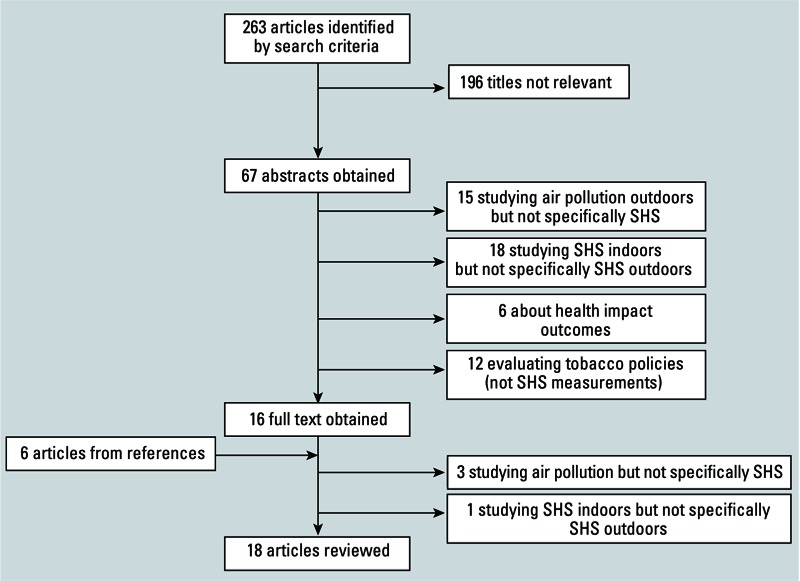
We conducted different searches in PubMed for the period prior to September 2012. We checked the references of the identified papers, and conducted a similar search in Google Scholar.
Our search terms included combinations of "secondhand smoke," "environmental tobacco smoke," "passive smoking" OR "tobacco smoke pollution" AND "outdoors" AND "PM" (particulate matter), "PM(2.5)" (PM with diameter ≤ 2.5 µm), "respirable suspended particles," "particulate matter," "nicotine," "CO" (carbon monoxide), "cotinine," "marker," "biomarker" OR "airborne marker." In total, 18 articles and reports met the inclusion criteria.
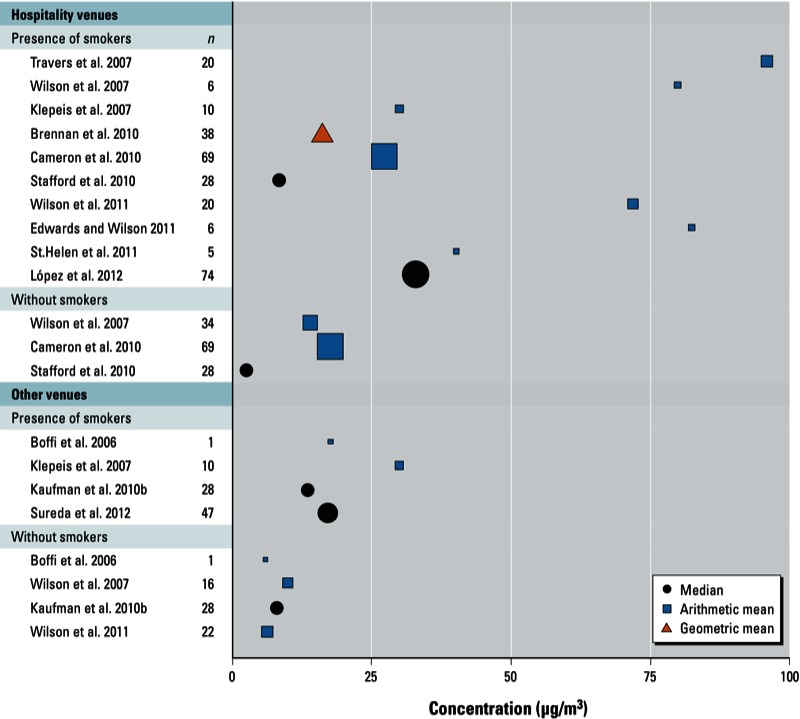
Almost all studies used PM(2.5) concentration as an SHS marker. Mean PM(2.5) concentrations reported for outdoor smoking areas when smokers were present ranged from 8.32 to 124 µg/m(3) at hospitality venues, and 4.60 to 17.80 µg/m(3) at other locations. Mean PM(2.5) concentrations in smoke-free indoor settings near outdoor smoking areas ranged from 4 to 120.51 µg/m(3). SHS levels increased when smokers were present, and outdoor and indoor SHS levels were related. Most studies reported a positive association between SHS measures and smoker density, enclosure of outdoor locations, wind conditions, and proximity to smokers.
The available evidence indicates high SHS levels at some outdoor smoking areas and at adjacent smoke-free indoor areas. Further research and standardization of methodology is needed to determine whether smoke-free legislation should be extended to outdoor settings.
最近,一些国家将无烟政策扩大到特定的户外场所,但对于这在科学和伦理上是否合理存在争议。
本研究旨在综述户外环境中二手烟(SHS)暴露的研究。
我们在 PubMed 上针对 2012 年 9 月之前的时间段进行了不同的检索。我们检查了已确定论文的参考文献,并在 Google Scholar 上进行了类似的搜索。
我们的搜索词包括“二手烟”、“环境烟草烟雾”、“被动吸烟”或“烟草烟雾污染”与“户外”和“PM”(颗粒物)、“PM(2.5)”(直径≤2.5 µm 的 PM)、“可吸入悬浮颗粒物”、“颗粒物”、“尼古丁”、“CO”(一氧化碳)、“可替宁”、“标志物”、“生物标志物”或“空气传播标志物”的组合。共有 18 篇文章和报告符合纳入标准。
几乎所有研究都使用 PM(2.5)浓度作为 SHS 标志物。当吸烟者在场时,报告的户外吸烟区的 PM(2.5)浓度平均值在接待场所为 8.32 至 124 µg/m(3),在其他场所为 4.60 至 17.80 µg/m(3)。户外吸烟区附近无烟室内环境的 PM(2.5)浓度平均值在 4 至 120.51 µg/m(3)之间。当吸烟者在场时,SHS 水平会升高,户外和室内 SHS 水平也存在关联。大多数研究报告称,SHS 测量值与吸烟者密度、户外场所的封闭程度、风向条件和与吸烟者的距离之间存在正相关关系。
现有证据表明,一些户外吸烟区和相邻的无烟室内区域的 SHS 水平较高。需要进一步研究和方法标准化,以确定是否应将无烟立法扩大到户外场所。