Yuan Hang, Plekhanova Tatiana, Walmsley Rosemary, Reynolds Amy C, Maddison Kathleen J, Bucan Maja, Gehrman Philip, Rowlands Alex, Ray David W, Bennett Derrick, McVeigh Joanne, Straker Leon, Eastwood Peter, Kyle Simon D, Doherty Aiden
Nuffield Department of Population Health, University of Oxford, Oxford, UK.
Big Data Institute, Li Ka Shing Centre for Health Information and Discovery, University of Oxford, Oxford, UK.
NPJ Digit Med. 2024 May 20;7(1):86. doi: 10.1038/s41746-024-01065-0.
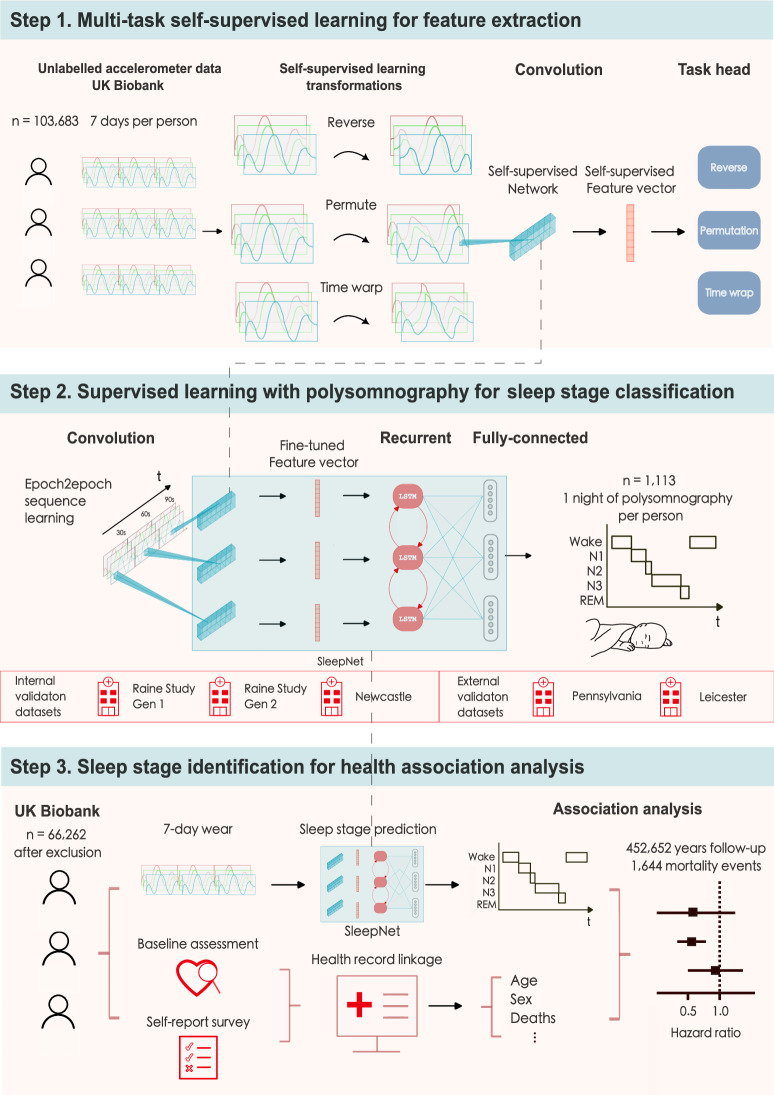
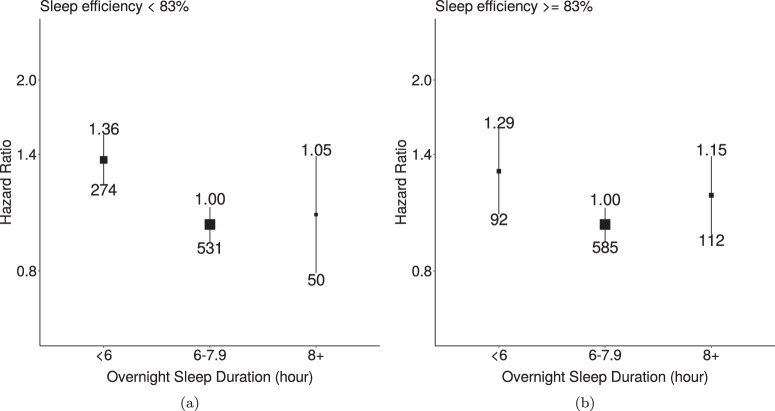
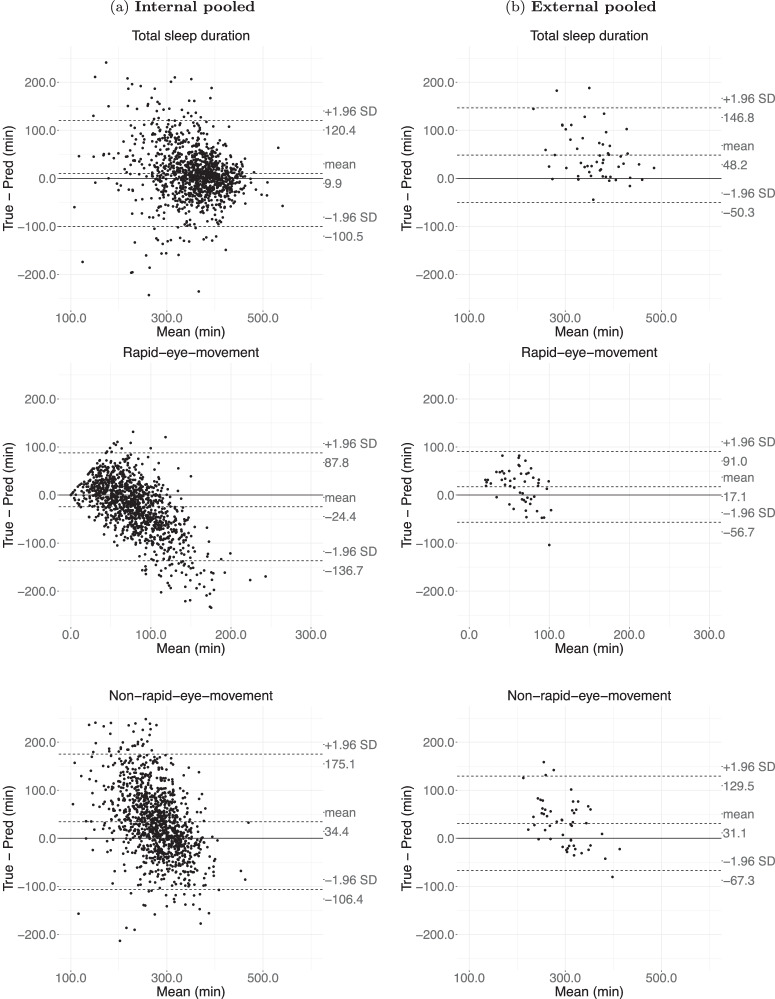
Sleep is essential to life. Accurate measurement and classification of sleep/wake and sleep stages is important in clinical studies for sleep disorder diagnoses and in the interpretation of data from consumer devices for monitoring physical and mental well-being. Existing non-polysomnography sleep classification techniques mainly rely on heuristic methods developed in relatively small cohorts. Thus, we aimed to establish the accuracy of wrist-worn accelerometers for sleep stage classification and subsequently describe the association between sleep duration and efficiency (proportion of total time asleep when in bed) with mortality outcomes. We developed a self-supervised deep neural network for sleep stage classification using concurrent laboratory-based polysomnography and accelerometry. After exclusion, 1448 participant nights of data were used for training. The difference between polysomnography and the model classifications on the external validation was 34.7 min (95% limits of agreement (LoA): -37.8-107.2 min) for total sleep duration, 2.6 min for REM duration (95% LoA: -68.4-73.4 min) and 32.1 min (95% LoA: -54.4-118.5 min) for NREM duration. The sleep classifier was deployed in the UK Biobank with 100,000 participants to study the association of sleep duration and sleep efficiency with all-cause mortality. Among 66,214 UK Biobank participants, 1642 mortality events were observed. Short sleepers (<6 h) had a higher risk of mortality compared to participants with normal sleep duration of 6-7.9 h, regardless of whether they had low sleep efficiency (Hazard ratios (HRs): 1.58; 95% confidence intervals (CIs): 1.19-2.11) or high sleep efficiency (HRs: 1.45; 95% CIs: 1.16-1.81). Deep-learning-based sleep classification using accelerometers has a fair to moderate agreement with polysomnography. Our findings suggest that having short overnight sleep confers mortality risk irrespective of sleep continuity.
睡眠对生命至关重要。准确测量和分类睡眠/觉醒及睡眠阶段,对于睡眠障碍诊断的临床研究以及解读用于监测身心健康的消费设备所采集的数据而言十分重要。现有的非多导睡眠图睡眠分类技术主要依赖于在相对较小队列中开发的启发式方法。因此,我们旨在确定腕部佩戴式加速度计进行睡眠阶段分类的准确性,并随后描述睡眠时间和效率(卧床时的总睡眠时间比例)与死亡率之间的关联。我们使用同步的基于实验室的多导睡眠图和加速度测量数据,开发了一种用于睡眠阶段分类的自监督深度神经网络。排除相关数据后,1448个参与者夜晚的数据用于训练。在外部验证中,多导睡眠图与模型分类在总睡眠时间上的差异为34.7分钟(95%一致性界限(LoA):-37.8至107.2分钟),快速眼动(REM)睡眠时间差异为2.6分钟(95% LoA:-68.4至73.4分钟),非快速眼动(NREM)睡眠时间差异为32.1分钟(95% LoA:-54.4至118.5分钟)。睡眠分类器在拥有10万名参与者的英国生物银行中进行部署,以研究睡眠时间和睡眠效率与全因死亡率之间的关联。在66214名英国生物银行参与者中,观察到1642例死亡事件。与睡眠时间正常为6至7.9小时的参与者相比,睡眠不足者(<6小时)的死亡风险更高,无论他们的睡眠效率是低(风险比(HRs):1.58;95%置信区间(CIs):1.19至2.11)还是高(HRs:1.45;95% CIs:1.16至1.81)。使用加速度计基于深度学习的睡眠分类与多导睡眠图有中等程度的一致性。我们的研究结果表明,夜间睡眠时间短会带来死亡风险,而与睡眠连续性无关。