Carr Tony W, Addo Felicity, Palazzo Amanda, Havlik Petr, Pérez-Guzmán Katya, Ali Zakari, Green Rosemary, Hadida Genevieve, Segnon Alcade C, Zougmoré Robert, Scheelbeek Pauline
Department of Population Health, London School of Hygiene & Tropical Medicine, London, UK.
International Institute for Applied Systems Analysis, Laxenburg, Austria.
Food Secur. 2024;16(3):691-704. doi: 10.1007/s12571-024-01444-1. Epub 2024 Apr 26.
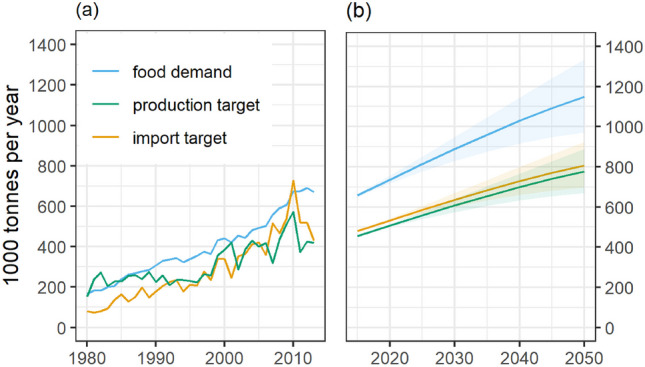
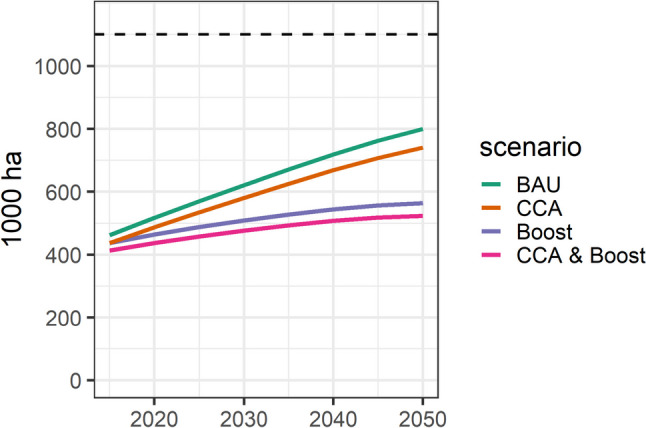
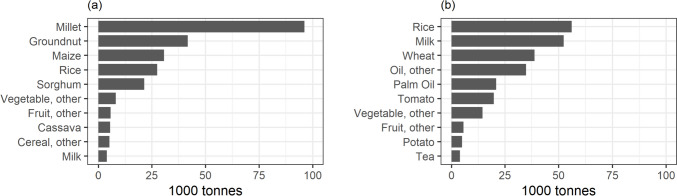
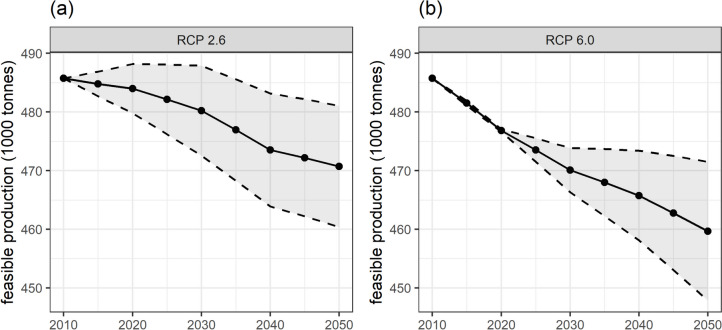
With rising demand for food and the threats posed by climate change, The Gambia faces significant challenges in ensuring sufficient and nutritious food for its population. To address these challenges, there is a need to increase domestic food production while limiting deforestation and land degradation. In this study, we modified the FABLE Calculator, a food and land-use system model, to focus on The Gambia to simulate scenarios for future food demand and increasing domestic food production. We considered the impacts of climate change on crops, the adoption of climate change adaptation techniques, as well as the potential of enhanced fertiliser use and irrigation to boost crop productivity, and assessed whether these measures would be sufficient to meet the projected increase in food demand. Our results indicate that domestic food production on existing cropland will not be sufficient to meet national food demand by 2050, leading to a significant supply-demand gap. However, investments in fertiliser availability and the development of sustainable irrigation infrastructure, coupled with climate change adaptation strategies like the adoption of climate-resilient crop varieties and optimised planting dates, could halve this gap. Addressing the remaining gap will require additional strategies, such as increasing imports, expanding cropland, or prioritising the production of domestic food crops over export crops. Given the critical role imports play in The Gambia's food supply, it is essential to ensure a robust flow of food imports by diversifying partners and addressing regional trade barriers. Our study highlights the urgent need for sustained investment and policy support to enhance domestic food production and food imports to secure sufficient and healthy food supplies amidst growing demand and climate change challenges.
The online version contains supplementary material available at 10.1007/s12571-024-01444-1.
随着对粮食需求的不断增加以及气候变化带来的威胁,冈比亚在确保其人口获得充足且营养丰富的食物方面面临重大挑战。为应对这些挑战,有必要增加国内粮食产量,同时限制森林砍伐和土地退化。在本研究中,我们对粮食与土地利用系统模型FABLE计算器进行了修改,使其聚焦于冈比亚,以模拟未来粮食需求和增加国内粮食产量的情景。我们考虑了气候变化对作物的影响、气候变化适应技术的采用,以及增加肥料使用和灌溉以提高作物生产力的潜力,并评估这些措施是否足以满足预计的粮食需求增长。我们的结果表明,到2050年,现有农田的国内粮食产量将不足以满足国家粮食需求,导致显著的供需缺口。然而,对肥料供应的投资和可持续灌溉基础设施的发展,再加上采用抗气候作物品种和优化种植日期等气候变化适应策略,可能会使这一缺口减半。解决剩余的缺口将需要额外的策略,例如增加进口、扩大耕地,或优先生产国内粮食作物而非出口作物。鉴于进口在冈比亚粮食供应中所起的关键作用,通过使伙伴多样化和消除区域贸易壁垒来确保粮食进口的强劲流动至关重要。我们的研究强调,迫切需要持续的投资和政策支持,以提高国内粮食产量和粮食进口,以便在需求不断增长和气候变化挑战的背景下确保充足且健康的粮食供应。
在线版本包含可在10.1007/s12571-024-01444-1获取的补充材料。