Ali Zakari, Scheelbeek Pauline F D, Felix Jyoti, Jallow Bakary, Palazzo Amanda, Segnon Alcade C, Havlík Petr, Prentice Andrew M, Green Rosemary
Nutrition and Planetary Health Theme, MRC Unit The Gambia at the London School of Hygiene and Tropical Medicine, Banjul, The Gambia.
Faculty of Epidemiology and Population Health, London School of Hygiene and Tropical Medicine, London, United Kingdom.
Environ Res Lett. 2022 Oct 1;17(10):104043. doi: 10.1088/1748-9326/ac9326. Epub 2022 Oct 6.
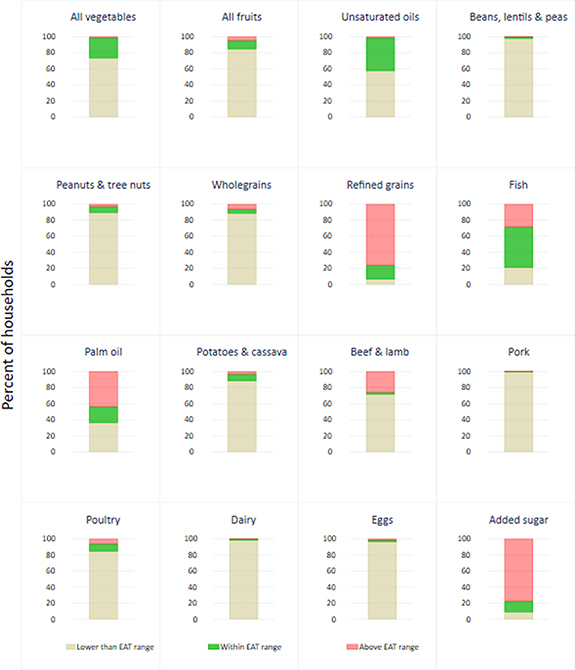
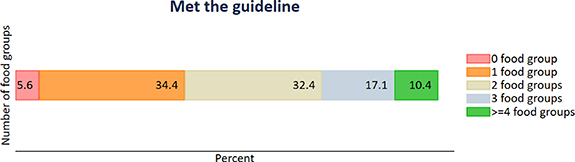
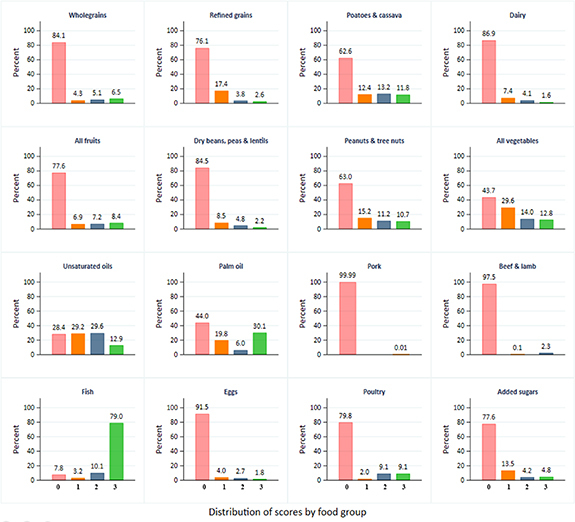
Facilitating dietary change is pivotal to improving population health, increasing food system resilience, and minimizing adverse impacts on the environment, but assessment of the current 'status-quo' and identification of bottlenecks for improvement has been lacking to date. We assessed deviation of the Gambian diet from the EAT-Lancet guidelines for healthy and sustainable diets and identified leverage points to improve nutritional and planetary health. We analysed the 2015/16 Gambian Integrated Household Survey dataset comprising food consumption data from 12 713 households. Consumption of different food groups was compared against the EAT-Lancet reference diet targets to assess deviation from the guidelines. We computed a 'sustainable and healthy diet index (SHDI)' based on deviation of different food groups from the EAT-Lancet recommendations and modelled the socio-economic and geographic determinants of households that achieved higher scores on this index, using multivariable mixed effects regression. The average Gambian diet had very low adherence to EAT-Lancet recommendations. The diet was dominated by refined grains and added sugars which exceeded the recommendations. SHDI scores for nutritionally important food groups such as fruits, vegetables, nuts, dairy, poultry, and beef and lamb were low. Household characteristics associated with higher SHDI scores included: being a female-headed household, having a relatively small household size, having a schooled head of the household, having a high wealth index, and residing in an urban settlement. Furthermore, diets reported in the dry season and households with high crop production diversity showed increased adherence to the targets. While average Gambian diets include lower amounts of food groups with harmful environmental footprint, they are also inadequate in healthy food groups and are high in sugar. There are opportunities to improve diets without increasing their environmental footprint by focusing on the substitution of refined grains by wholegrains, reducing sugar and increasing fruit and vegetables consumption.
促进饮食改变对于改善民众健康、增强食物系统韧性以及将对环境的不利影响降至最低至关重要,但迄今为止,仍缺乏对当前“现状”的评估以及对改进瓶颈的识别。我们评估了冈比亚饮食与EAT-柳叶刀健康和可持续饮食指南的偏差,并确定了改善营养和地球健康的杠杆点。我们分析了2015/16年冈比亚综合住户调查数据集,该数据集包含来自12713户家庭的食物消费数据。将不同食物组的消费量与EAT-柳叶刀参考饮食目标进行比较,以评估与指南的偏差。我们根据不同食物组与EAT-柳叶刀建议的偏差计算了一个“可持续健康饮食指数(SHDI)”,并使用多变量混合效应回归对在该指数上得分较高的家庭的社会经济和地理决定因素进行建模。冈比亚的平均饮食对EAT-柳叶刀建议的遵循程度很低。饮食以精制谷物和添加糖为主,均超过了建议量。水果、蔬菜、坚果、乳制品、家禽以及牛肉和羊肉等营养重要食物组的SHDI得分较低。与较高SHDI得分相关的家庭特征包括:女性为户主的家庭、家庭规模相对较小、户主受过教育、财富指数较高以及居住在城市地区。此外,旱季报告的饮食以及作物生产多样性高的家庭对目标的遵循程度有所提高。虽然冈比亚的平均饮食中对环境足迹有害的食物组含量较低,但健康食物组含量也不足,且糖分含量较高。通过专注于用全谷物替代精制谷物、减少糖分并增加水果和蔬菜的消费量,有机会在不增加环境足迹的情况下改善饮食。