Guangxi Key Laboratory of Special Biomedicine, School of Medicine, Guangxi University, Nanning, Guangxi, 530004, PR China.
Department of Gastroenterology, People's Hospital of Guangxi Zhuang Autonomous Region, Nanning, Guangxi, 530021, PR China.
BMC Cancer. 2024 May 27;24(1):644. doi: 10.1186/s12885-024-12321-7.
Understanding the metabolic changes in colorectal cancer (CRC) and exploring potential diagnostic biomarkers is crucial for elucidating its pathogenesis and reducing mortality. Cancer cells are typically derived from cancer tissues and can be easily obtained and cultured. Systematic studies on CRC cells at different stages are still lacking. Additionally, there is a need to validate our previous findings from human serum.
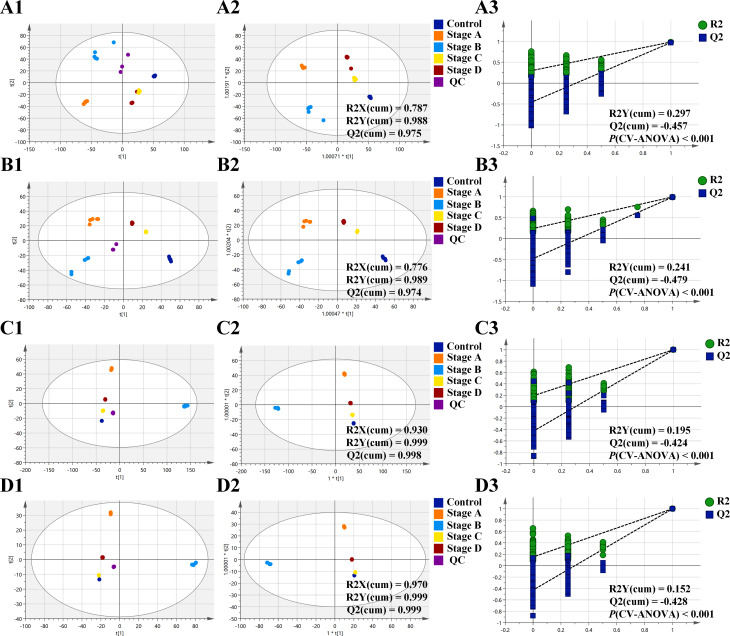
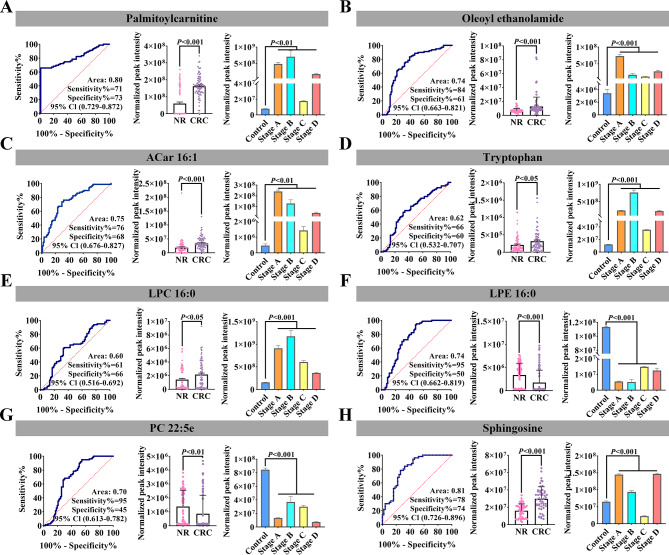
Ultrahigh-performance liquid chromatography tandem high-resolution mass spectrometry (UHPLC-HRMS)-based metabolomics and lipidomics were employed to comprehensively measure metabolites and lipids in CRC cells at four different stages and serum samples from normal control (NR) and CRC subjects. Univariate and multivariate statistical analyses were applied to select the differential metabolites and lipids between groups. Biomarkers with good diagnostic efficacy for CRC that existed in both cells and serum were screened by the receiver operating characteristic curve (ROC) analysis. Furthermore, potential biomarkers were validated using metabolite standards.
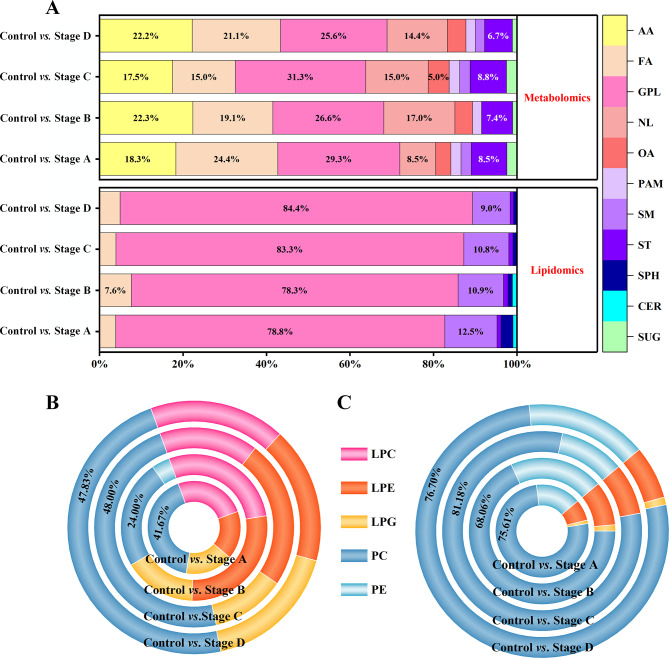
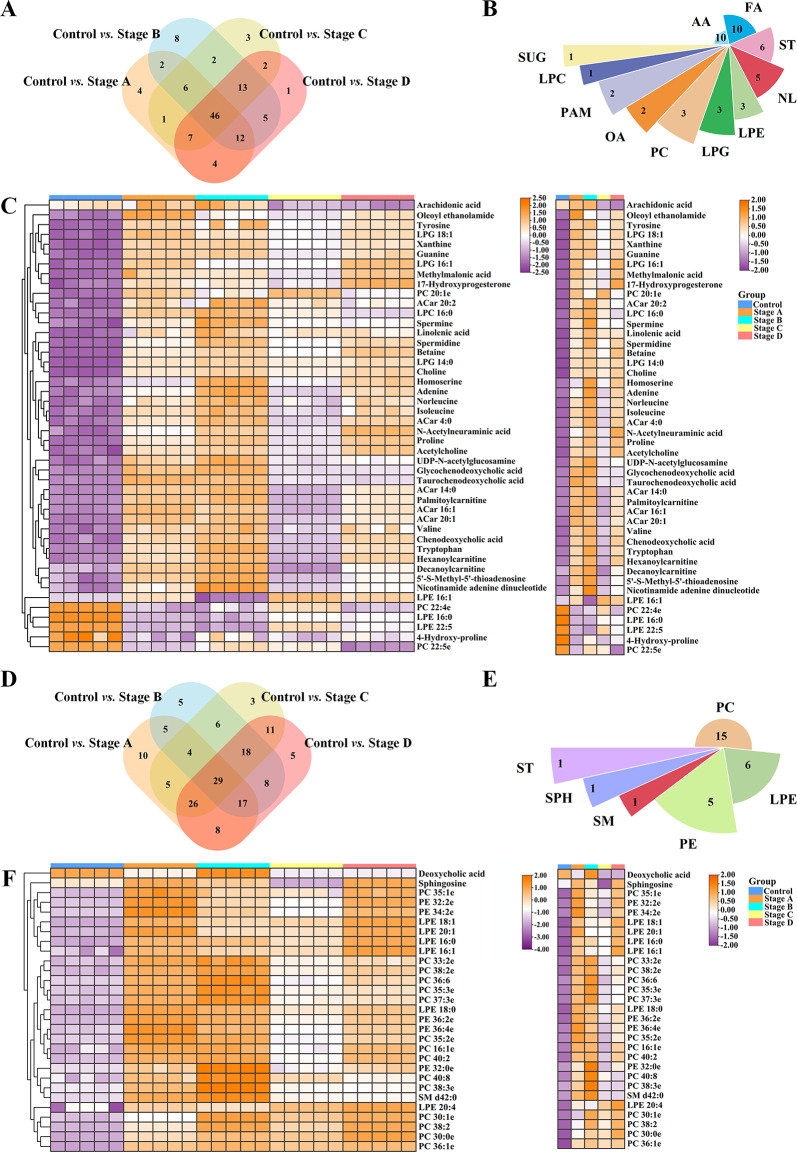
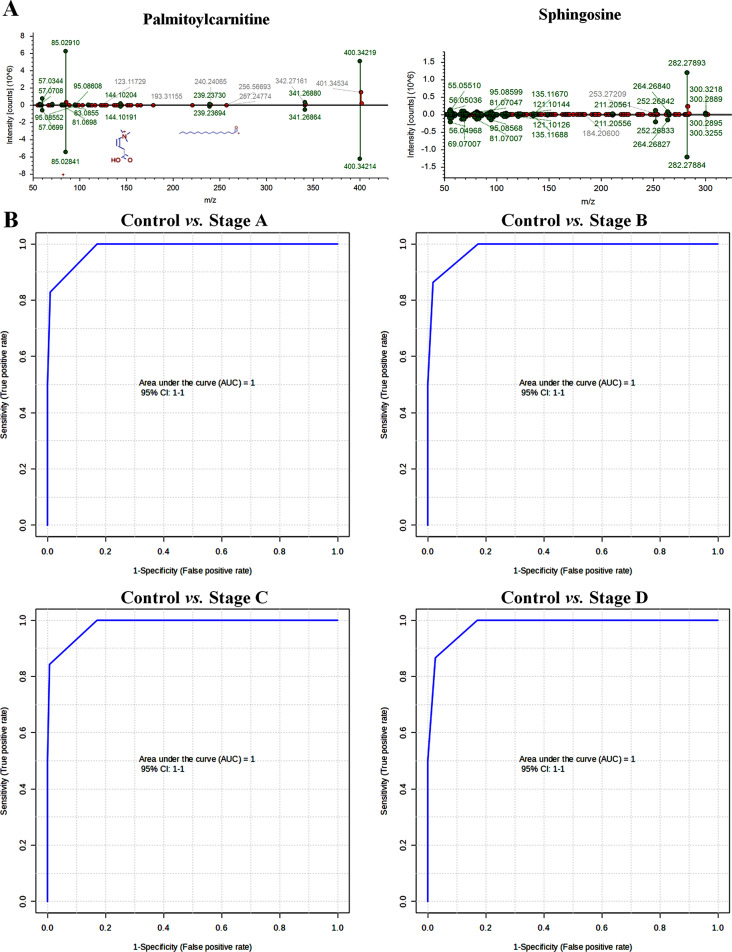
Metabolite and lipid profiles differed significantly among CRC cells at stages A, B, C, and D. Dysregulation of glycerophospholipid (GPL), fatty acid (FA), and amino acid (AA) metabolism played a crucial role in the CRC progression, particularly GPL metabolism dominated by phosphatidylcholine (PC). A total of 46 differential metabolites and 29 differential lipids common to the four stages of CRC cells were discovered. Eight metabolites showed the same trends in CRC cells and serum from CRC patients compared to the control groups. Among them, palmitoylcarnitine and sphingosine could serve as potential biomarkers with the values of area under the curve (AUC) more than 0.80 in the serum and cells. Their panel exhibited excellent performance in discriminating CRC cells at different stages from normal cells (AUC = 1.00).
To our knowledge, this is the first research to attempt to validate the results of metabolism studies of serum from CRC patients using cell models. The metabolic disorders of PC, FA, and AA were closely related to the tumorigenesis of CRC, with PC being the more critical factor. The panel composed of palmitoylcarnitine and sphingosine may act as a potential biomarker for the diagnosis of CRC, aiding in its prevention.
了解结直肠癌(CRC)的代谢变化,探索潜在的诊断生物标志物,对于阐明其发病机制和降低死亡率至关重要。癌细胞通常来源于癌组织,容易获得和培养。目前还缺乏对不同阶段 CRC 细胞的系统研究。此外,还需要验证我们之前从人血清中获得的发现。
采用超高效液相色谱串联高分辨质谱(UHPLC-HRMS)代谢组学和脂质组学方法,全面测定 4 个不同阶段 CRC 细胞和正常对照(NR)及 CRC 患者血清中的代谢物和脂质。应用单变量和多变量统计分析方法筛选组间差异代谢物和脂质。通过受试者工作特征曲线(ROC)分析筛选在细胞和血清中均存在且对 CRC 诊断效能良好的生物标志物。然后,利用代谢物标准品对潜在生物标志物进行验证。
CRC 细胞在 A、B、C 和 D 期的代谢物和脂质图谱存在显著差异。甘油磷脂(GPL)、脂肪酸(FA)和氨基酸(AA)代谢的失调在 CRC 进展中起着关键作用,特别是以磷脂酰胆碱(PC)为主的 GPL 代谢。共发现 46 种差异代谢物和 29 种差异脂质在 CRC 细胞的四个阶段共同存在。与对照组相比,在 CRC 细胞和 CRC 患者血清中发现了 8 种具有相同变化趋势的代谢物。其中,棕榈酰肉碱和神经鞘氨醇可作为潜在的生物标志物,在血清和细胞中的曲线下面积(AUC)值均大于 0.80。它们的组合在区分不同阶段的 CRC 细胞与正常细胞方面表现出优异的性能(AUC=1.00)。
据我们所知,这是首次尝试使用细胞模型验证 CRC 患者血清代谢研究结果的研究。PC、FA 和 AA 的代谢紊乱与 CRC 的发生密切相关,其中 PC 是更为关键的因素。由棕榈酰肉碱和神经鞘氨醇组成的标志物可能作为 CRC 诊断的潜在生物标志物,有助于其预防。