Dhingra Lovedeep S, Aminorroaya Arya, Pedroso Aline F, Khunte Akshay, Sangha Veer, McIntyre Daniel, Chow Clara K, Asselbergs Folkert W, Brant Luisa Cc, Barreto Sandhi M, Ribeiro Antonio Luiz P, Krumholz Harlan M, Oikonomou Evangelos K, Khera Rohan
Section of Cardiovascular Medicine, Department of Internal Medicine, Yale School of Medicine, New Haven, CT, USA.
Department of Computer Science, Yale University, New Haven, CT, USA.
medRxiv. 2024 Dec 21:2024.05.27.24307952. doi: 10.1101/2024.05.27.24307952.
Despite the availability of disease-modifying therapies, scalable strategies for heart failure (HF) risk stratification remain elusive. Portable devices capable of recording single-lead electrocardiograms (ECGs) can enable large-scale community-based risk assessment.
To evaluate an artificial intelligence (AI) algorithm to predict HF risk from noisy single-lead ECGs.
Multicohort study.
Retrospective cohort of individuals with outpatient ECGs in the integrated Yale New Haven Health System (YNHHS) and prospective population-based cohorts of UK Biobank (UKB) and Brazilian Longitudinal Study of Adult Health (ELSA-Brasil).
Individuals without HF at baseline.
AI-ECG-defined risk of left ventricular systolic dysfunction (LVSD).
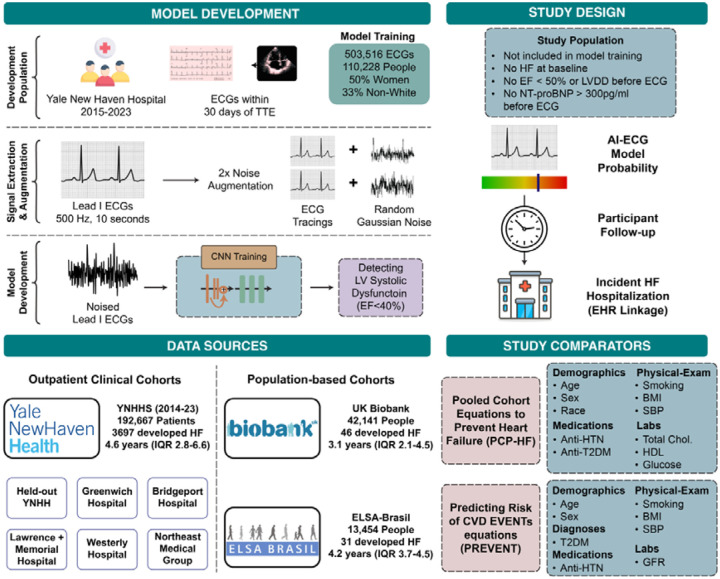
Among individuals with ECGs, we isolated lead I ECGs and deployed a noise-adapted AI-ECG model trained to identify LVSD. We evaluated the association of the model probability with new-onset HF, defined as the first HF hospitalization. We compared the discrimination of AI-ECG against two risk scores for new-onset HF (PCP-HF and PREVENT equations) using Harrel's C-statistic, integrated discrimination improvement (IDI), and net reclassification improvement (NRI).
There were 192,667 YNHHS patients (age 56 years [IQR, 41-69], 112,082 women [58%]), 42,141 UKB participants (65 years [59-71], 21,795 women [52%]), and 13,454 ELSA-Brasil participants (56 years [41-69], 7,348 women [55%]) with baseline ECGs. A total of 3,697 developed HF in YNHHS over 4.6 years (2.8-6.6), 46 in UKB over 3.1 years (2.1-4.5), and 31 in ELSA-Brasil over 4.2 years (3.7-4.5). A positive AI-ECG screen was associated with a 3- to 7-fold higher risk for HF, and each 0.1 increment in the model probability portended a 27-65% higher hazard across cohorts, independent of age, sex, comorbidities, and competing risk of death. AI-ECG's discrimination for new-onset HF was 0.725 in YNHHS, 0.792 in UKB, and 0.833 in ELSA-Brasil. Across cohorts, incorporating AI-ECG predictions in addition to PCP-HF and PREVENT equations resulted in improved Harrel's C-statistic (Δ=0.112-0.114; Δ=0.080-0.101). AI-ECG had IDI of 0.094-0.238 and 0.090-0.192, and NRI of 15.8%-48.8% and 12.8%-36.3%, vs. PCP-HF and PREVENT, respectively.
Across multinational cohorts, a noise-adapted AI model defined HF risk using lead I ECGs, suggesting a potential portable and wearable device-based HF risk-stratification strategy.
尽管有疾病改善疗法,但心力衰竭(HF)风险分层的可扩展策略仍然难以捉摸。能够记录单导联心电图(ECG)的便携式设备可实现基于社区的大规模风险评估。
评估一种人工智能(AI)算法,以从嘈杂的单导联心电图预测HF风险。
多队列研究。
耶鲁纽黑文医疗系统(YNHHS)综合门诊心电图患者的回顾性队列,以及英国生物银行(UKB)和巴西成人健康纵向研究(ELSA - Brasil)基于人群的前瞻性队列。
基线时无HF的个体。
AI - ECG定义的左心室收缩功能障碍(LVSD)风险。
在有心电图的个体中,我们分离出I导联心电图,并部署了经过噪声适应训练以识别LVSD的AI - ECG模型。我们评估了模型概率与新发HF(定义为首次HF住院)的关联。我们使用Harrel's C统计量、综合判别改善(IDI)和净重新分类改善(NRI),比较了AI - ECG与两种新发HF风险评分(PCP - HF和PREVENT方程)的判别能力。
YNHHS有192,667名患者(年龄56岁[四分位间距,41 - 69岁],112,082名女性[58%]),UKB有42,141名参与者(65岁[59 - 71岁],21,795名女性[52%]),ELSA - Brasil有13,454名参与者(56岁[41 - 69岁],7,348名女性[55%])有基线心电图。在YNHHS中,4.6年(2.8 - 6.6年)内共有3,697人发生HF,UKB在3.1年(2.1 - 4.5年)内有46人,ELSA - Brasil在4.2年(3.7 - 4.5年)内有31人。AI - ECG筛查阳性与HF风险高3至7倍相关,模型概率每增加0.1,各队列的风险增加27% - 65%,与年龄、性别、合并症和死亡竞争风险无关。AI - ECG对新发HF的判别能力在YNHHS中为0.725,在UKB中为0.792,在ELSA - Brasil中为0.833。在各队列中,除了PCP - HF和PREVENT方程外纳入AI - ECG预测可改善Harrel's C统计量(Δ = 0.112 - 0.114;Δ = 0.080 - 0.101)。与PCP - HF和PREVENT相比,AI - ECG的IDI分别为0.094 - 0.238和0.090 - 0.192,NRI分别为15.8% - 48.8%和12.8% - 36.3%。
在跨国队列中,一种经过噪声适应的AI模型使用I导联心电图定义HF风险,提示了一种基于便携式和可穿戴设备的潜在HF风险分层策略。