Donnay Corinne, Okar Serhat V, Tsagkas Charidimos, Gaitán María I, Poorman Megan, Reich Daniel S, Nair Govind
Translational Neuroradiology Section, National Institutes of Health, National Institute of Neurological Disorders and Stroke, Bethesda, MD, United States.
Wellcome Centre for Integrative Neuroimaging, FMRIB, Nuffield Department of Clinical Neurosciences, University of Oxford, Oxford, United Kingdom.
Front Neurol. 2024 May 24;15:1330203. doi: 10.3389/fneur.2024.1330203. eCollection 2024.
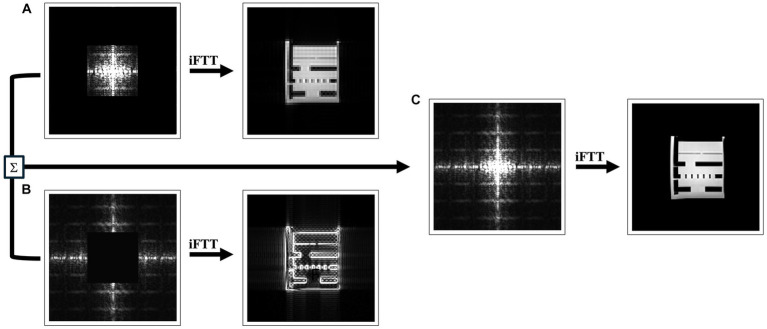
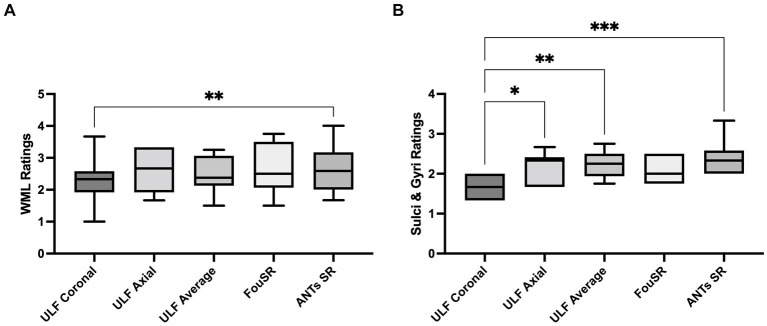
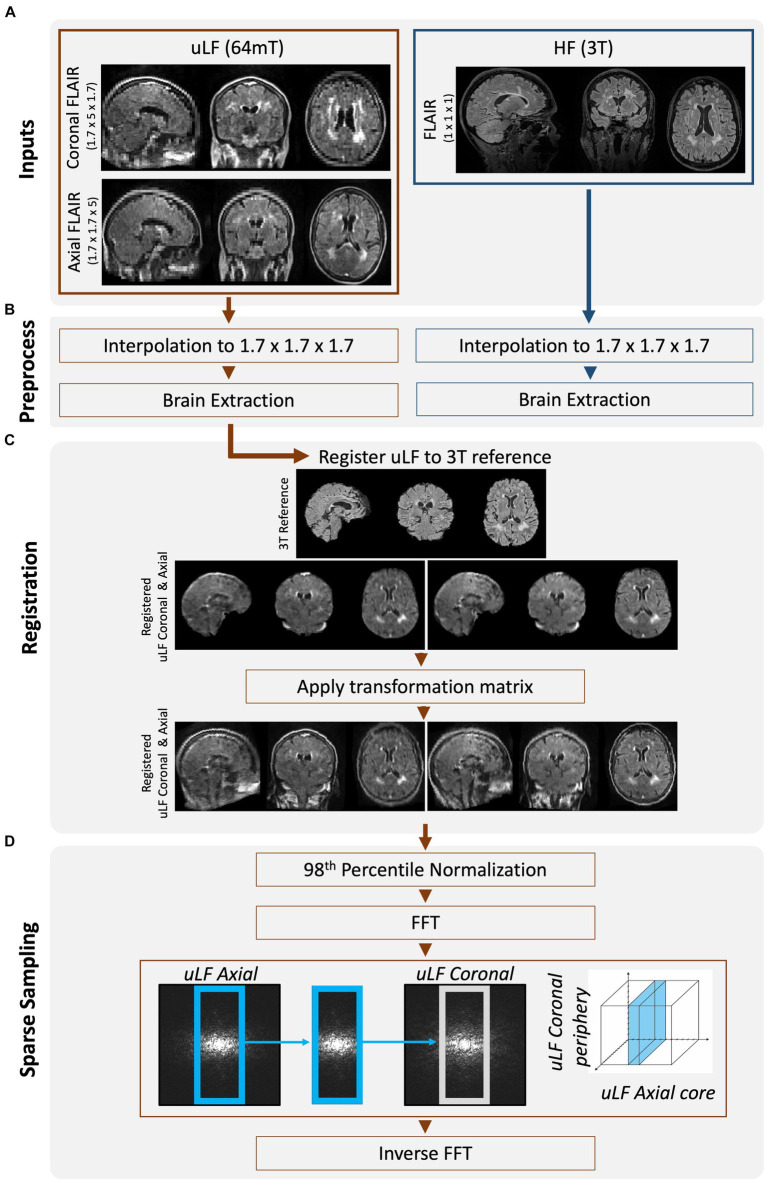
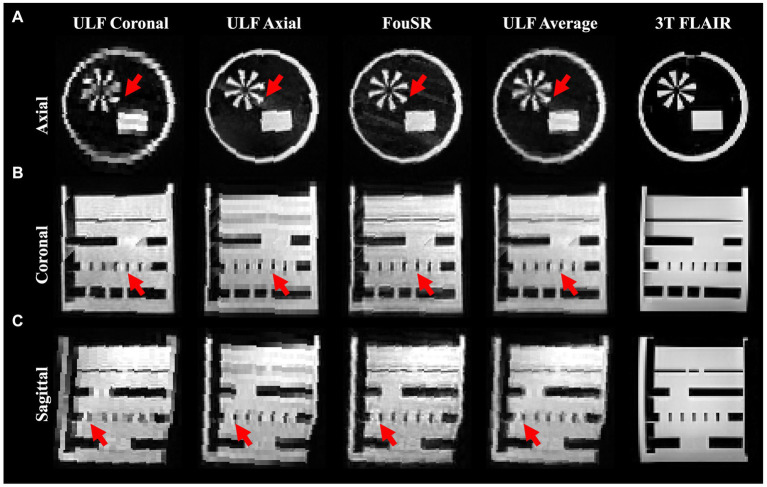
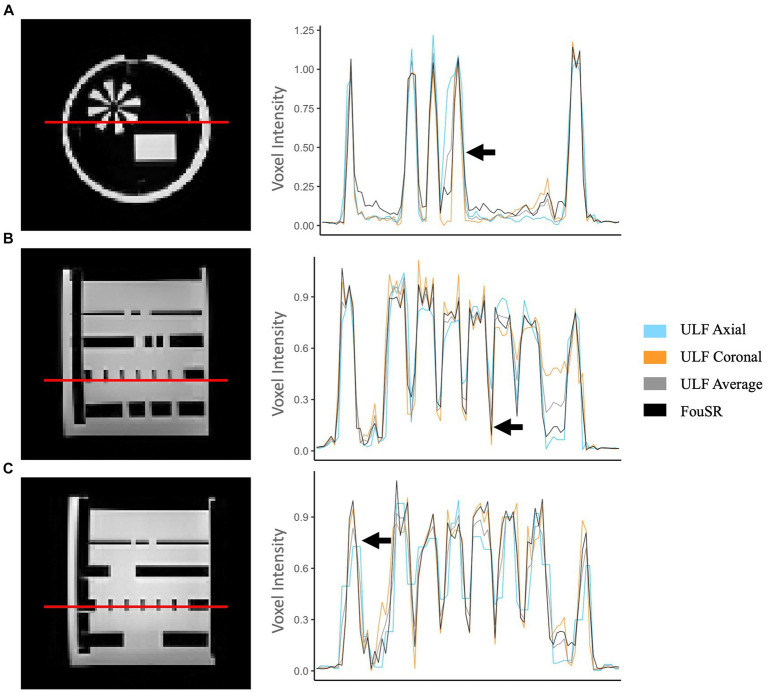
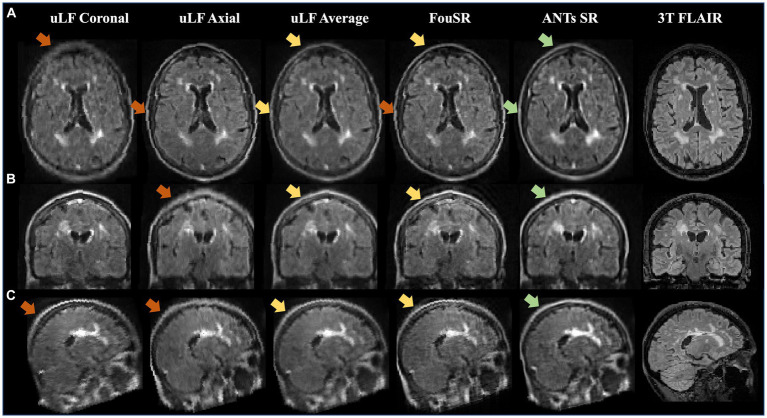
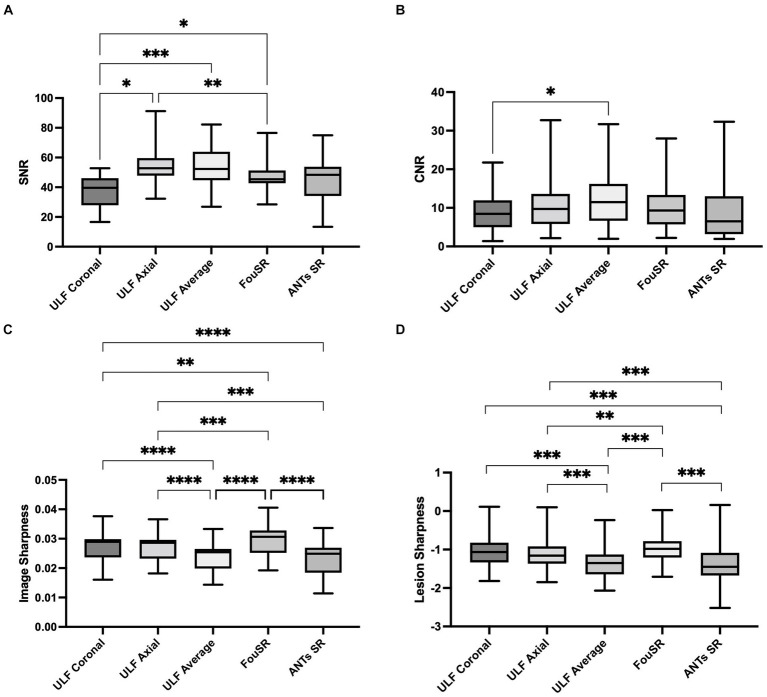
Ultra-low field (ULF) magnetic resonance imaging (MRI) holds the potential to make MRI more accessible, given its cost-effectiveness, reduced power requirements, and portability. However, signal-to-noise ratio (SNR) drops with field strength, necessitating imaging with lower resolution and longer scan times. This study introduces a novel Fourier-based Super Resolution (FouSR) approach, designed to enhance the resolution of ULF MRI images with minimal increase in total scan time. FouSR combines spatial frequencies from two orthogonal ULF images of anisotropic resolution to create an isotropic T2-weighted fluid-attenuated inversion recovery (FLAIR) image. We hypothesized that FouSR could effectively recover information from under-sampled slice directions, thereby improving the delineation of multiple sclerosis (MS) lesions and other significant anatomical features. Importantly, the FouSR algorithm can be implemented on the scanner with changes to the -space trajectory. Paired ULF (Hyperfine SWOOP, 0.064 tesla) and high field (Siemens, Skyra, 3 Tesla) FLAIR scans were collected on the same day from a phantom and a cohort of 10 participants with MS or suspected MS (6 female; mean ± SD age: 44.1 ± 4.1). ULF scans were acquired along both coronal and axial planes, featuring an in-plane resolution of 1.7 mm × 1.7 mm with a slice thickness of 5 mm. FouSR was evaluated against registered ULF coronal and axial scans, their average (ULF average) and a gold standard SR (ANTs SR). FouSR exhibited higher SNR (47.96 12.6) compared to ULF coronal (36.7 12.2) and higher lesion conspicuity (0.12 0.06) compared to ULF axial (0.13 0.07) but did not exhibit any significant differences contrast-to-noise-ratio (CNR) compared to other methods in patient scans. However, FouSR demonstrated superior image sharpness (0.025 0.0040) compared to all other techniques (ULF coronal 0.021 0.0037, = 5.9, -adj. = 0.011; ULF axial 0.018 0.0026, = 11.1, -adj. = 0.0001; ULF average 0.019 0.0034, = 24.2, -adj. < 0.0001) and higher lesion sharpness (-0.97 0.31) when compared to the ULF average (-1.02 0.37, (543) = -10.174, = <0.0001). Average blinded qualitative assessment by three experienced MS neurologists showed no significant difference in WML and sulci or gyri visualization between FouSR and other methods. FouSR can, in principle, be implemented on the scanner to produce clinically useful FLAIR images at higher resolution on the fly, providing a valuable tool for visualizing lesions and other anatomical structures in MS.
超低场(ULF)磁共振成像(MRI)具有使MRI更易于使用的潜力,因为其具有成本效益、降低的功率要求和便携性。然而,信噪比(SNR)会随着场强下降,这就需要以较低分辨率和更长扫描时间进行成像。本研究引入了一种基于傅里叶的新型超分辨率(FouSR)方法,旨在以总扫描时间的最小增加来提高ULF MRI图像的分辨率。FouSR将来自具有各向异性分辨率的两个正交ULF图像的空间频率组合起来,以创建一个各向同性的T2加权液体衰减反转恢复(FLAIR)图像。我们假设FouSR可以有效地从欠采样的切片方向恢复信息,从而改善多发性硬化症(MS)病变和其他重要解剖特征的描绘。重要的是,FouSR算法可以在扫描仪上通过改变k空间轨迹来实现。在同一天从一个体模和一组10名患有MS或疑似MS的参与者(6名女性;平均±标准差年龄:44.1±4.1)中收集配对的ULF(Hyperfine SWOOP,0.064特斯拉)和高场(西门子,Skyra,3特斯拉)FLAIR扫描。ULF扫描沿冠状面和轴面进行,面内分辨率为1.7毫米×1.7毫米,切片厚度为5毫米。将FouSR与配准后的ULF冠状面和轴面扫描、它们的平均值(ULF平均值)以及金标准超分辨率(ANTs SR)进行评估。与ULF冠状面(36.7±12.2)相比,FouSR表现出更高的SNR(47.96±12.6),与ULF轴面(0.13±0.07)相比,表现出更高的病变清晰度(0.12±0.06),但在患者扫描中与其他方法相比,在对比噪声比(CNR)方面没有表现出任何显著差异。然而,与所有其他技术相比,FouSR表现出更高的图像锐度(0.025±0.0040)(ULF冠状面0.021±0.0037,t = 5.9,p调整后 = = 0.011;ULF轴面0.018±0.0026,t = 11.1,p调整后 = = 0.0001;ULF平均值0.019±0.0034,t = 24.2,p调整后 < 0.0001),并且与ULF平均值(-1.02±0.37,t(543) = -10.174,p = <0.0001)相比,病变锐度更高(-0.97±0.3)。三位经验丰富的MS神经科医生进行的平均盲法定性评估显示,FouSR与其他方法在白质病变和脑沟或脑回可视化方面没有显著差异。原则上,FouSR可以在扫描仪上实现,以便即时生成具有更高分辨率的临床有用FLAIR图像,为可视化MS中的病变和其他解剖结构提供了一个有价值的工具。