Arias-Aranda Leslie R, Salinas Gerardo, Kuhn Alexander, Xu Guobao, Kanoufi Frédéric, Bouffier Laurent, Sojic Neso
Univ. Bordeaux, CNRS UMR 5255, Bordeaux INP, Site ENSMAC 33607 Pessac France
State Key Laboratory of Electroanalytical Chemistry, Changchun Institute of Applied Chemistry, Chinese Academy of Sciences Changchun Jilin 130022 P. R. China.
Chem Sci. 2024 May 21;15(23):8723-8730. doi: 10.1039/d4sc02528h. eCollection 2024 Jun 12.
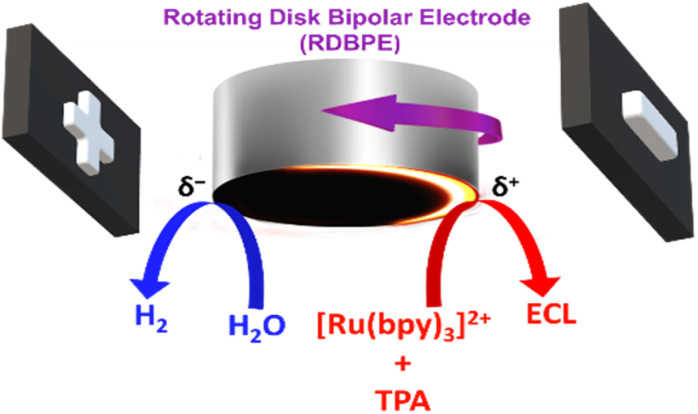
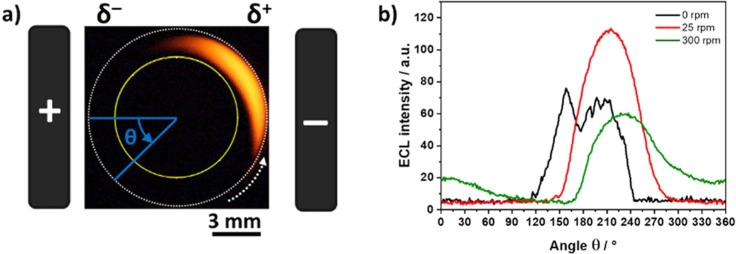
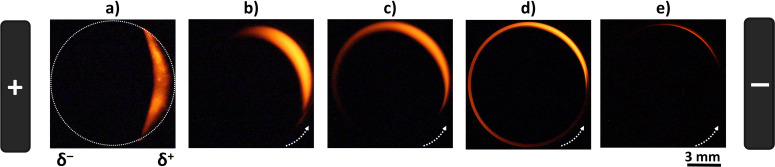
Electrochemiluminescence (ECL) is a powerful analytical approach that enables the optical readout of electrochemical processes. Over the last few years, ECL has gained considerable attention due to its large number of applications, including chemical sensing, bioanalysis and microscopy. In these fields, the promotion of ECL at bipolar electrodes has offered unprecedented opportunities thanks to wireless electrochemical addressing. Herein, we take advantage of the synergy between ECL and bipolar electrochemistry (BE) for imaging light-emitting layers shaped by hydrodynamics, polarization effects and the nature of the electrochemical reactions taking place wirelessly on a rotating bipolar electrode. The proof-of-principle is established with the model ECL system [Ru(bpy)]/tri--propylamine. Interestingly, the ECL-emitting region moves and expands progressively from the anodic bipolar pole to the cathodic one where ECL reactants should neither be generated nor ECL be observed. Therefore, it shows a completely unusual behavior in the ECL field since the region where ECL reagents are oxidized does not coincide with the zone where ECL light is emitted. In addition, the ECL patterns change progressively to an "ECL croissant" and then to a complete ring shape due to the hydrodynamic convection. Such an approach allows the visualization of complex light-emitting patterns, whose shape is directly controlled by the rotation speed, chemical reactivity and BE-induced polarization. Indeed, the bipolar electrochemical addressing of the electrode breaks the circular symmetry of the reported rotating system. This unexplored and simple configuration yields unique ECL behavior and raises new curious questions from the theoretical and experimental points of view in analytical chemistry. Finally, this novel wireless approach will be useful for the development of original ECL systems for analytical chemistry, studies of electrochemical reactivity, coupling microfluidics with ECL and imaging.
电化学发光(ECL)是一种强大的分析方法,能够对电化学过程进行光学读出。在过去几年中,ECL因其大量的应用,包括化学传感、生物分析和显微镜技术,而备受关注。在这些领域中,由于无线电化学寻址,双极电极上ECL的促进提供了前所未有的机会。在此,我们利用ECL与双极电化学(BE)之间的协同作用,对由流体动力学、极化效应以及在旋转双极电极上无线发生的电化学反应的性质所形成的发光层进行成像。通过模型ECL系统[Ru(bpy)]/三丙胺建立了原理验证。有趣的是,ECL发射区域从阳极双极极点逐渐移动并扩展到阴极双极极点,而在阴极双极极点既不应产生ECL反应物,也不应观察到ECL。因此,它在ECL领域表现出一种完全不寻常的行为,因为ECL试剂被氧化的区域与ECL发光的区域不一致。此外,由于流体动力学对流,ECL图案逐渐变为“ECL新月形”,然后变为完整的环形。这种方法允许可视化复杂的发光图案,其形状直接由旋转速度、化学反应性和BE诱导的极化控制。实际上,电极的双极电化学寻址打破了所报道的旋转系统的圆对称性。这种未被探索的简单配置产生了独特的ECL行为,并从分析化学的理论和实验角度提出了新的有趣问题。最后,这种新颖的无线方法将有助于开发用于分析化学的原始ECL系统、电化学反应性研究、将微流体与ECL耦合以及成像。