Im Yanghee, Kang Sung Hoon, Park Gilsoon, Yoo Heejin, Chun Min Young, Kim Chi-Hun, Park Chae Jung, Kim Jun Pyo, Jang Hyemin, Kim Hee Jin, Oh Kyungmi, Koh Seong-Beom, Lee Jong-Min, Na Duk L, Seo Sang Won, Kim Hosung
USC Steven Neuroimaging and Informatics Institute, Keck School of Medicine of University of Southern California, Los Angeles, CA 90033, USA.
Department of Biomedical Engineering, Hanyang University, Seoul 04763, Korea.
Brain Commun. 2024 Jul 12;6(4):fcae213. doi: 10.1093/braincomms/fcae213. eCollection 2024.
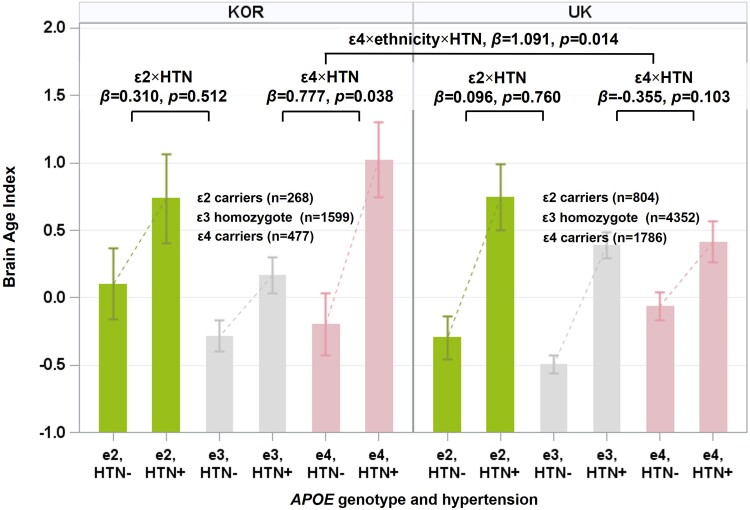
The frequency of the apolipoprotein E ɛ4 allele and vascular risk factors differs among ethnic groups. We aimed to assess the combined effects of apolipoprotein E ɛ4 and vascular risk factors on brain age in Korean and UK cognitively unimpaired populations. We also aimed to determine the differences in the combined effects between the two populations. We enrolled 2314 cognitively unimpaired individuals aged ≥45 years from Korea and 6942 cognitively unimpaired individuals from the UK, who were matched using propensity scores. Brain age was defined using the brain age index. The apolipoprotein E genotype (ɛ4 carriers, ɛ2 carriers and ɛ3/ɛ3 homozygotes) and vascular risk factors (age, hypertension and diabetes) were considered predictors. Apolipoprotein E ɛ4 carriers in the Korean ( = 0.511, = 0.012) and UK ( = 0.302, = 0.006) groups had higher brain age index values. The adverse effects of the apolipoprotein E genotype on brain age index values increased with age in the Korean group alone (ɛ2 carriers × age, = 0.085, = 0.009; ɛ4 carriers × age, = 0.100, < 0.001). The apolipoprotein E genotype, age and ethnicity showed a three-way interaction with the brain age index (ɛ2 carriers × age × ethnicity, = 0.091, = 0.022; ɛ4 carriers × age × ethnicity, = 0.093, = 0.003). The effects of apolipoprotein E on the brain age index values were more pronounced in individuals with hypertension in the Korean group alone (ɛ4 carriers × hypertension, = 0.777, = 0.038). The apolipoprotein E genotype, age and ethnicity showed a three-way interaction with the brain age index (ɛ4 carriers × hypertension × ethnicity, =1.091, = 0.014). We highlight the ethnic differences in the combined effects of the apolipoprotein E ɛ4 genotype and vascular risk factors on accelerated brain age. These findings emphasize the need for ethnicity-specific strategies to mitigate apolipoprotein E ɛ4-related brain aging in cognitively unimpaired individuals.
载脂蛋白Eε4等位基因的频率和血管危险因素在不同种族群体中存在差异。我们旨在评估载脂蛋白Eε4和血管危险因素对韩国和英国认知未受损人群脑龄的综合影响。我们还旨在确定这两个人群在综合影响方面的差异。我们招募了2314名年龄≥45岁的韩国认知未受损个体和6942名英国认知未受损个体,这些个体使用倾向得分进行匹配。脑龄使用脑龄指数来定义。载脂蛋白E基因型(ε4携带者、ε2携带者和ε3/ε3纯合子)和血管危险因素(年龄、高血压和糖尿病)被视为预测因素。韩国组(β = 0.511,P = 0.012)和英国组(β = 0.302,P = 0.006)中的载脂蛋白Eε4携带者具有更高的脑龄指数值。仅在韩国组中,载脂蛋白E基因型对脑龄指数值的不利影响随年龄增加(ε2携带者×年龄,β = 0.085,P = 0.009;ε4携带者×年龄,β = 0.100,P < 0.001)。载脂蛋白E基因型、年龄和种族与脑龄指数存在三向交互作用(ε2携带者×年龄×种族,β = 0.091,P = 0.022;ε4携带者×年龄×种族,β = 0.093,P = 0.003)。仅在韩国组中,载脂蛋白E对脑龄指数值的影响在患有高血压的个体中更为明显(ε4携带者×高血压,β = 0.777,P = 0.038)。载脂蛋白E基因型、年龄和种族与脑龄指数存在三向交互作用(ε4携带者×高血压×种族,β = 1.091,P = 0.014)。我们强调了载脂蛋白Eε4基因型和血管危险因素对加速脑龄的综合影响中的种族差异。这些发现强调了需要采取针对特定种族的策略来减轻认知未受损个体中与载脂蛋白Eε4相关的脑衰老。