Hoffmann Malte, Hoopes Andrew, Greve Douglas N, Fischl Bruce, Dalca Adrian V
Athinoula A. Martinos Center for Biomedical Imaging, Charlestown, MA, United States.
Department of Radiology, Massachusetts General Hospital, Boston, MA, United States.
Imaging Neurosci (Camb). 2024 Jun 25;2:1-33. doi: 10.1162/imag_a_00197.
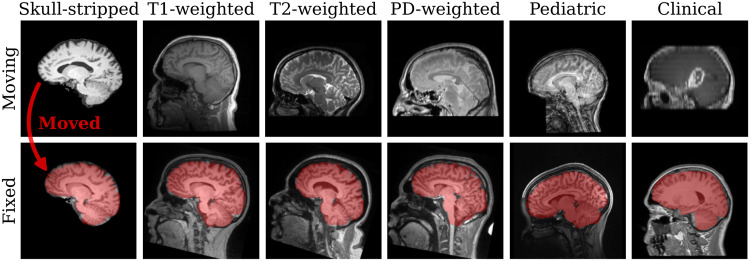
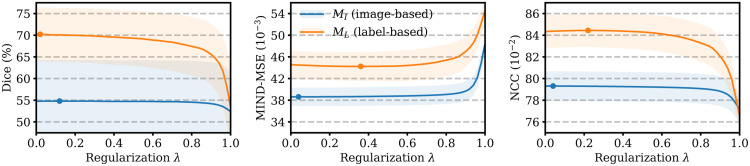
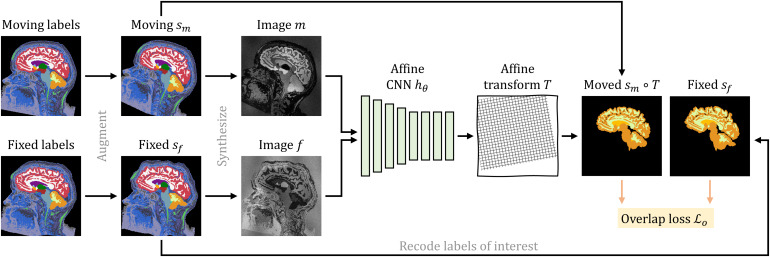
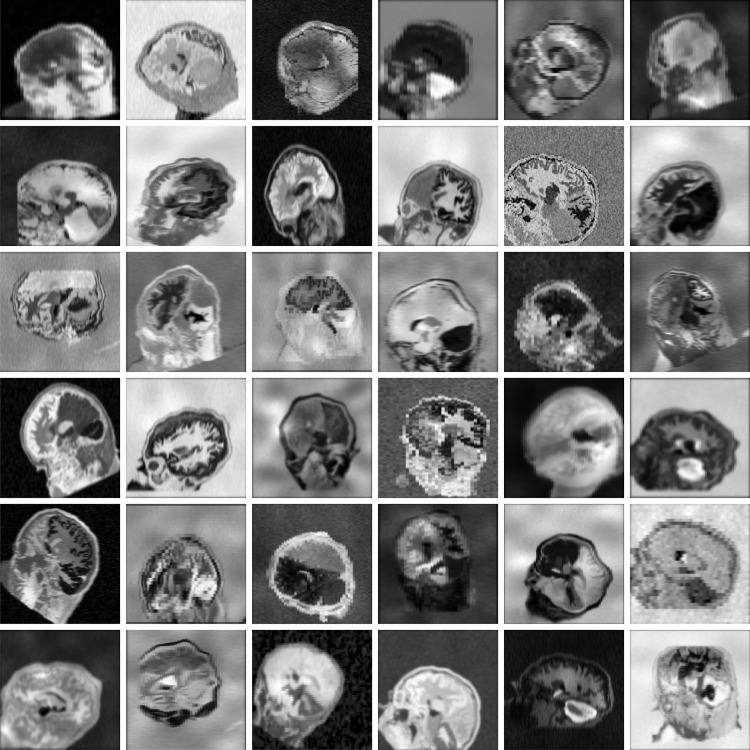
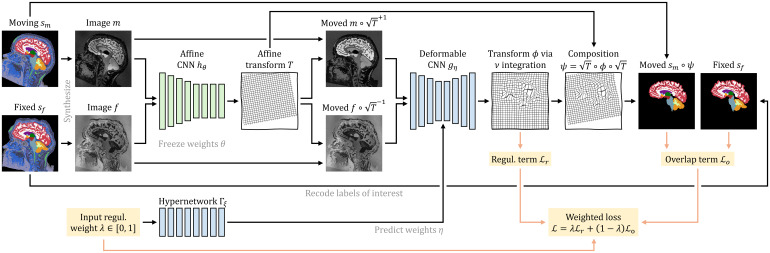
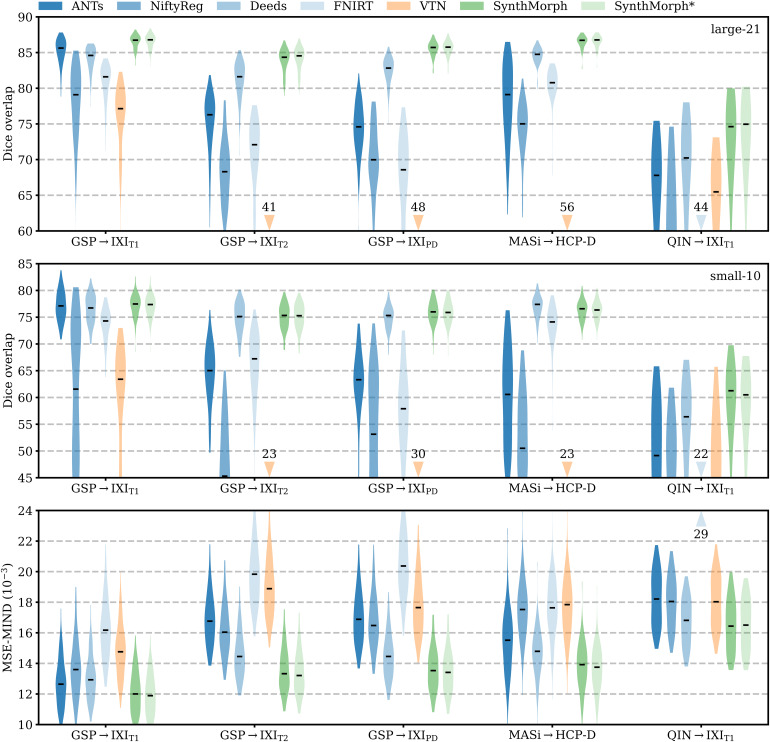
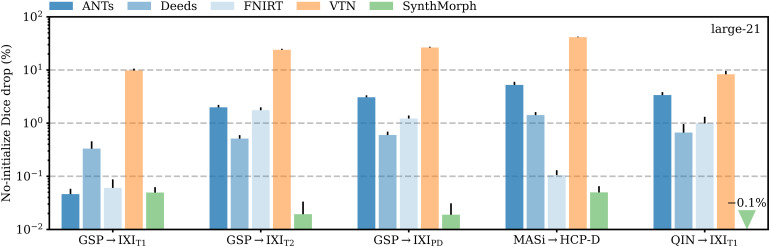
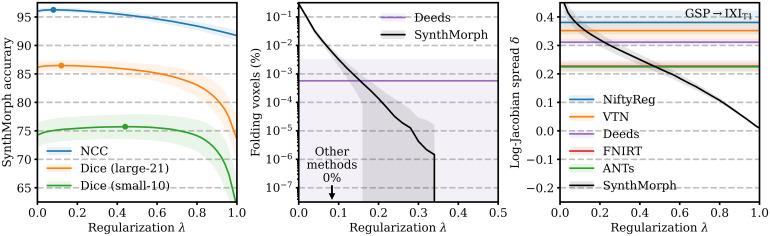
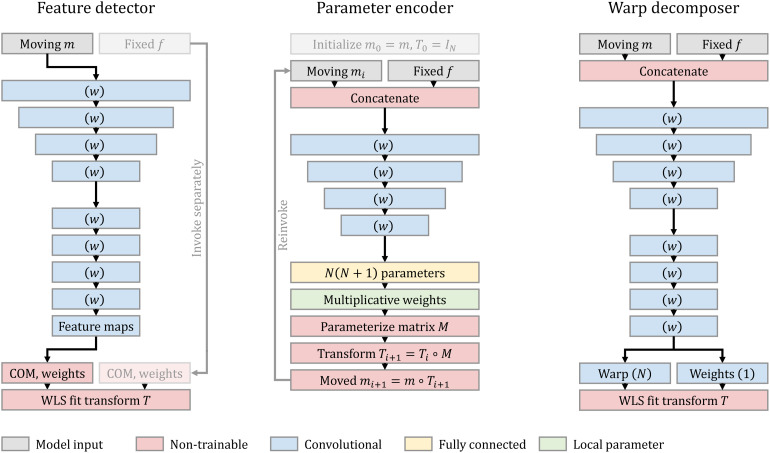
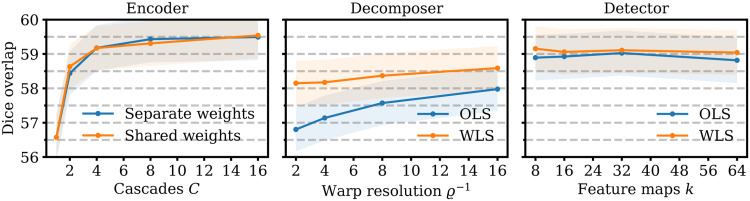
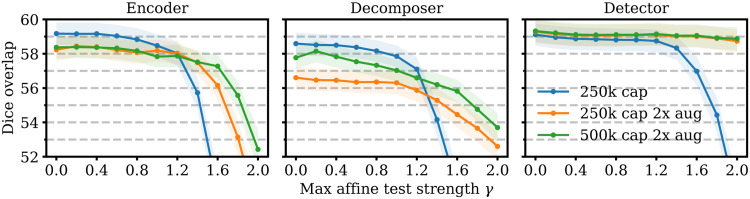
Affine image registration is a cornerstone of medical-image analysis. While classical algorithms can achieve excellent accuracy, they solve a time-consuming optimization for every image pair. Deep-learning (DL) methods learn a function that maps an image pair to an output transform. Evaluating the function is fast, but capturing large transforms can be challenging, and networks tend to struggle if a test-image characteristic shifts from the training domain, such as the resolution. Most affine methods are agnostic to the anatomy the user wishes to align, meaning the registration will be inaccurate if algorithms consider all structures in the image. We address these shortcomings with SynthMorph, a fast, symmetric, diffeomorphic, and easy-to-use DL tool for joint affine-deformable registration of any brain image without preprocessing. First, we leverage a strategy that trains networks with widely varying images synthesized from label maps, yielding robust performance across acquisition specifics unseen at training. Second, we optimize the spatial overlap of select anatomical labels. This enables networks to distinguish anatomy of interest from irrelevant structures, removing the need for preprocessing that excludes content which would impinge on anatomy-specific registration. Third, we combine the affine model with a deformable hypernetwork that lets users choose the optimal deformation-field regularity for their specific data, at registration time, in a fraction of the time required by classical methods. This framework is applicable to learning anatomy-aware, acquisition-agnostic registration of any anatomy with any architecture, as long as label maps are available for training. We analyze how competing architectures learn affine transforms and compare state-of-the-art registration tools across an extremely diverse set of neuroimaging data, aiming to truly capture the behavior of methods in the real world. SynthMorph demonstrates high accuracy and is available at https://w3id.org/synthmorph, as a single complete end-to-end solution for registration of brain magnetic resonance imaging (MRI) data.
仿射图像配准是医学图像分析的基石。虽然经典算法可以实现极高的精度,但它们针对每一对图像都要进行耗时的优化。深度学习(DL)方法学习一个将图像对映射到输出变换的函数。评估该函数速度很快,但捕捉大的变换可能具有挑战性,并且如果测试图像的特征与训练域不同,例如分辨率,网络往往会表现不佳。大多数仿射方法对用户希望对齐的解剖结构不敏感,这意味着如果算法考虑图像中的所有结构,配准将不准确。我们使用SynthMorph来解决这些缺点,它是一种快速、对称、微分同胚且易于使用的DL工具,用于对任何脑图像进行联合仿射-可变形配准,无需预处理。首先,我们采用一种策略,用从标签图合成的广泛变化的图像训练网络,从而在训练时未见过的采集细节方面产生强大的性能。其次,我们优化选定解剖标签的空间重叠。这使网络能够将感兴趣的解剖结构与无关结构区分开来,无需进行排除会影响特定解剖结构配准的内容的预处理。第三,我们将仿射模型与可变形超网络相结合,让用户在配准时刻为其特定数据选择最佳的变形场正则化,所需时间仅为经典方法的一小部分。只要有标签图可用于训练,该框架就适用于学习任何解剖结构的解剖学感知、采集无关的配准,且适用于任何架构。我们分析了竞争架构如何学习仿射变换,并在极其多样的神经成像数据集中比较了最先进的配准工具,旨在真正捕捉方法在现实世界中的行为。SynthMorph展示了高精度,可在https://w3id.org/synthmorph获取,作为用于脑磁共振成像(MRI)数据配准的单一完整端到端解决方案。